Larry David, America's greatest living folk hero, on The Daily Show last night.
| The Daily Show With Jon Stewart | Mon - Thurs 11p / 10c | |||
| Larry David | ||||
| ||||
My blog has moved!
You should be automatically redirected to the new home page in 60 seconds. If not, please visit
http://gerrycanavan.com
and be sure to update your bookmarks. Sorry about the inconvenience.
Larry David, America's greatest living folk hero, on The Daily Show last night.
| The Daily Show With Jon Stewart | Mon - Thurs 11p / 10c | |||
| Larry David | ||||
| ||||
There's more video of Springsteen in Philly yesterday at this blog, including "Promised Land" and a very nice acoustic "Thunder Road." I hadn't realized how much stumping he was doing; apparently he was in Ohio today, doing it all again.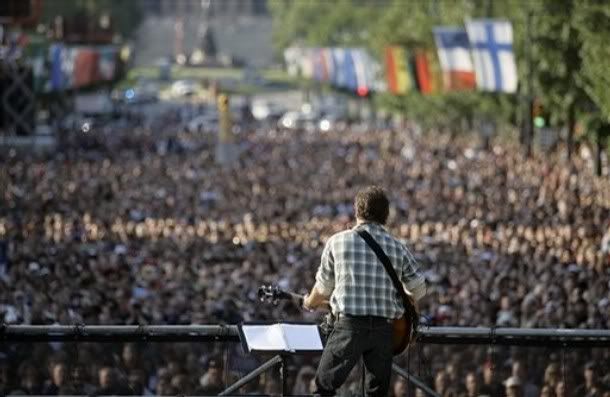
USA Today has a long and rather excellent profile on America's greatest living folk hero, Bruce Springsteen. Here he is on his work as it relates to the 2008 presidential campaign:
But while he won't endorse Hillary Clinton or Barack Obama yet, he specifically praises the latter, who cited Springsteen as the person he would most like to meet in a recent interview with People.The Wikipedia articles on Born to Run and Darkness actually make this point about the distance between promise and reality in a very nice way:
"I always look at my work as trying to measure the distance between American promise and American reality," Springsteen says. "And I think (Obama's) inspired a lot of people with that idea: How do you make that distance shorter? How do we create a more humane society? We've lived through such ugly times that people want to have a romance with the idea of America again, and I think they need to.
"The hard realities and how things get done are important, too, but if you can effectively convince people that it's possible to make things better, they get excited."
In terms of the original LP's sequencing, Springsteen eventually adopted a "four corners" approach, as the songs beginning each side ("Thunder Road", "Born to Run") were uplifting odes to escape, while the songs ending each side ("Backstreets", "Jungleland") were sad epics of loss, betrayal, and defeat. (Originally, he had planned to begin and end the album with alternative versions of "Thunder Road".)and
In terms of the original LP's sequencing [for Darkness], Springsteen continued his "four corners" approach from Born to Run, as the songs beginning each side ("Badlands" and "The Promised Land") were martial rallying cries to overcome circumstances, while the songs ending each side ("Racing in the Street", "Darkness on the Edge of Town") were sad dirges of circumstances overcoming all hope.
Unsolved Mysteries of the North American Comic Strip from the November 26th New Yorker, by America's greatest living folk hero, Chris Ware.
New York Magazine has a long feature on America's greatest living folk hero, Wes Anderson, on the eve of Darjeeling. The latter half of the article deals with the lukewarm reception for the (much, much underappreciated) Life Aquatic, as well as Anderson's reaction to the reaction—as well as what all this means for the new one:
Still, Anderson was tense at the premiere in Venice. It is the same at all premieres—Anderson worrying about how his movies, crafted in something of a parallel universe, will play in the world at large. “Mostly it’s just a process of steeling oneself for what’s going to happen. I’m sitting there thinking, Is the movie gonna be received with a lull of silence? Or with a boo?” says Anderson. “That’s a common thing in Europe, you know? They boo here.”Much more on Wes in the next couple of days, no doubt...
For the record, they did not boo. The early reviews were mainly positive, much more so than with Aquatic, though there was the requisite grumbling that the movie was “good but more of the same,” as Anderson puts it, shaking his head, after reading what Variety had to say. But the director does not seem particularly hurt or defensive this time around. “It’s probably not a good idea to put too much of your self-esteem on something like this, because, really, you can make a bad movie and it can be well received, and you can make a good movie and it can be badly received,” he says. “I think people who’ve done it a lot have learned, like the Coen brothers, for instance. My impression of them is that they really aren’t that vulnerable to what comes back at them. And they could get anything from any of their movies. Like The Big Lebowski, the first time I saw it I thought it didn’t quite work, but the second time I saw it I thought, Oh, I didn’t get it. I just didn’t understand it. And I really loved it then.” He adds, “You know, everyone’s limited. You can only do so much. I think in the end all I can do is say, Let me live the moment. I can still do what I want to do. I’m lucky enough to be able to do these movies so far.”


 Posts
Posts


