The full run of classic British sitcom Spaced (from Simon Pegg of Shaun of the Dead and Hot Fuzz fame) is now available on Hulu. Jaimee and I Netflixed this a few months ago; it's a decade old, but I thought it held up really well.
Showing posts with label comedy. Show all posts
Showing posts with label comedy. Show all posts
Friday, July 24, 2009

Thursday, July 09, 2009
Getting very close to the start of my term at [Undisclosed Location], which will mean a lot less blogging. I won't be blogging much during the day at all.
In other words, it'll be kind of like today.
* In the comments earlier today sb offered me a much-deserved Trophy of Perpetual Futility.
* Today's Infinite Summer writeup comes from the L.A. Times book blog. Via Paper Cuts.
JC: Might this turn into an annual tradition, perhaps with other books?* Non-Essential Mnemonics, at McSweeney's.
MB: I have already received a raft of suggestions for next summer's reading, including "Ulysses," "Underworld," "Don Quixote" and the entire "Lord of the Rings" trilogy. Whether this becomes an annual or year-around thing will depend largely on how successful this one proves, and whether or not I am utterly exhausted by its end.
What about Jersey? Mafioso, murderers, addicts, juvenile vagrants, Bon Jovi. Here they praise these felonious people. Blighted little Jersey: guns, hookers, Goombas, Atlantic City. "Come home, criminal miscreants" reads the tourism website. And here come the hucksters, racketeers, trannies, and every korrupt-cop. Jersey, news flash: Criminals rarely benefit children, businesses, or organizations.* "Locavore," "frenemy," "staycation," and "vlog" make Webster's.
A short essay on the socio-political climate in New Jersey and a mnemonic for the last names of all 44 American presidents.
* Salon's David Rakoff and Anthony Lane review Brüno. Here's Lane:
How efficient, though, is embarrassment as a comic device? It’s a quick hit, and it corrals the audience on the side of smugness; but its victories are Pyrrhic, and it tends to fizzle out unless held in by a plot—as it was in “Fawlty Towers,” which, from its base on the English seaside, fathomed the most embarrassable race on earth. Baron Cohen, in exporting his japes, comes up against a people much less devoted to the wince. I realized, watching “Borat” again, that what it exposed was not a vacuity in American manners but, more often than not, a tolerance unimaginable elsewhere. Borat’s Southern hostess didn’t shriek when he appeared with a bag of feces; she sympathized, and gently showed him what to do, and the same thing happens in “Brüno,” when a martial-arts instructor, confronted by a foreigner with two dildos, doesn’t flinch. He teaches Brüno some defensive moves, then adds, “This is totally different from anything I’ve ever done.” Ditto the Hollywood psychic—another risky target, eh?—who watches Brüno mime an act of air-fellatio and says, after completion, “Well, good luck with your life.” In both cases, I feel that the patsy, though gulled, comes off better than the gag man; the joke is on Baron Cohen, for foisting indecency on the decent. The joker is trumped by the square.I'm sure I'm not the first to think of what George Saunders wrote of Borat, or, for that matter, of the bad taste it still leaves in my mouth.
Wednesday, June 24, 2009
Larry David, America's greatest living folk hero, on The Daily Show last night.
| The Daily Show With Jon Stewart | Mon - Thurs 11p / 10c | |||
| Larry David | ||||
| ||||
Friday, June 12, 2009
Rise up, sheeple! David Letterman must be stopped!
UPDATE: Read The Plank. I disagree with the sentiment expressed in the last section; Bristol, while arguably some level of "public figure" now, only came to national prominence as part of a deeply inappropriate personal attack on her family during the election and I think TV comedians should respect her privacy. But Zengerle's right about this:
Letterman has said that he wasn't joking about Palin's 14-year-old daughter, Willow, but her 18-year-old daughter, Bristol; and, frankly, I believe him. Why? Because the jokes make no sense if they're not about Bristol. First, Bristol is far and away the most famous of the Palin children; late night comics generally don't tell jokes about people who are obscure, for the simple reason that their audience won't get the jokes. Second, Bristol is famous for her sex life, having had an out-of-wedlock child and now, more recently, becoming a spokesperson for teen abstinence--which is why, for better or worse, any joke about her is likely to be one laced with sexual innuendo.
Yes, it's true (as Hanson emphasizes) that it was Willow, not Bristol, who attended the Yankees game with her mom. But my guess is Letterman was simply confused about which daughter was in attendance. More importantly, I can't imagine many people watching Letterman even knew which Palin daughter was at the Yankee game (it wasn't exactly national news), and, therefore, when they heard the joke, they just assumed the unnamed Palin daughter whom Letterman was joking about was Bristol--since Bristol is the Palin daughter who's not only famous but is famous for the very thing Letterman was joking about.
Indeed, if it weren't for Palin and Hanson and other conservatives making such a big stink about this, no one would be talking about the"statutory rape of . . . Willow"--as Palin herself did on the "Today Show" this morning. I once wondered how Palin, as a mother, could have accepted McCain's offer to be his running mate when she knew that, by doing so, she would subject her pregnant teenage daughter to national attention (and, with that attention, criticism and ridicule). But I'm even more baffled by her behavior here. Even if she does think Letterman was making inappropriate jokes about her 14-year-old daughter, how does it help her 14-year-old daughter to continue to fan the flames this controversy and just call more attention to the jokes? If I was a 14-year-old girl, I sure as hell wouldn't want my mother going on national TV to keep on talking about my hypothetical statutory rape. Contrast Palin's behavior, for instance, with that of Bill Clinton's after Rush Limbaugh and John McCain made nasty jokes about the attractiveness (or lack thereof) of his teenage daughter Chelsea. Clinton was reportedly furious about the jokes, as any father would be, but he didn't make a public spectacle of his anger or try to score political points from the episode. In fact, so far as I can tell, he (and the White House) refused to make any public comment on Limbaugh and McCain's jokes--presumably because doing so would make things even worse for Chelsea. Bill Clinton's name isn't exactly synonymous with family values, but, on this one, I think Palin could definitely stand to follow his example.
Wednesday, June 10, 2009
Letterman beat Conan's Tonight Show in the ratings on Tuesday, but that's been lost in the controversy over a pair of borderline Palin family jokes from Monday night. The "slutty flight attendant" line, though certainly uncalled for, seems to me equivalent to the sorts of things that are said about the Clintons and the Kennedys—uncool, that is to say, but roughly commensurate with the price of fame. The "knocked up by Alex Rodriguez” thing strikes me as significantly worse because celebrity children who are underage or don't seek the spotlight should, I think, be left alone, even in the otherwise unrestrained pursuit of comedy. (I think I'd probably feel differently in Letterman had been in a comedy club or on a college campus somewhere; the Chelseas and Bristols of the world shouldn't have to see themselves mocked on TV.)
The idea currently shooting around the right-wing blogs that this was a joke about raping a fourteen-year-old girl, though, strikes me as a completely hysterical overreaction. There's no remotely charitable reading of the situation that suggests the phrase "her daughter was knocked up by Alex Rodriguez" would ever be intended to trigger thoughts of Willow Palin. (To whit: Instapundit.) That it was Willow and not Bristol at the game is certainly bad luck for Dave, and I wouldn't have blamed Sarah Palin for getting in a jibe or two about it, but that fact is not something either the audience or Dave himself can reasonably be believed to have been thinking of. You can call Letterman out for crossing the line without turning things all the way to 11.
Sunday, May 10, 2009
I still think there's something unseemly about our millionaire elites dropping all pretense of opposition and coming together for a night of revelry, but it is a little funnier when it's our guy at the helm.
Friday, April 03, 2009
Having finally recovered from their last tussle, your liberal guilt and your sense of humor are ready for another ten rounds. Here comes Brüno.
Wednesday, March 25, 2009
Wednesday links.
* Scandal at UConn! The Plank says the story is peanuts; this sort of corruption is endemic to the NCAA.
* Cover Stories From the Most-Requested Back Issues of The American Prognosticator (1853–1987).
* Duke University professor and civil rights icon John Hope Franklin has died.
* Upright Citizens Brigade parodies Wes Anderson. Bastards!
* A 93-year-old Japanese man has become the first person certified as a survivor of both U.S. atomic bombings at the end of the Second World War.
* The first unambiguous case of electronic voting machine fraud in the U.S.?
* Solitary confinement as torture.
* Roman engineers chipped an aqueduct through more than 100 kilometers of stone to connect water to cities in the ancient province of Syria. The monumental effort took more than a century, says the German researcher who discovered it. How could the Romans think in terms of centuries but we can't think past a single business cycle?
* Lots of people are linking to this letter from an AIG bonus recipient. The merits of the contracts aside—I've said before they should be enforced unless fraudulent or predicated on fraud—but I don't think he helps his case much when he puts a number on it. His one-time after-tax "bonus" is more than I would have made in thirty years of adjuncting.
* David Brin wants to "uplift" animals, i.e., make them sentient. This is exactly why people don't take science fiction seriously; it's totally crazy, pointless, and cruel and it wouldn't even work...
Tuesday, March 10, 2009
A little busy today, but here are a few links I've saved up.
* Watchmen link of the day: The Fate of Hooded Justice and Captain Metropolis. Via the comments at the Candleblog review.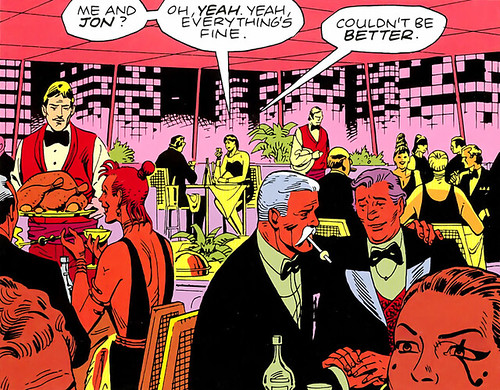
* Grant Morrison on the superhero genre.
I’m not even sure if there is a superhero genre or if the idea of the superhero is a special chilli pepper-like ingredient designed to energize other genres. The costumed superhero has survived since 1938, constantly shifting in tone from decade to decade to reflect the fears and the needs of the audience. The current mainstream popularity of the superhero has, I think, a lot to do with the fact that the Terror-stricken, environmentally-handicapped, overpopulated, paedophile-haunted world that’s being peddled by our news media is crying out for utopian role models and for any hopeful images of humankind’s future potential!* Don't Look Back—a flash game based on the Orpheus myth.
* Top 10 myths about sustainability.
* Bad news for solipsists: the universe exists independently of our observation. Via Kottke.
* Also from Kottke: famous directors take on famous comedy bits. A little amateurish, but it made me smile.
Saturday, March 07, 2009
Saturday night's all right for blogging. After the first few links we even get to some stuff that's not about Watchmen.
* Walter Chaw's Watchmen review goes to many of the same places as my own, albeit in a more thoroughgoing way:
Freeze any frame of the film and find in it the panel that inspired it. With each section separated by grabs from the covers of the comic book's initial run, fanboys should have no quarrel with the fidelity of the piece--but the reaction to the picture will likely continue to be fairly muted, as devotees of the graphic novel didn't exactly appreciate it for its slickness and sexiness. I'd hazard that what attracted people to the book is that Moore's vision is one of absolute respect for the power of the image in molding human history. Snyder does seem to understand this in restaging the Kennedy assassination with one of his masked heroes as the culprit, drawing a line pure and true from Zapruder's inauguration of film as history to the comic-book medium's inextricable hold on the collective imagination-in-formation. The power of Moore's work is that it takes the divine and, like Milton's mission, explains the ways of these gods to men in terms that men can understand: they're corrupted by their power and governed by their avarice and the essential baseness of being human. This sentiment is all but jettisoned, alas, by the time Snyder recasts the pathetic victories of sexually-reawakened schlub Night Owl (Patrick Wilson) and paramour Silk Spectre (a severely overmatched Malin Akerman) as triumphant victories. Watchmen--filthy with its director's now-trademark ramping technique--sees itself as a superhero adaptation of a human book. The failures of these characters are just weaknesses our übermenchen must overcome, not the foibles and hubris that lead to their downfall--and ours.Vu and kate both get at this deep in the comments to my original post as well.
* Meanwhile, Spencer Ackerman says Watchmen is a "great film" and then spends the rest of the post explaining why it isn't.
* The headline reads, "Watchmen's first day disappoints." You're telling me!
* John Scalzi argues for a statute of limitations on spoilers.
Television: One week (because it’s generally episodic, and that’s how long you have until the next episode)To my mind the whole "spoiler" hysteria needs to end; suspense is an overrated aesthetic in all but the rarest cultural productions.
Movies: One year (time enough for everyone to see it in the theaters, on DVD and on cable)
Books: Five years (because books don’t reach nearly as many people at one time)
* Husband, Wife Unaware They Are A Comedy Team.
* I suffered from this for years without knowing there was a name for it besides "being a college student."
* Another picture of a grown-up Calvin and Hobbes for your collection.
* The economy and literature: Will this crisis produce a Gatsby? More at MeFi.
* Does the financial crisis signal the end of neo-liberalism? David Harvey on the credit crunch and class.
* Abandoned places: a LiveJournal community. (Thanks, Eli!)
* And attention would-be humanities grad students: there are no jobs. None.
Saturday, February 21, 2009
As I was saying yesterday it's a little strange to find oneself in a post-Conan universe, even if it's been nearly a decade since I watched an episode. Between his work on The Simpsons and his early work on Late Night, he's definitely something like a saint for my particular demographic.
Huffington Post has some highlights from the final show.
Saturday, November 15, 2008
Anyone ever heard of this guy Jerry Seinfeld? He came to Raleigh last night and Jaimee took me out to see him. I gotta admit, he was pretty funny.
Sunday, August 17, 2008
Funny-but-incredibly-juvenile (and not at all safe for work) diversion of the night: hit Canadian "reality" show Kenny vs. Spenny. Of course there's clips at YouTube, including the best episodes I've seen, "First One to Get a Stain Loses" and "Who Can Handle More Torture?"
Monday, August 04, 2008
Completely unserious links.
* Ask yourself: What would Don Draper do? What would Joan Holloway do?
* Take the Zombie Survival Quiz. I got a Z+.
* Behold the Hand Drawn Map Association.
* Three's a trend: Is The Dark Knight cursed?
* Two good posts from Cosmic Variance: Obama backing off of plans to cut NASA’s budget and what will the Large Hadron Collider find?
* And is Michael Cera the greatest comic mind of this generation, "the Bob Newhart of the 21st century"? You know where I stand on this.
Wednesday, July 23, 2008
 Vanity Fair has a clone of the New Yorker cover, this time about John and Cindy McCain and functioning orthogonally to the original. Whereas that was a parody of the right-wing whisper campaign, this is the left-wing whisper campaign, somehow made acceptable (or speakable-in-public) by the controversy over the New Yorker cover. Because it reflects its audience's shared understanding of reality, as opposed to mocking someone else's caricature of it, this cover is significantly nastier than the first, and, I think, even less effective, ranking about as high as a Family Guy let's-remember-together gag on the Laff Meter.
I actually like what Gawker has to say about it:
As you can see, it's like taking the square root of comic failure. Not only is McCain not depicted as a caricature of feverish political imagination (he doesn't look half bad here, really), but there's hardly an exaggerated element in the pic, save perhaps the burning Constitution in the fireplace.
Thursday, July 17, 2008
Thursday joke remainders.
* An intellectual was on a sea voyage when a big storm blew up, causing his slaves to weep in terror. "Don’t cry," he consoled them, "I have freed you all in my will." Old jokes.
* And John McCain's problem with old jokes, blogged here the other day, is actually getting some media attention: Ben Smith wrote it up at the Politico this week.
* Ricky Gervais has announced on his This Side of the Truth filming blog that Karl Pilkington has finally agreed to a fourth and presumably final series of The Ricky Gervais Show podcast.
Wednesday, July 16, 2008
 From the comments:
Disagree with you on the New Yorker cover.Now, I agree with Shankar on a wide range of issues, but I still think this anxiety is simply overheated. First, the image's meaning is unmistakable, because frankly it deconstructs itself; it's impossible for anyone with either a modicum of political intelligence or cultural savvy to take this image at face value. Obama doesn't dress like that; Michelle Obama doesn't look like that; presidential candidates don't burn flags or stand in front of pictures of Osama bin Laden. That's not to say that there aren't still people who won't get the joke, despite all its obvious tells—sadly, there probably are—but I just don't think there are especially large numbers of people in that category, nor to the extent that there are do I see much compelling reason to dumb down the culture in an effort to cater to them.
I'm even not sure who these mythical people are supposed to be who are with it enough to have heard of the New Yorker in the first place yet still clueless enough to take the cover at face value.
People who walk by magazine stands? People who have it emailed to them? People who see it posted on a bulletin board or as the new desktop background of someone who just had it emailed to them?
We have a politics of image and symbolism. You can't throw this kind of stuff out there into the public sphere and not expect it to be misused and abused.
I think the "oh, everyone gets the joke" thing comes from a fairly parochial point of view.
Art and literature are misunderstood all the time. That's their nature. They're nonetheless good things to have in the public sphere, even when they're misused and abused at the margins.
I'm also not clear on what the actual objection to the cover is supposed to be. Most of the concern on the left seems to be that the cover isn't "useful," which may or may not be true, but it's neither here nor there with regard to its cultural value. (And I'd add that for what it's worth the image may actually prove itself pretty useful to Obama—the best response to this sort of under-the-radar bullshit is mockery and marginalization, which is what we all agree this is.)
Then there are the claims that the image is tasteless or offensive. Now, I write from a very privileged subject position, white heterosexual upper-middle-class American male, and it's certainly possible that this cartoon trips sensitivities I just don't have. I'm open to that. But I haven't seen any compelling explanation of just what about this extremely pro-Obama cartoon is actually supposed to be offensive; instead, its offensiveness and tasteless are simply taken for granted, as if everyone in the world but me and Jon Stewart's writers had forgotten what irony is.
Irony: it's a good thing, and a powerful weapon. Didn't we learn from Orwell that without irony language is just Newspeak?
'The Eleventh Edition is the definitive edition,' he said. 'We're getting the language into its final shape -- the shape it's going to have when nobody speaks anything else. When we've finished with it, people like you will have to learn it all over again. You think, I dare say, that our chief job is inventing new words. But not a bit of it! We're destroying words -- scores of them, hundreds of them, every day. We're cutting the language down to the bone. The Eleventh Edition won't contain a single word that will become obsolete before the year 2050.'
He bit hungrily into his bread and swallowed a couple of mouthfuls, then continued speaking, with a sort of pedant's passion. His thin dark face had become animated, his eyes had lost their mocking expression and grown almost dreamy.
'It's a beautiful thing, the destruction of words. Of course the great wastage is in the verbs and adjectives, but there are hundreds of nouns that can be got rid of as well. It isn't only the synonyms; there are also the antonyms. After all, what justification is there for a word which is simply the opposite of some other word? A word contains its opposite in itself. Take "good", for instance. If you have a word like "good", what need is there for a word like "bad"? "Ungood" will do just as well -- better, because it's an exact opposite, which the other is not. Or again, if you want a stronger version of "good", what sense is there in having a whole string of vague useless words like "excellent" and "splendid" and all the rest of them? "Plusgood" covers the meaning, or " doubleplusgood" if you want something stronger still. Of course we use those forms already. but in the final version of Newspeak there'll be nothing else. In the end the whole notion of goodness and badness will be covered by only six words -- in reality, only one word. Don't you see the beauty of that, Winston? It was B.B.'s idea originally, of course,' he added as an afterthought.
A sort of vapid eagerness flitted across Winston's face at the mention of Big Brother. Nevertheless Syme immediately detected a certain lack of enthusiasm.
'You haven't a real appreciation of Newspeak, Winston,' he said almost sadly. 'Even when you write it you're still thinking in Oldspeak. I've read some of those pieces that you write in The Times occasionally. They're good enough, but they're translations. In your heart you'd prefer to stick to Oldspeak, with all its vagueness and its useless shades of meaning. You don't grasp the beauty of the destruction of words. Do you know that Newspeak is the only language in the world whose vocabulary gets smaller every year?'
Winston did know that, of course. He smiled, sympathetically he hoped, not trusting himself to speak. Syme bit off another fragment of the dark-coloured bread, chewed it briefly, and went on:
'Don't you see that the whole aim of Newspeak is to narrow the range of thought? In the end we shall make thoughtcrime literally impossible, because there will be no words in which to express it. Every concept that can ever be needed, will be expressed by exactly one word, with its meaning rigidly defined and all its subsidiary meanings rubbed out and forgotten. Already, in the Eleventh Edition, we're not far from that point. But the process will still be continuing long after you and I are dead. Every year fewer and fewer words, and the range of consciousness always a little smaller. Even now, of course, there's no reason or excuse for committing thoughtcrime. It's merely a question of self-discipline, reality-control. But in the end there won't be any need even for that. The Revolution will be complete when the language is perfect. Newspeak is Ingsoc and Ingsoc is Newspeak,' he added with a sort of mystical satisfaction. 'Has it ever occurred to you, Winston, that by the year 2050, at the very latest, not a single human being will be alive who could understand such a conversation as we are having now?'
'Except-' began Winston doubtfully, and he stopped.
It had been on the tip of his tongue to say 'Except the proles,' but he checked himself, not feeling fully certain that this remark was not in some way unorthodox. Syme, however, had divined what he was about to say.
'The proles are not human beings,' he said carelessly. ' By 2050 earlier, probably -- all real knowledge of Oldspeak will have disappeared. The whole literature of the past will have been destroyed. Chaucer, Shakespeare, Milton, Byron -- they'll exist only in Newspeak versions, not merely changed into something different, but actually changed into something contradictory of what they used to be. Even the literature of the Party will change. Even the slogans will change. How could you have a slogan like "freedom is slavery" when the concept of freedom has been abolished? The whole climate of thought will be different. In fact there will be no thought, as we understand it now. Orthodoxy means not thinking -- not needing to think. Orthodoxy is unconsciousness.'
Jon Stewart nicely explains the foolishness of media outrage! over the New Yorker cover on last night's Daily Show.
More on the nature of satire from John Oliver et al. and The Stephen Colbert Show.
Tuesday, July 15, 2008
John McCain has obviously elected to skip my beginners' course on jokes and more immediately to the advanced class. This is, of course, part of a long pattern, one that has been entirely ignored by the media in favor of Really Important Questions like how many former members of the Weather Underground live in Obama's neighborhood and whether drinking orange juice makes him an elitist.
Via Think Progress and Crooks & Liars. Every day I find the prediction that McCain will drop out before the RNC convention less and less far-fetched. He's just an awful candidate.
Barack Obama and a kangaroo pull up to a gas station. The gas station attendant takes one look at the kangaroo and says, "You know, we don't get many kangaroos here." Barack Obama replies, "At these prices, I'm not surprised. That's why we need to reduce our dependence on foreign oil."
 Andy Borowitz has the list of official, campaign-approved Barack Obama jokes in the wake of the now-infamous New Yorker cover flap, undoubtedly the silliest Outrage! of the election yet. Reasonable people can disagree about the success of the cover as satire—personally I think it works, and I think the ensuing shitstorm is pretty strong evidence of that—but whether it's a "good" satire or not the meaning is absolutely clear, inoffensive, and pro-Obama: it's the morons who believe this crap and the media figures who cynically peddle it who are being mocked, not the Obamas.
 I'm even not sure who these mythical people are supposed to be who are with it enough to have heard of the New Yorker in the first place yet still clueless enough to take the cover at face value.
However, it must be said that Jon Stewart gets this wrong:
When Mr. Stewart on “The Daily Show” recently tried to joke about Mr. Obama changing his position on campaign financing, for instance, he met with such obvious resistance from the audience, he said, “You know, you’re allowed to laugh at him.” Mr. Stewart said in a telephone interview on Monday, “People have a tendency to react as far as their ideology allows them.”Comedy Rule #1: Don't blame the audience when your jokes fall flat; get better jokes. His writers, much more than Colbert's, have clearly been struggling when it comes to Obama; just about the only successful Obama joke they've run is this one: "I wonder when he'll break our hearts."


 Posts
Posts


