Ryan Dunlavey's excellent comic strips mashups.


Showing posts with label Calvin and Hobbes. Show all posts
Showing posts with label Calvin and Hobbes. Show all posts
Saturday, October 24, 2009

Thursday, June 18, 2009
Things it is known I cannot resist: Calvin and Hobbes tribute videos. Via Kotaku.
A Jagged Gorgeous Winter - The Main Drag from Main Drag on Vimeo.
Saturday, March 07, 2009
Saturday night's all right for blogging. After the first few links we even get to some stuff that's not about Watchmen.
* Walter Chaw's Watchmen review goes to many of the same places as my own, albeit in a more thoroughgoing way:
Freeze any frame of the film and find in it the panel that inspired it. With each section separated by grabs from the covers of the comic book's initial run, fanboys should have no quarrel with the fidelity of the piece--but the reaction to the picture will likely continue to be fairly muted, as devotees of the graphic novel didn't exactly appreciate it for its slickness and sexiness. I'd hazard that what attracted people to the book is that Moore's vision is one of absolute respect for the power of the image in molding human history. Snyder does seem to understand this in restaging the Kennedy assassination with one of his masked heroes as the culprit, drawing a line pure and true from Zapruder's inauguration of film as history to the comic-book medium's inextricable hold on the collective imagination-in-formation. The power of Moore's work is that it takes the divine and, like Milton's mission, explains the ways of these gods to men in terms that men can understand: they're corrupted by their power and governed by their avarice and the essential baseness of being human. This sentiment is all but jettisoned, alas, by the time Snyder recasts the pathetic victories of sexually-reawakened schlub Night Owl (Patrick Wilson) and paramour Silk Spectre (a severely overmatched Malin Akerman) as triumphant victories. Watchmen--filthy with its director's now-trademark ramping technique--sees itself as a superhero adaptation of a human book. The failures of these characters are just weaknesses our übermenchen must overcome, not the foibles and hubris that lead to their downfall--and ours.Vu and kate both get at this deep in the comments to my original post as well.
* Meanwhile, Spencer Ackerman says Watchmen is a "great film" and then spends the rest of the post explaining why it isn't.
* The headline reads, "Watchmen's first day disappoints." You're telling me!
* John Scalzi argues for a statute of limitations on spoilers.
Television: One week (because it’s generally episodic, and that’s how long you have until the next episode)To my mind the whole "spoiler" hysteria needs to end; suspense is an overrated aesthetic in all but the rarest cultural productions.
Movies: One year (time enough for everyone to see it in the theaters, on DVD and on cable)
Books: Five years (because books don’t reach nearly as many people at one time)
* Husband, Wife Unaware They Are A Comedy Team.
* I suffered from this for years without knowing there was a name for it besides "being a college student."
* Another picture of a grown-up Calvin and Hobbes for your collection.
* The economy and literature: Will this crisis produce a Gatsby? More at MeFi.
* Does the financial crisis signal the end of neo-liberalism? David Harvey on the credit crunch and class.
* Abandoned places: a LiveJournal community. (Thanks, Eli!)
* And attention would-be humanities grad students: there are no jobs. None.
Sunday, March 01, 2009
Found on the Internet: grown-up Calvins and Hobbeses. I've seen a couple links to this one and it made me want to poke around.

That's Susie Derkins, of course.
This one, I think, is my favorite:
A few others. I found these via a Google image search, so I confess I don't know where they came from.


(original context)
This last one is less a grown-up Calvin than an updated one, but there's a similar poignance to it all the same. And I know from the file name it comes from Jim Rugg, who I published way back in Backwards City #1:
It's quite reminiscent of this better-known "end of Calvin," which I've linked before.
If you're not done yet, there's always Fight Club.
(a couple via NeilAlien and this Marvel Peanuts MeFi thread, but mostly just via Google)
Tuesday, February 03, 2009
Whether by pure chance or divine plan, a couple of stories about childhood atheism and/or conversion to atheism ran across my screen yesterday.
* Ricky Gervais
* Calvin & Hobbes
* Julia Sweeney
In varying ways the story of my own "conversion" has affinities with each of these three; I think I've told it somewhere on the Internets before. There's really two stories. The first is the night when I was five or so and figured out that Santa Claus, the Tooth Fairy, the Easter Bunny, and all the rest didn't exist, in a row, one after another. The second is a few years later, eleven or twelve years old and obscenely terrified of death because I didn't really believe in God anymore. My parents, eventually fed up with my panic, took me to see our local priest, who gave me a couple of metaphors to chew on and told me I should pray for guidance.
So I did, and when I was done, I realized I'd been talking to myself.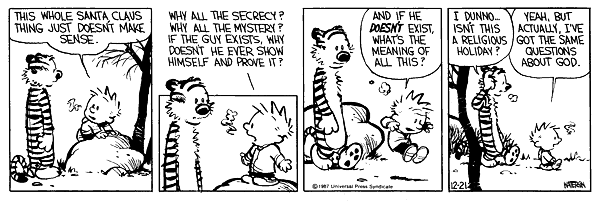
Thursday, August 07, 2008
Calvin and Jobs.
Tuesday, August 05, 2008
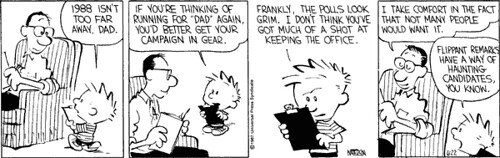
Today's Calvin & Hobbes (originally run June 22, 1987) brings back to mind one of the strip's better running gags: Calvin's perennial polling of his father's performance as "Dad." For some reason people who should know better keep breathlessly reporting the daily oscillations of months-out national polls as if they actually mean something—and given that we still have (at least) 91 more days of this silliness, I think we can all use the reminder.
Thanks to this extremely exhaustive Calvin & Hobbes archive and search engine for the images.
December 2, 1985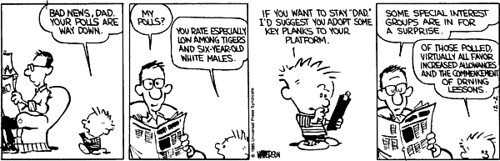
January 28, 1986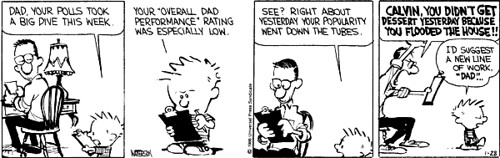
March 18, 1986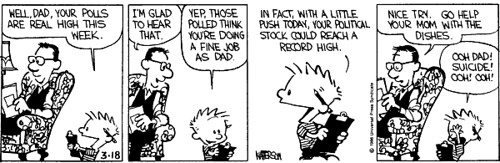
August 30, 1986
(this one's my favorite)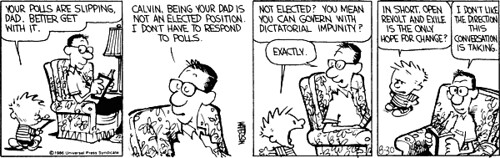
July 24, 1987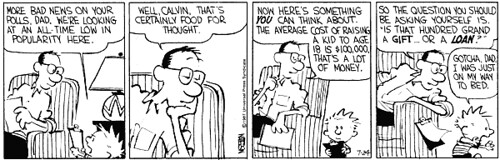
April 11, 1988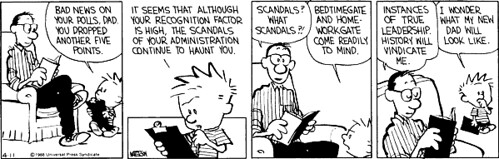
April 12, 1988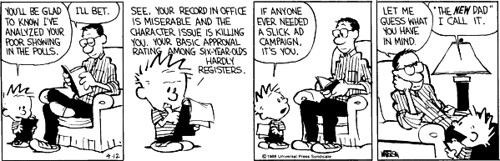
November 7, 1988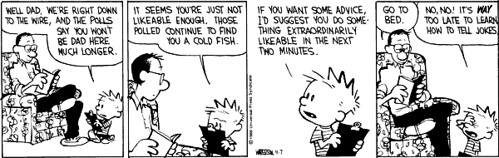
January 3, 1992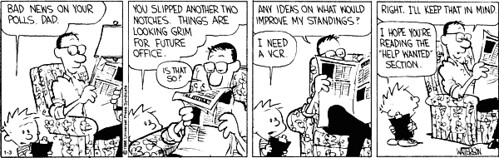
April 30, 1992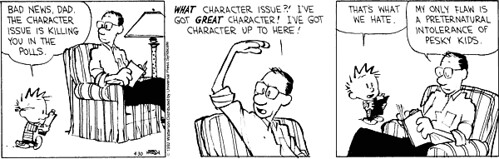
September 20, 1993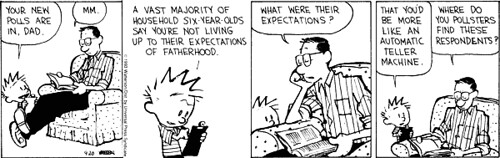
July 26, 1994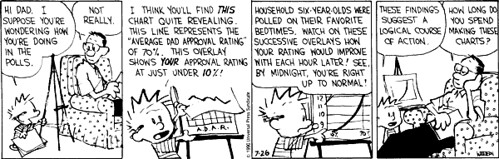
And probably the most important comment on the state of democracy in a mass-media culture in the entire run of Calvin & Hobbes, March 1, 1994: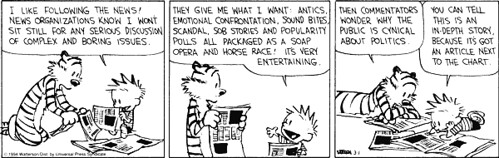
UPDATE: Okay, two more, also highly appropriate for the moment.
September 2, 1988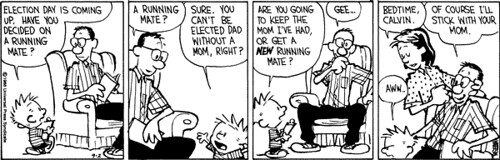
August 31, 1992
Wednesday, July 30, 2008
I think I've mentioned before how much I've come to appreciate my MacBook's Dashboard feature. Today's addition was the Say Cheese widget, which throws up a new Calvin & Hobbes strip for me daily.
Friday, July 11, 2008
A late convert to the greatness of the early Charles Schulz, I must admit to being oddly moved by this years-old requiem for Peanuts written on the occasion of Charles Schulz's death. Via Progressive Ruin, which had a nice future-of-Peanuts thing going earlier in the week.
Thursday, October 25, 2007
Bill Waterson rareties, "for the Calvin connoisseur." I have the rare privilege of identifying with both sides of this equation:
More via Drawn!
Saturday, October 13, 2007
The world's greatest living folk hero, Bill Watterson, reviews a book on the life of Charles Schulz.
Lucy, for all her domineering and insensitivity, is ultimately a tragic, vulnerable figure in her pursuit of Schroeder. Schroeder's commitment to Beethoven makes her love irrelevant to his life. Schroeder is oblivious not only to her attentions but also to the fact that his musical genius is performed on a child's toy (not unlike a serious artist drawing a comic strip). Schroeder's fanaticism is ludicrous, and Lucy's love is wasted. Schulz illustrates the conflict in his life, not in a self-justifying or vengeful manner but with a larger human understanding that implicates himself in the sad comedy. I think that's a wonderfully sane way to process a hurtful world. Of course, his readers connected to precisely this emotional depth in the strip, without ever knowing the intimate sources of certain themes. Whatever his failings as a person, Schulz's cartoons had real heart.Watterson talks about Schulz about once a decade:
Indeed, everything about the strip is a reflection of its creator's spirit. "Peanuts" is one of those magical strips that creates its own world. Its world is a distortion of our own, but we enter it on its terms and, in doing so, see our world more clearly. It may seem strange that there are no adults in the world of "Peanuts," but in asking us to identify only with children, Schulz reminds us that our fears and insecurities are not much different when we grow up. We recognize ourselves in Schulz's vividly tragic characters: Charlie Brown's dogged determination in the face of constant defeat, Lucy's self-righteous crabbiness, Linus' need for a security blanket, Peppermint Patty's plain looks and poor grades, Rerun's baffled innocence, Spike's pathetic alienation and loneliness. For a "kid strip" with "gentle humor," it shows a pretty dark world, and I think this is what makes the strip so different from, and so much more significant than, other comics. Only with the inspired surrealism of Snoopy does the strip soar into silliness and fantasy. And even then, the Red Baron shoots the doghouse full of holes.Via MeFi.
Friday, October 12, 2007
I was thinking just the other day how much I miss The Show (with Ze Frank). This little song doesn't make me miss it less. Via Waxy.
Salon reviews Persepolis, which I'm really looking forward to. Salon also wants to abolish the electoral college, just a few hundred years too late.
AskMe: Help me survive the coming apocalypse. Remember: Zombies hate sunlight, and always aim for the head.
And at New Scientist: How does it feel to die? You might ask Funky Winkerbean's Lisa Moore, who has just died of cancer. The funny pages sure seem to have gotten a lot less funny since I stopped reading them on December 31, 1995.
Tuesday, August 21, 2007
McSweeney's presents Calvin & Hobbes: The Movie.
Thursday, May 17, 2007
Below, the best "Calvin and Hobbes" animated film we are ever likely to get. (Of course, I still hold out hope for the hand-drawn Watterson project that's been rumored forever.) I agree with the commenters in the MetaFilter thread about the importance of the Italian language; if it were in English I suspect I'd be more hostile, but in a language I don't understand it's nicely surreal.


 Posts
Posts


