Monday!
* Steve Benen covers the behind-the-scenes wrangling around the public option. Surprising to see a hack like Bill Frist on board. Is he trying to make up for his past?
* io9's ten essential Superman stories. Missing: Alan Moore's Supreme, Superman in all but name. (Also: Kingdom Come? Dark Knight Returns?)
* Conservatives have finally gotten around to removing the Bible's liberal bias.
* The life story of Richard Leroy Walters, a homeless man who left $4 million dollars to NPR.
* Superhero Status Updates.
* The waking nightmare of sleep paralysis.
* And Angel is ten years old today.
Showing posts with label Alan Moore. Show all posts
Showing posts with label Alan Moore. Show all posts
Monday, October 05, 2009

Friday, July 24, 2009
Exciting comics nerds everywhere, Marvel Comics has unexpectedly announced that it now owns the rights to Miracleman/Marvelman. Keep an eye on this; it's great news.
Friday, July 03, 2009
Three-way dance: Michael Moorcock, Alan Moore and Iain Sinclair. A short snippet:
Michael Moorcock says “I invented the multiverse!”Via Bookslut.
Michael Moorcock says he invented the multiverse as a reassurance against the second law of thermodynamics and heat death of the universe.
...
Alan Moore says that “Jerusalem” disproves the existence of death from a scientific standpoint...
Thursday, May 28, 2009
Thursday night links.
* Is the rumored Buffy reboot just a ploy to get Sarah Michelle Gellar on board?
* This brief history of Star Trek reboots makes a persuasive case for the centrality of the "reboot" in the logic of SF franchise.
* Manga collector faces 15 years for comics collection. More at MeFi.
* Hulu has a desktop client.
* Alan Moore's "Future Shocks" goes digital. These are all good, get to iTunes immediately.
* Today's bizarre outrage of the day is a Fox-News-backed conspiracy theory that Obama is selectively closing Republican-owned Chrysler dealerships. Nate Silver and Kevin Drum debunk.
* Also at FiveThirtyEight: Operation Gringo: Can the Republicans Sacrifice the Hispanic Vote and Win the White House?
Sunday, May 03, 2009
Sunday 2.
* Caprica: actually not bad? Will I really allow myself to be roped in by Ron Moore again? The worst parts of the pilot are the parts that force the tie-in to BSG; I wish the show could have been green-lit without it.
* Dollhouse tidbits: an easter egg from the last episode pointing to the true owners of the Dollhouse and an answer to the question of what's going on with Fred/Dr. Saunders/Whiskey.
I'm not your friend in here, EchoLooks more and more as if Fred's body, the former Whiskey, was imprinted with a copy of Dr. Saunders after the original was killed by Alpha. I think this accounts for both why she hates the Dollhouse and why she won't act against it; she needs it to continue to exist.
* A six-part interview with Alan Moore at Newsarama from my new friend and local writer Zack Smith. Via MeFi.
Tuesday, April 14, 2009
Tuesday, I'll never forget you.
* Precision Hacking: 4chan hacks a Time poll not just at the top but all the way down.
* In the fifth and final installment of his Wes Anderson series, Matt Zoller Seitz annotates the prologue to The Royal Tenenbaums.
* You and I know it's fair and balanced, but believe it or not there are those who argue that the reporting on Fox may show a slight rightward tilt.
* On the making of Swamp Thing #20.
* And Blographia Literaria calls FAIL on failblog.org.
Tuesday, March 10, 2009
Scott Eric Kaufman finally gets around to watching Watchmen. Special attention is paid to the absurd ubiquity of the Twin Towers throughout the film, something my viewing group mocked afterwards but which hasn't come up in discussions here thus far.
My review was also a focus of the discussion on the Poli-Sci-Fi Radio podcast this week, to which my rage-filled rebuttal is currently being shouted impotently into the void.
Saturday, March 07, 2009
Two more Watchmen links: the credit sequence—which is decent but which didn't thrill me quite like it did others, probably because I'd read exactly what it would be like in advance—and the real-life smiley face on Mars. Via io9 and AICN.
The review thread is still going strong, too, for those with more thoughts on the film.
Saturday night's all right for blogging. After the first few links we even get to some stuff that's not about Watchmen.
* Walter Chaw's Watchmen review goes to many of the same places as my own, albeit in a more thoroughgoing way:
Freeze any frame of the film and find in it the panel that inspired it. With each section separated by grabs from the covers of the comic book's initial run, fanboys should have no quarrel with the fidelity of the piece--but the reaction to the picture will likely continue to be fairly muted, as devotees of the graphic novel didn't exactly appreciate it for its slickness and sexiness. I'd hazard that what attracted people to the book is that Moore's vision is one of absolute respect for the power of the image in molding human history. Snyder does seem to understand this in restaging the Kennedy assassination with one of his masked heroes as the culprit, drawing a line pure and true from Zapruder's inauguration of film as history to the comic-book medium's inextricable hold on the collective imagination-in-formation. The power of Moore's work is that it takes the divine and, like Milton's mission, explains the ways of these gods to men in terms that men can understand: they're corrupted by their power and governed by their avarice and the essential baseness of being human. This sentiment is all but jettisoned, alas, by the time Snyder recasts the pathetic victories of sexually-reawakened schlub Night Owl (Patrick Wilson) and paramour Silk Spectre (a severely overmatched Malin Akerman) as triumphant victories. Watchmen--filthy with its director's now-trademark ramping technique--sees itself as a superhero adaptation of a human book. The failures of these characters are just weaknesses our übermenchen must overcome, not the foibles and hubris that lead to their downfall--and ours.Vu and kate both get at this deep in the comments to my original post as well.
* Meanwhile, Spencer Ackerman says Watchmen is a "great film" and then spends the rest of the post explaining why it isn't.
* The headline reads, "Watchmen's first day disappoints." You're telling me!
* John Scalzi argues for a statute of limitations on spoilers.
Television: One week (because it’s generally episodic, and that’s how long you have until the next episode)To my mind the whole "spoiler" hysteria needs to end; suspense is an overrated aesthetic in all but the rarest cultural productions.
Movies: One year (time enough for everyone to see it in the theaters, on DVD and on cable)
Books: Five years (because books don’t reach nearly as many people at one time)
* Husband, Wife Unaware They Are A Comedy Team.
* I suffered from this for years without knowing there was a name for it besides "being a college student."
* Another picture of a grown-up Calvin and Hobbes for your collection.
* The economy and literature: Will this crisis produce a Gatsby? More at MeFi.
* Does the financial crisis signal the end of neo-liberalism? David Harvey on the credit crunch and class.
* Abandoned places: a LiveJournal community. (Thanks, Eli!)
* And attention would-be humanities grad students: there are no jobs. None.
Friday, March 06, 2009
 Watchmen is, as feared, a creative failure. There's a lot that's already been said about this and a lot still to be said, but here in brief is my take on what went wrong.
The first half of the film, as I put it to our group shortly after leaving the theater, is not even terrible. It's just completely unremarkable—a perfectly slavish adaptation of the comic that holds about the same level of critical interest as a high school theater club production of Watchmen might. (This is, of course, a little too glib—there are numerous things about the first half that are in fact actively terrible, most notably the soundtrack and most of the acting, but let those slide for now.) The effort to recreate panel-by-panel the experience of reading the comic is impressive in its dedication but doubly wrongheaded, because (a) it will always fail to achieve perfect fidelity, and therefore fail to satisfy and (b) films are not comics, they are films. The point (if Watchmen must be made into a film at all) is not to "make the pictures move" but to translate from one media to another. Translation in this case would entail studying and appreciating the moves Moore and Gibbons make in the comic and then finding analogous moves that speak to/against cinematic form; it's not about doing a shot-for-panel remake.
One of the best shots in the film is therefore a shot of a door slowly swinging open and closed, allowing us momentary glimpses inside a closed space the camera does not enter. It's a shot that nicely evokes comics without using the already hackneyed slow-everything-down-to-the-speed-of-panels technique, while at the same time being something comics cannot themselves do. Sadly, there's hardly anything else like this moment in Watchmen, as Snyder relies almost entirely on slo-mo and failed attempts at direct quotation throughout.
That's the first half of the film: not even terrible.
The second half—beginning approximately at the moment of a laughable sex scene during which (among other things) the film's bad soundtrack completely jumps the shark—is terrible, precisely because it ventures away from inoffensive slavish fidelity to plot changes and directorial choices that completely misunderstand the very point of Watchmen. And no, I'm not talking about the squid. I'm talking about:
* the replacement of the Schmittian friend-enemy logic in favor of very poorly explained God-is-watching-you-so-be-good silliness;
* the inability of the filmmakers to let the characters fail as the theme demands they must, most notably in the case of the filmic Nite Owl pointedly not signing on to Ozymandias's scheme (but for some reason being allowed to leave Antarctica anyway);
* a general (if inevitable) dumbing down (instanced for example in the switch from "Robert Redford" to "Ronald Reagan" in the last scene, almost certainly because it was feared that the audience wouldn't get the reference).
Even "I did it thirty-five minutes ago" is bungled; the line is delivered, at which time we jump to a countdown-in-progress. The anti-simultaneity was the entire point. This isn't hard.
If Watchmen the comic deconstructs the superhero, does Watchmen the film? Not at all. The characters' rough edges have all been sanded away, leaving little more than generic action movie badasses that (in our theater at least) were getting cheers in all the wrong places. Both Rorschach and Nite Owl, in different ways, remain uncomplicatedly and conventionally "heroic" in word, deed, and presentation—with plot and dialogue changes shoehorned in whenever necessary to keep it that way—and if you were going to make a Watchmen in which such a thing were possible, you really shouldn't have made the film at all.
And did I mention the soundtrack? Unbelievably bad.
Friday morning links.
* Is Dollhouse already canceled? Fox is advertising that Prison Break returns to Fridays on 4/17.
* Mike Krzyzewski gets a tough evaluation on ratemyprofessor.com.
* Alternate-universe Watchmens. Only the Woody Allen hypothesis really sings.
* And this xkcd is quieter than the ones that usually get ricocheted across the Internet, but damn if it didn't make me laugh.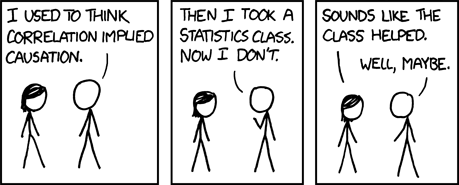
* And is time really the fire in which we burn? Consider the thermal time hypothesis. More at MetaFilter.
According to Connes and Rovelli, the same applies to the universe at large. There are many more constituents to keep track of: not only do we have particles of matter to deal with, we also have space itself and therefore gravity. When we average over this vast microscopic arrangement, the macroscopic feature that emerges is not temperature, but time. "It is not reality that has a time flow, it is our very approximate knowledge of reality that has a time flow," says Rovelli. "Time is the effect of our ignorance."I think Rovelli just wrote Alan Moore's next three graphic novels. Grant Morrison's, too.
Thursday, March 05, 2009
Whoops, missed a day somehow. (Even grad students get busy sometimes.) Here's a few links I've been saving; scroll all the way to the bottom for your daily dose of Watchmen panic.
* One of our most beloved blog denizens has started up a March Madness blog. Add it to your feeds immediately.
* Executing someone on their birthday may seem hilarious, but actually it's sort of cold. (via Srinivas)
* Same goes for trading your minor-league pitcher for ten bats. Via MeFi.
* All about experimental philosophy.
* The Daily Show's evisceration of CNBC was amazing last night. Also, incredibly well-deserved.
* Forget man-on-dog: will gay marriage start us down the slippery slope to human/robot marriages? It could happen right here in North Carolina. Only Steve Benen sees where this really leads: man/dog/robot/robot-dog polygamy.
* Two games: Linear RPG and Exploit, the second from amateur-game-creator of the moment, Gregory Weir, (The Majesty of Colors, Bars of Black and White).
* “You have to understand,” he told me, “Iceland is no longer a country. It is a hedge fund.” Vanity Fair has a huge feature on the Icelandic financial collapse that really makes for fascinating reading. More discussion at MetaFilter. (via my dad)
Global financial ambition turned out to have a downside. When their three brand-new global-size banks collapsed, last October, Iceland’s 300,000 citizens found that they bore some kind of responsibility for $100 billion of banking losses—which works out to roughly $330,000 for every Icelandic man, woman, and child. On top of that they had tens of billions of dollars in personal losses from their own bizarre private foreign-currency speculations, and even more from the 85 percent collapse in the Icelandic stock market. The exact dollar amount of Iceland’s financial hole was essentially unknowable, as it depended on the value of the generally stable Icelandic krona, which had also crashed and was removed from the market by the Icelandic government. But it was a lot.* When will voters start blaming Obama for the economy? Nate Silver has the numbers suggesting that will start in 18 or so months, though I bet that timeline could halve or worse that as people grow frustrated with prolonged economic hardship.
Iceland instantly became the only nation on earth that Americans could point to and say, “Well, at least we didn’t do that.” In the end, Icelanders amassed debts amounting to 850 percent of their G.D.P. (The debt-drowned United States has reached just 350 percent.) As absurdly big and important as Wall Street became in the U.S. economy, it never grew so large that the rest of the population could not, in a pinch, bail it out. Any one of the three Icelandic banks suffered losses too large for the nation to bear; taken together they were so ridiculously out of proportion that, within weeks of the collapse, a third of the population told pollsters that they were considering emigration.
* What Obama could learn from Watchmen: Matt Yglesias reports on Ronald Reagan's own Ozymandian scheme for global unity.
* And Jacob sends along your hope-crushing Watchmen reviews for the day.
J. Hoberman in Village Voice: The philosopher Iain Thomson (who valiantly brought Heidegger's Being and Time to bear on his reading of Watchmen) maintained that Moore not only deconstructed the idea of comic book super-heroism but pulverized the very notion of the hero—and the hero-worship that comics traditionally sell. For all its superficial fidelity, Snyder's movie stands Moore's novel on its head, trying to reconstruct a conventional blockbuster out of those empty capes and scattered shards.
David Edelstein, New York Magazine: ...this kind of reverence kills what it seeks to preserve. The movie is embalmed.
Meanwhile, Steve Benen and Adam Serwer take a stand against Anthony Lane on behalf of geeks everywhere.
Monday, March 02, 2009
“Watchmen,” like “V for Vendetta,” harbors ambitions of political satire, and, to be fair, it should meet the needs of any leering nineteen-year-old who believes that America is ruled by the military-industrial complex, and whose deepest fear—deeper even than that of meeting a woman who requests intelligent conversation—is that the Warren Commission may have been right all along. The problem is that Snyder, following Moore, is so insanely aroused by the look of vengeance, and by the stylized application of physical power, that the film ends up twice as fascistic as the forces it wishes to lampoon. The result is perfectly calibrated for its target group: nobody over twenty-five could take any joy from the savagery that is fleshed out onscreen, just as nobody under eighteen should be allowed to witness it.Professional curmudgeon Anthony Lane reviews Watchmen in the New Yorker. Spoiler alert: Lane's so insanely aroused by textual vengeance and by the stylized application of critical power that he goes out of his way to spoil the surprise ending—the fascist.
Friday, February 27, 2009
#2: culture!
* How HBO changed TV.
* Is Sarah Connor canceled?
* Europe names crew for simulated mission to Mars. Devotees may remember that this is strikingly reminiscent of the first episode of The Twilight Zone.
* Examined Life is your crash course in contemporary philosophy.
I'm not suggesting that Taylor set out to sandbag or ironize her subjects in "Examined Life." In fact, I'm quite sure she didn't. But as with Taylor's previous film, "Zizek!" (whose subject, the Slovenian madman Slavoj Zizek, appears here at a London garbage dump, claiming that mankind isn't alienated enough from the natural world), the movie has a philosophical element of its own that is not free of guile. By conducting her conversations in public spaces, and removing her interlocutors from desks and offices and book-lined studies and other appurtenances of intellectual authority, Taylor introduces a degree of playfulness and unpredictability that becomes the movie's M.O. Trying to rehabilitate the concept of revolution while rowing in the Central Park lake, post-Marxist philosopher Michael Hardt literally runs aground on a half-submerged boulder. I'm far more sympathetic to Hardt's intellectual project than I should admit, but, really, what can you say?* The great American novel v. women. (Or maybe that's the other way around.)
* Alan Moore v. comic book films. More Moore here and here.
* How they marketed Watchmen: a look back at the original solicits from 1986.
* Gary Westfahl: Why Science Fiction So Often Fails to Predict the Future. Another thing Suvin makes clear in his very good book on science fiction is that if you're expecting science fiction to predict the future you're asking the wrong questions.
* The Indy just announced the winners of their 2009 poetry contest, and once again Jaimee was one of the judges.
* And Neil sends along some optical illusion fun.
Tuesday, February 17, 2009
Seriously, I have pink eye. That's just absurd. Here are some links.
* Utopia is now: curing cancer by virus.
* Dystopia is now: New York is talking about taxing Internet porn. What's 4% of free?
* How the Crash will reshape America.
* Debt: The First Five Thousand Years. Via American Stranger.
* Salute to British comic creators.
* Is Final Crisis "the death knell of the 'mad ideas' school of comics writing"?
* Nate Silver tries to statisticize the Oscars.
* Goodbye, Dubai.
* And Candleblog directs us to the official Trilogy Meter. Pretty good, but they got Back to the Future 2 wrong; it's not only better than the original, it's the greatest cinematic achievement of all time.
Thursday, January 22, 2009
NBS Nightly News celebrates a decade of Dr. Manhattan.
Sunday, January 18, 2009


Saturday, January 17, 2009
I know I said I was going to cut back on link dumps, but in my defense I have been busy. I'm likely remain fairly busy (and therefore link dumping) until I get back from the inauguration, at which time I'll be able to devote more time and energy to blogging. In theory, anyway.
Anyway, the link dump.
* Bastard Tetris: the version of Tetris that does openly what all the others just do secretly. (Thanks Jacob!) * Things to say during sex.
* Another call for a Bush administration truth and reconciliation commission. Via Yglesias, who has more on the subject, as does Steve Benen.
* Big ups to Will Wheaton, who Twittered yesterday: Best thing I've heard all day: "We're in the final 100 hours of the Bush administration."
* Douglas Wolk has Watchmen for dummies.
* The stimulus package needs more trains. More from Yglesias.
* What's in the stimulus for higher education? I could use a second yacht.
* Republicans continue to have trouble with the fact that 24 is not based on a true story.
* Name your child "Adolf Hitler" and you're labeled a prat, and that's the game. * How many AAAAAs in KHAAAAAAAN? In honor of the late great Ricardo Montelban, Boing Boing reports. Via Bill.
* Is the world a giant hologram?
* And they're going to make a movie out of Jericho. (Failed-)TV-show-to-movie is officially the latest trend—things used to run the other way.
Wednesday, January 07, 2009
Manga Watchmen. That's pretty awesome. Via Tor and Progressive Ruin.

Monday, December 15, 2008
Alan Moore, seen here grooming his beard, explained the current financial crisis in Miracleman #16. Via NeilAlien.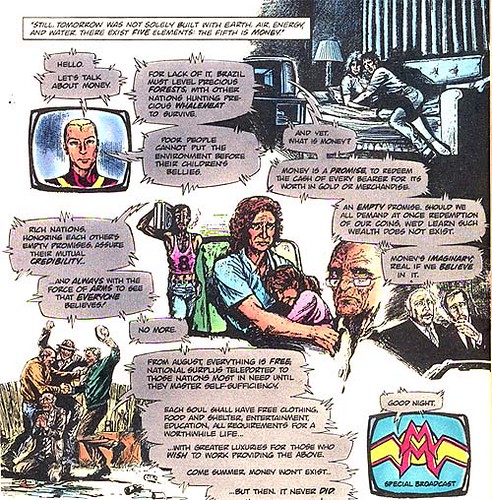


 Posts
Posts


