My blog has moved!

You should be automatically redirected to the new home page in 60 seconds. If not, please visit
http://gerrycanavan.com
and be sure to update your bookmarks. Sorry about the inconvenience.

Showing posts with label graduate student life. Show all posts

Sunday, November 01, 2009

Up to half of all doctoral students in English drop out before getting their degrees (something that appears to be the case in doctoral education generally), and only about half of the rest end up with the jobs they entered graduate school to get—that is, tenured professorships. Over the three decades since the branch was grabbed, a kind of protective shell has grown up around this process, a culture of “realism,” in which exogenous constraints are internalized, and the very conditions that make doctoral education problematic are turned into elements of that education. Students are told from the very start, almost from the minute they apply to graduate school, that they are effectively entering a lottery. This has to have an effect on professional self-conception.
There comes a time in every scholar's life where they turn their attention to what is wrong with graduate education today. This month is Louis Menand's turn, and the surprise is that the resulting article is not half bad, mostly because Menand eschews the cranky "We must teach the good books!" trope in favor of insights that seem, perhaps, to have been lifted unattributed from Marc Bousquet's How the University Works (reviewed by me here, Bousquet's blog here):
One pressure on universities to reduce radically the time-to-degree is simple humanitarianism. Lives are warped because of the length and uncertainty of the doctoral education process. Many people drop in and drop out and then drop in again; a large proportion of students never finish; and some people have to retool at relatively advanced ages. Put in less personal terms, there is a huge social inefficiency in taking people of high intelligence and devoting resources to training them in programs that half will never complete and for jobs that most will not get. Unfortunately, there is an institutional efficiency, which is that graduate students constitute a cheap labor force. There are not even search costs involved in appointing a graduate student to teach. The system works well from the institutional point of view not when it is producing Ph.D.s, but when it is producing ABDs. It is mainly ABDs who run sections for lecture courses and often offer courses of their own. The longer students remain in graduate school, the more people are available to staff undergraduate classes. Of course, overproduction of Ph.D.s also creates a buyer’s advantage in the market for academic labor. These circumstances explain the graduate-student union movement that has been going on in higher education since the mid 1990s.
Some additional discussion, but mostly mockery of English majors, here.

Monday, October 19, 2009

Aw, crap: 'The path to tenure begins in the first year of graduate school.' Academic career advice from Crooked Timber's Eszter Hargittai.

Tuesday, September 01, 2009

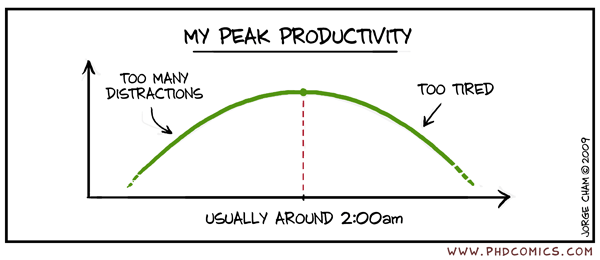
I have to admit PhD Comics nailed this one.

Wednesday, August 26, 2009


Go to grad school?

Monday, August 24, 2009

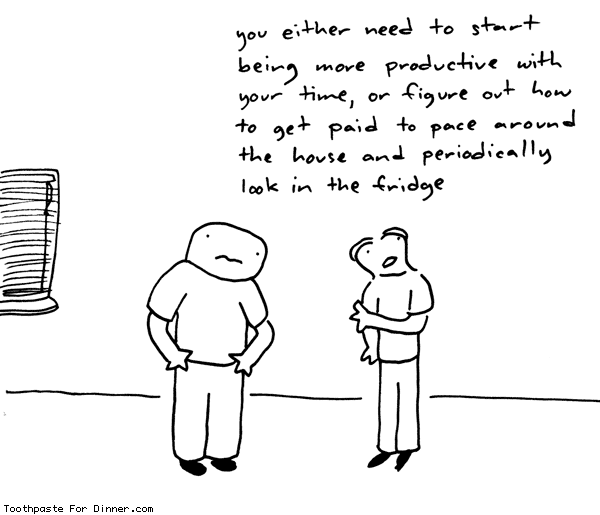
The salience of this particular moment fades a bit as we get further and further from Friday's spoiler-line, but I feel compelled to comment briefly on the conversation between Marathe and Steeply that begins on page 638. How can I, or anyone who has chosen a life in academia, read this week's material without feeling interpolated by it? How could any academic, would-be or otherwise, avoid asking him- or herself more than once just what it is that separates us from Steeply's M*A*S*H-obsessed father beyond the razor-thin veneer of professional legitimacy? It's my job, allegedly, to develop intricate and sometimes bizarre readings of pop-culture artifacts, which means it's perfectly okay for me to (still) spend all my time reading science-fiction novels and watching science-fiction movies just like I did when I was twelve. Heck, I wouldn't be doing my work if I didn't! And if I can just trick somebody into paying me to do it I'll never have to stop.

Herman Blume:What's the secret, Max?
Max Fischer: The secret?
Herman Blume: Yeah, you seem to have it pretty figured out.
Max Fischer: The secret, I don't know... I guess you've just gotta find something you love to do and then do it for the rest of your life. For me, it's going to Rushmore.
Intellectually, of course, I've always been able to recognize the tragic irony of this exchange—Rushmore, you'll remember, doesn't offer a post-graduate year—but I wonder sometimes whether deep down I've ever really come to terms with it.

Is this addiction? Does pursuing a academic career studying literature and pop culture—a preoccupation which over the years has diverted me from any number of more financially lucrative pursuits—mark me as the writerly equivalent of a functional alcoholic? Do I even qualify as functional? And it occurs to me now, reading this section against not only my own life and those of my grad student associates but against the life of anyone who has ever been a "fan" of anything—anyone, that is, who can recognize themselves in the way Steeply's father looked at M*A*S*H—that the danger DFW is highlighting is central to the construction of modern subjectivity. If everything is at least potentially bad for us—even/especially the things that give us pleasure, the things that make life appear to be worth living—just what is it we're supposed to be doing? Where is the authentic, healthy, free life, if there was ever such a thing to begin with? When even the things we love conspire to destroy us, what is left?

Sunday, August 23, 2009

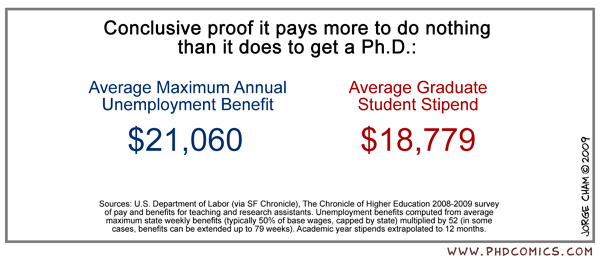
My life by the numbers.

Tuesday, July 28, 2009

A writer to the Economist has discovered my secret.

I once proposed a solution somewhat tongue in cheek to the problem of pensions: turn retirement upside down. In my plan, people would be supported by society up to the age of 30. During that period they would study, travel, prepare for a profession, reproduce and give full-time care to their young. They would not hold any positions of responsibility, where their youthful enthusiasm, unbounded energy and over-ambition were likely to cause problems. After 30, they would work until they dropped dead or became incapacitated.

Monday, July 13, 2009

Rather short Infinite Summer post from me this time around as I put together all the things that need to be put together for my late-summer stint as an instructor at the Duke University Institute for Gifted Youngsters. Like last year, posting will be somewhat slow the next three weeks; I'll mostly be posting only in the very early morning, at night, and on weekends, with occasional daytime posts here and there whenever I'm able to commit a little time theft.

With IGY on my mind, I was really struck by footnote 76, which provides as good a summary as you'll find of the inner life of anyone stamped "gifted" when they are young, not just Hal Incandenza but also my IGY students and me and most of the people who have become my close friends over the years and maybe you as well:

Hal Incandenza had been thought for a while as a toddler to have some sort of Attention Deficit Disorder—partly because he read so fast and spent so little time on each level of various pre-CD-ROM video games, partly because just about any upscale kid even slightly to port or starboard of the bell curve's acme was thought at that time to have A.D.D.—and for a while there'd been a certain amount of specialist-shuttling, and many of the specialists were veterans of Mario and were preconditioned to see Hal as also damaged, but thanks to the diagnostic savvy of Brandeis's Child Development Center the damage assessments were not only retracted but reversed way out to the other side of the Damaged-to-Gifted spectrum, and for much of the glabrous part of his childhood Hal'd been classified as somewhere between "Borderline Gifted" and "Gifted"—though part of this high cerebral rank was because B.C.D.C.'s diagnostic tests weren't quite so keen when it came to distinguishing between raw neural gifts and the young Hal's monomaniacally obsessive interest and effort, as if Hal were trying as if his very life were in the balance to please some person or persons, even though no one had ever even hinted that his life depended on seeming gifted or precocious or even exceptionally pleasing—and when he'd committed to memory entire dictionaries and vocab-check software and syntax manuals and then had gotten some chance to recite some small part of what he'd pounded into his RAM for a proudly nonchalant mother or even a by-this-time-as-far-as-he-was-concerned-pretty-much-out-there father, at these times of public performance and pleasure—the Weston M.A. school district in the early B.S. 1990s had had interschool range-of-reading-and-recall spelling-beeish competitions called "Battle of the Books," which these were for Hal pretty much of a public turkey-shoot and approval-fest—when he'd extracted what was desired from memory and faultlessly pronounced it before certain persons, he'd felt almost that same pale sweet aura that an LSD afterglow conferred, some milky corona, like almost a halo of approved grace, made all the milkier by the faultless nonchalance of a Moms who made it clear that his value was not contingent on winning first or even second prize, ever.
The incredibly slippery slope from this sort of childhood precociousness to adult dysfunction is something we've talked about here once or twice before in connection with the films of Wes Anderson, whose thematically similar The Royal Tenenbaums pops up around the fringes of IJ discussion quite a bit. And we can see now what a hard-luck case I really am: thirty years old and I'm still a student, still chasing the same damn high.

Most of the rest of what I'd have to say about today's spoiler line was already covered in my post last week on DFW, addiction, and suicide, for which Joelle is something of an exemplary case. This weekend's pages were pretty much all Joelle, all the time, not that I'm complaining. She's an interesting character and somehow able to bring us closer to the mind of Himself than anyone else we've met thus far.

Wednesday, July 01, 2009

Other stuff:

* Duke swine flu Patient Zero located. Get your torches and pitchforks and meet me by the Chapel.

* NPR is having a microfiction contest, no entry fee (but no real prize either). I've already entered more than 1,300 times.

* Trailer for Ricky Gervais's SFish comedy "The Invention of Lying" about a universe where no one has ever thought to lie.

* What is a master's degree worth? My advice to students in the humanities, as always, is to stay away unless they're paying you to go. Don't miss the structural analysis from Columbia's Mark C. Taylor:

The next bubble to burst will be the education bubble. Make no mistake about it, education is big business and, like other big businesses, it is in big trouble. What people outside the education bubble don’t realize and people inside won’t admit is that many colleges and universities are in the same position that major banks and financial institutions are: their assets (endowments down 30-40 percent this year) are plummeting, their liabilities (debts) are growing, most of their costs are fixed and rising, and their income (return on investments, support from government and private donations, etc.) is falling.

This is hardly a prescription for financial success. Faced with this situation, colleges and universities are on the prowl for new sources of income. And one place they invariably turn is to new customers, i.e., students.
* Also on the academic front is this on the split between reading and writing in English departments from the always insightful Marc Bousquet, at the Valve. Welcome to my future, everyone:
As of Fall 2007, contingent faculty outnumber the tenure stream by at least 3 to 1, roughly the inverse of the proportions forty years earlier. Across the profession, this trend line will drive the percentage of tenure-stream faculty into single digits within twenty years. It is hard to imagine that the trend line for English could be worse--but it is-- and the outlook for literature is worse yet. A 2008 MLA analysis of federal IPEDS data (Integrated Postsecondary Education Data System) shows that between 1993 and 2004, the hiring of nontenurable faculty continued to dramatically outpace tenure-track hiring in the profession as a whole.

However, in terms of absolute numbers most disciplines actually gained a modest number of tenure-track lines, or at least held steady. Political science gained 2.5 percent new lines; philosophy and religion packed on 43 percent. English, however, lost over 3,000 tenure-track lines, an average annual loss of 300 positions. This amounted to slightly more than one in every 10 tenurable positions in English — literally a decimation. If that trend proves to have continued — and all indications are that it has — by early 2010 English will have shed another 1,500 lines.
I just thank God I have an MFA to fall back on.

Thursday, May 14, 2009

Lots of open tabs from the last few days. Here's a first crack at it.

* 'Parasitic flies turn fire ants into zombies.' You heard it here first, get ready for zompocalypse.

* By request (hey, Tim) my last two Star Trek posts for a good long while.
* Star Trek: a military analysis.
* Star Trek vs. Star Wars.
* See also, God help me: The Duck Tales theme song gone horribly wrong.

* First pages from DC's Elseworlds 80-Page Giant. Via MeFi.

* Famous movie misquotes. I defy anyone to quote the line from The Graduate accurately. Also via MeFi.

* Oldest piece of art determined to be porn. Via Cyn-C.

* Top PhD programs shrinking. Still trying to figure out whether this is good news or bad. See also: 'The Universities in Trouble.'

Wednesday, March 25, 2009

As things stand, I can only identify a few circumstances under which one might reasonably consider going to graduate school in the humanities:

* You are independently wealthy, and you have no need to earn a living for yourself or provide for anyone else.

* You come from that small class of well-connected people in academe who will be able to find a place for you somewhere.

* You can rely on a partner to provide all of the income and benefits needed by your household.

* You are earning a credential for a position that you already hold — such as a high-school teacher — and your employer is paying for it.

Those are the only people who can safely undertake doctoral education in the humanities. Everyone else who does so is taking an enormous personal risk, the full consequences of which they cannot assess because they do not understand how the academic-labor system works and will not listen to people who try to tell them.
Graduate school in the humanities: just don't go. Part two is here. (h/t: Allen)

Monday, March 23, 2009

Oink, oink, baby, in the most Orwellian and neo-Freudian senses.

* At McSweeney's: Saved by the Bell: The Grad School Years.

* The University of Michigan Press is announcing today that it will shift its scholarly publishing from being primarily a traditional print operation to one that is primarily digital.

* J.G. Ballard's Alien and Starsky and Hutch.

* Every time a bell rings a volcano erupts, Bobby Jindal doesn't become president.

* Life as a $100,000-a-year clown.

* Life as the world's hottest basketball prospect—in sixth grade.

Monday, March 16, 2009

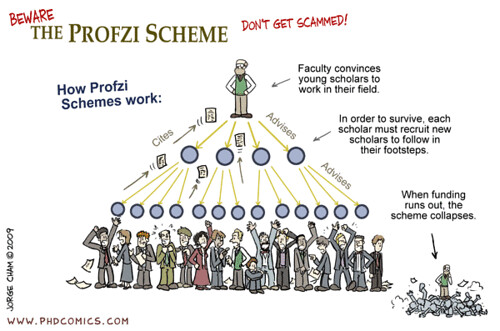
How the Profzi scheme works.

Saturday, March 07, 2009

Saturday night's all right for blogging. After the first few links we even get to some stuff that's not about Watchmen.

* Walter Chaw's Watchmen review goes to many of the same places as my own, albeit in a more thoroughgoing way:

Freeze any frame of the film and find in it the panel that inspired it. With each section separated by grabs from the covers of the comic book's initial run, fanboys should have no quarrel with the fidelity of the piece--but the reaction to the picture will likely continue to be fairly muted, as devotees of the graphic novel didn't exactly appreciate it for its slickness and sexiness. I'd hazard that what attracted people to the book is that Moore's vision is one of absolute respect for the power of the image in molding human history. Snyder does seem to understand this in restaging the Kennedy assassination with one of his masked heroes as the culprit, drawing a line pure and true from Zapruder's inauguration of film as history to the comic-book medium's inextricable hold on the collective imagination-in-formation. The power of Moore's work is that it takes the divine and, like Milton's mission, explains the ways of these gods to men in terms that men can understand: they're corrupted by their power and governed by their avarice and the essential baseness of being human. This sentiment is all but jettisoned, alas, by the time Snyder recasts the pathetic victories of sexually-reawakened schlub Night Owl (Patrick Wilson) and paramour Silk Spectre (a severely overmatched Malin Akerman) as triumphant victories. Watchmen--filthy with its director's now-trademark ramping technique--sees itself as a superhero adaptation of a human book. The failures of these characters are just weaknesses our übermenchen must overcome, not the foibles and hubris that lead to their downfall--and ours.
Vu and kate both get at this deep in the comments to my original post as well.

* Meanwhile, Spencer Ackerman says Watchmen is a "great film" and then spends the rest of the post explaining why it isn't.

* The headline reads, "Watchmen's first day disappoints." You're telling me!

* John Scalzi argues for a statute of limitations on spoilers.
Television: One week (because it’s generally episodic, and that’s how long you have until the next episode)

Movies: One year (time enough for everyone to see it in the theaters, on DVD and on cable)

Books: Five years (because books don’t reach nearly as many people at one time)
To my mind the whole "spoiler" hysteria needs to end; suspense is an overrated aesthetic in all but the rarest cultural productions.

* Husband, Wife Unaware They Are A Comedy Team.

* I suffered from this for years without knowing there was a name for it besides "being a college student."

* Another picture of a grown-up Calvin and Hobbes for your collection.

* The economy and literature: Will this crisis produce a Gatsby? More at MeFi.

* Does the financial crisis signal the end of neo-liberalism? David Harvey on the credit crunch and class.

* Abandoned places: a LiveJournal community. (Thanks, Eli!)

* And attention would-be humanities grad students: there are no jobs. None.

Thursday, March 05, 2009

Late night links.

* Here comes your Seinfeld reunion. God bless Larry David.

* You won't have Dr. Sanjay Gupta to kick around anymore.

* From My Unfinished Doctoral Dissertation on Breakfast Cereal.

* The artist-less art of Tim Knowles.

* ...each extra close friend in high school is associated with earnings that are 2 percent higher later in life after controlling for other factors. I had no idea I was so deeply disliked. (via MR)

* The headline reads, 'Diebold Voting System Has 'Delete' Button for Erasing Audit Logs.' No way that could be abused. Via MeFi.

Tuesday, March 03, 2009

Grad school vs. the recession. The short version is "Don't go," but you knew that already. Via Marginal Revolution.

1. Grad school pointlessly delays adulthood.
The best thing you can do for yourself is take time to figure out who you are and where you fit in the world. No one teaches you that in school. You need to do it yourself. Grad school is a way to delay this process, rather than move you forward, according to Thomas Benton of the Chronicle of Higher Education. So instead of dodging tough questions by going back to school, try being lost. It’s normal, and honest, and you will end up with more self-knowledge and less debt than your grad-school counterparts, and in many cases, you will be similarly qualified for your next big job.

2. PhD programs are pyramid schemes
It’s very hard to get a job teaching at a university. And if you are not going to teach, why are you getting a degree? You don’t need a piece of paper to show that you are learning. Go read books after work. Because look: In the arts, you would have a better chance of surviving the Titanic than getting a tenure-track position; and once you adjust for IQ, education, and working hours, post-PhD science jobs are among the most low-paying jobs you could get.
Check and mate. I'm out of here.

Monday, February 02, 2009

Still still more more.

* Marc Bousquet says the appointment of Wilma Liebman as chair of the NLRB is a good sign for advocates of grad student unionization. One of the most striking things about meeting grad students from other schools at conferences is always the recognition of just how good we actually have it at Duke—our situation is pretty far from perfect, but a lot of people at other institutions really do have it much worse.

To admit graduate students in the humanities with no or almost no funding isn't just insane, it's cruel.

* Iceland to appoint first openly gay woman as prime minister. The gynocracy (lesbocracy?) is finally here.

* Matt Yglesias, who of course now blogs for a nonprofit, says nonprofits are the future of journalism.

* Science fiction book covers that channel pure id.

* Create your own original Star Trek story: a flowchart.

* What? A Blade Runner sequel? Has the whole world gone crazy?

* While we're on the subject: some articles about Blade Runner. Via MeFi.

* The words of David Foster Wallace.

Tuesday, January 13, 2009

Is a GED more valuable than a PhD? "In an economy where everyone is overqualified, having an advanced degree is virtually worthless." Tell me about it. (Thanks, Erica!)

Wednesday, December 31, 2008

All is quiet on New Year's Day.

* As the Bush administration blessedly draws to a close, it's important to remember the casualties of the War of Terror, people like Alberto Gonzales. (via)

* More people get their news from the Internet than from newspapers. More importantly:

The percentage of people younger than 30 citing television as a main news source has declined from 68% in September 2007 to 59% currently.
That's good, good news.

* Howard Dean, Vermonter of the Year. Maybe next year, Ben and Jerry.

* Batman casting rumors you can believe in: Philip Seymour Hoffman as the Penguin.

* It's the future, and Microsoft still sucks.

* Top 10 space stories of 2008. A different 10.

* Top 10 cryptozoology stories of 2008.

* James Howard Kunstler's predictions for 2009. Prediction: Pain. Via MetaFilter.

* Thank god for philosophy grad students, the only graduate demographic upon Lit students can look down.

Monday, December 08, 2008

Potpourri and remainders.

* Is Dollhouse doomed? 7 Trouble Signs. Yes, it is doomed, and not just because of the Friday Night Death Slot—it's a comparatively weak premise that's already been messed with by the network and which requires Eliza Dushku to be a much better actress than she is. Despite attempts to put a brave face on, it's evident that Joss has a disaster on his hands:

2. Work stoppage. Production was actually halted. Twice. Once for script issues on the fourth episode, and once for the sixth and seventh. Whedon said in a blog, "To get a sense of how completely turned around I was during this process, you should know there was a scene with Eliza and the astonishing Ashley Johnson that I wrote and shot completely differently three different times, with different characters in different places (actually I wrote it closer to eight times), and none of it will ever see air." Really? The creator of the show had to reshoot something three times, and it still didn't work?
Don't get too attached to Dollhouse. Bring on Dr. Horrible: The Series.

* Nate Silver previews the 2010 Senate race and concludes "Even if momentum has swung somewhat against the Democrats by 2010, they remain in a strong position to gain seats in the Senate."

* Unexpectedly, applications to grad school are down, despite the economic downturn.
On Friday, David G. Payne, associate vice president of ETS for college and graduate programs, said that the “current hypothesis” is that the credit crunch is discouraging some people from considering graduate school, especially if they think they will not receive substantial financial support from the programs they might consider.
It also seems likely that more and more students are seeing themselves as simply maxed out when it comes to student debt, regardless of the larger credit crunch.

* Ten ways Canada is not more progressive than the U.S. #2 seems particularly important at the moment.
2. The Monarchy: Related to #1, the head of state in Canada is still technically the Queen of England. While this is generally just a curiousity for Americans to good naturedly rib Canadians about, this past week it made a huge difference. The Queen’s representative, the Governor General of Canada, made the decision that allowed Prime Minister Harper to hang on to power when the left (and nearly two-thirds of Canadian voters picked someone to the left of Harper in the October 2008 election) finally found a way to get together and form a coalition.
* And, via MeFi, the 40 greatest lost icons In pop culture history. Does Letterman still use "Buttafouco" as an all-purpose punch line?