 Other links.
* Inevitable endpoint of historical trends: Administrators in the Undergraduate Studies (US) office [at UC Davis] have asked if freshmen seminar instructors would voluntarily opt out of their quarterly stipend for teaching the one-to-two-unit courses for freshmen.
* The Italian magazine Wired has your map of the future.
* Bootleg DVD covers.
* Dick Armey: "The largest empirical problem we have in health care today is too many people are too overinsured." Of course! That's the problem.
* Someone really didn't think this one through.
* How American politics works, part 1: [The Boxer] bill will be a dead letter. Already there’s an undercurrent of anxiety in Washington that a bill can never pass as long as it’s associated with an unpopular lady senator who runs one of the body’s most liberal committees. The Senate isn’t like the House. There is no party discipline among Democrats; in fact, Democratic senators are fond of explicitly disclaiming party discipline. It’s a chamber full of large, jostling egos and not a little old-boy sexism. They’re not about to let a combative liberal woman run the show.
* How American politics works, part 2: What not to spend your empire's money on.
* Who is running for president in 2012? Only the new mayor of Manchester, N.H., knows for sure. Matt Yglesias has your chart showing no Republican can win in 2012, while Hendrik Hertzberg has something you can't get in your fancy East Coast universities: his gut.
* And Pandagon considers Betty Draper.
Thursday, November 05, 2009

Monday, November 02, 2009
A few midday links.
* In my previous election prediction thread I forgot to mention tomorrow's marriage equality vote in Maine, on which Adam Bink has an update at Open Left. I always think people will do the right thing on these marriage equality votes and I am always disappointed, so this year I'm expecting to lose but still hoping to be wrong.
* Looking past health care: can a climate bill actually pass the Senate? Steve Benen has more.
* The Climate Race: How Climate Change Is Already Affecting Us. Via Boing Boing. In the American Southeast:
* Average daily temperature about 2 degrees higher with the greatest increase in winter.* 23 Private College Presidents Made More Than $1 Million. I was a little surprised not to see Brodhead's name on the list, until I remembered how much money we pay Coach K.
* Days below freezing (32 degrees) reduced to four to seven per year.
* Average fall precipitation 30% higher since 1901, with the exception of South Florida.
* Moderate to severe droughts in spring and summer have increased 12% and 14%, respectively.
* Destructive potential of hurricanes has increased since 1970, due to an increase in sea surface temperature.
* Elsewhere in North Carolina, a majority favors the public option.
Fifty-four percent of North Carolina residents surveyed by Elon University said they would support a public option. Forty-one percent said they would use a public option plan should one become available.It's crucial to recognize here that the health care reform that is under discussion is far less ambitious than what the public would actually support; nothing close to 41% of the state will be eligible for the very limited version of the public option that is actually going to be voted on.
* How is televised science fiction doing in the ratings? What this list really shows, Dollhouse aside, is how bad TV SF is right now. Even the shows I do watch—FlashForward, Fringe—aren't exactly what I'd call good.
Sunday, November 01, 2009
Privatizing the public university.
Up to half of all doctoral students in English drop out before getting their degrees (something that appears to be the case in doctoral education generally), and only about half of the rest end up with the jobs they entered graduate school to get—that is, tenured professorships. Over the three decades since the branch was grabbed, a kind of protective shell has grown up around this process, a culture of “realism,” in which exogenous constraints are internalized, and the very conditions that make doctoral education problematic are turned into elements of that education. Students are told from the very start, almost from the minute they apply to graduate school, that they are effectively entering a lottery. This has to have an effect on professional self-conception.There comes a time in every scholar's life where they turn their attention to what is wrong with graduate education today. This month is Louis Menand's turn, and the surprise is that the resulting article is not half bad, mostly because Menand eschews the cranky "We must teach the good books!" trope in favor of insights that seem, perhaps, to have been lifted unattributed from Marc Bousquet's How the University Works (reviewed by me here, Bousquet's blog here):
One pressure on universities to reduce radically the time-to-degree is simple humanitarianism. Lives are warped because of the length and uncertainty of the doctoral education process. Many people drop in and drop out and then drop in again; a large proportion of students never finish; and some people have to retool at relatively advanced ages. Put in less personal terms, there is a huge social inefficiency in taking people of high intelligence and devoting resources to training them in programs that half will never complete and for jobs that most will not get. Unfortunately, there is an institutional efficiency, which is that graduate students constitute a cheap labor force. There are not even search costs involved in appointing a graduate student to teach. The system works well from the institutional point of view not when it is producing Ph.D.s, but when it is producing ABDs. It is mainly ABDs who run sections for lecture courses and often offer courses of their own. The longer students remain in graduate school, the more people are available to staff undergraduate classes. Of course, overproduction of Ph.D.s also creates a buyer’s advantage in the market for academic labor. These circumstances explain the graduate-student union movement that has been going on in higher education since the mid 1990s.Some additional discussion, but mostly mockery of English majors, here.
Thursday, September 03, 2009
Thursday!
* I'll be posting this year as a HASTAC Scholar at the Humanities, Arts, Science, and Technology Advanced Collaboatory. My first post is about status update activism of the sort that is all over your Facebook newsfeed today.
* Speaking of health care, Olympia Snowe now runs your health care.
* LRB makes an impressively desperate bid for my attention with Fredric Jameson's review of Margaret Atwood's The Year of the Flood alongside reviews of Inglourious Basterds and Inherent Vice.
* Madoff-mania: The SEC—which he claims he was shortlisted to chair (!)— now admits it badly mishandled multiple investigations of his company. Still more here.
* Kevin Carey nicely notes the difficulty inherent to blogging about a book you're two-thirds through with. Another post or two on Infinite Jest soon. The total collapse of blogging at A Supposedly Fun Blog is one of the great disappointments of Infinite Summer, I think.
* Hiding adjuncts so the U.S. News rankings can't find them. Meanwhile, this year's Washington Monthly undergraduate rankings leave Duke out of the Top 25.
* So you've invented a board game. (via)
* 68 Sci-Fi Sites to See in the U.S.
* And Gawker declares the Michael Cera backlash has officially begun.
Monday, August 10, 2009
Great moments in Polygraph blurbs. (Thanks, Alex!)
Polygraph 21: Study, Students, Universities. Fair warning: these kids are Marxists. This issue of what is perhaps the best-run graduate student journal in the U.S. is sparked by a simple, core, observation: There are students in the university.
Monday, July 27, 2009
Happy Monday. The summer is dying. We have to face it.
* With the Institute for Gifted Youngsters shut down I returned to Infinite Summer blogging over the weekend with a post on maps and territories.
* The issue of Polygraph I contributed to on study, students, and the university is available from Amazon, or will be soon.
* Time-lapse video of the construction of Disneyland at (where else?) Boing Boing.
* Colin Marshall sings the praises of my favorite film, Rushmore.
Because thousands of a certain generation's cinematic lives have been changed by this film, its territory is best approached with caution. Mine, however, happens to be among those thousands, 1998 marking as it did the opening of my prime window of cultural absporpton. Cinephilic teenagers of the 1960s had The 400 Blows, Breathless, Dr. Strangelove; cinephilic teenagers of the 1970s has Harold and Maude, Chinatown, Taxi Driver; cinephilic teenagers of the 1980s had Repo Man, Blue Velvet, Stranger than Paradise; cinephilic teenagers of the 1990s had Rushmore.*Revisiting the Rosenhan experiment. Via MeFi.
* And fair warning: Toy Story 3 will break your heart.
Wednesday, July 22, 2009
Out of college , money spent / see no future , pay no rent / all the money's gone, nowhere to go. I wrote a little bit about hard times at Harvard in that review of How the University Works for Polygraph; now here's a whole piece in Vanity Fair on the subject. Via Infectious Greed.
Incensed, one member of the board of Harvard Management Company, the fund that manages Harvard’s endowment, told me, “This story is about leadership. It isn’t about money.” He may be right. At some point in the last five years, the men and women who run Harvard convinced themselves that the endowment would grow at double-digit rates forever. If Harvard were a publicly traded company, those people would have been fired by now.
“Apparently nobody in our financial office has read the story in Genesis about Joseph interpreting Pharaoh’s dream—you know, during the seven good years you save for the seven lean years,” remarked Alan Dershowitz, a professor at Harvard Law School since 1967. “And now they’re coming hat in hand, pleading to the faculty and students to bear the burden of cutbacks. It’s a scandal! It’s an absolute scandal, the way Harvard has handled this financial crisis.”
Sunday, July 19, 2009
 The blog Infinite Thought beat me to the punch in announcing the publication of Polygraph 21: Study, Students, Universities, which contains a short book review by me of the indispensable Marc Bousquet's indispensable How the University Works that concerns in part university endowments in the wake of the financial crisis. Here's a bit from the beginning of my review:
Bousquet begins with a pointed rejection of the Lapsarian myth-making that typically characterizes discussions about what has happened to the University in recent decades, a notion that due to pernicious external influence or betrayal from within the purity of the University has somehow been corrupted. Bousquet’s University is not the victim of late capitalism; it is its agent. As Bousquet puts it: “Late capitalism doesn’t just happen to the university; the university makes late capitalism happen.” An analysis of the student as already a worker forms an important part of this picture, as we will see—but it is worth taking a moment to simply peruse Bousquet’s prodigious list of intersections between university capital and late capitalism writ large:
apparel sales; sports marketing; corporate-financed research, curriculum, endowment, and building; job training; direct financial investment via portfolios, pensions, and cooperative venture; the production and enclosure of intellectual property; the selection of vendors for books, information technology, soda pop, and construction; the purchase and provision of nonstandard labor; and so forth.
That’s an awful lot being monetized at “not-for-profit” institutions. And most of these functions have little or nothing to do with humanistic paeans to the “value” of a liberal education or the fantasy of the pure pursuit of knowledge for its own sake; in fact, the intellectual mission of the University rapidly recedes into the background as a type of side business, if not, indeed, a kind of hobby. There’s more truth than we might at first admit to the truistic assertion that NYU (to pick for a moment on the corporate entity responsible, among other things, for the publication and distribution of Bousquet’s critique) is a real-estate trust running a college for tax purposes.
Wednesday, July 01, 2009
Other stuff:
* Duke swine flu Patient Zero located. Get your torches and pitchforks and meet me by the Chapel.
* NPR is having a microfiction contest, no entry fee (but no real prize either). I've already entered more than 1,300 times.
* Trailer for Ricky Gervais's SFish comedy "The Invention of Lying" about a universe where no one has ever thought to lie.
* What is a master's degree worth? My advice to students in the humanities, as always, is to stay away unless they're paying you to go. Don't miss the structural analysis from Columbia's Mark C. Taylor:
The next bubble to burst will be the education bubble. Make no mistake about it, education is big business and, like other big businesses, it is in big trouble. What people outside the education bubble don’t realize and people inside won’t admit is that many colleges and universities are in the same position that major banks and financial institutions are: their assets (endowments down 30-40 percent this year) are plummeting, their liabilities (debts) are growing, most of their costs are fixed and rising, and their income (return on investments, support from government and private donations, etc.) is falling.* Also on the academic front is this on the split between reading and writing in English departments from the always insightful Marc Bousquet, at the Valve. Welcome to my future, everyone:
This is hardly a prescription for financial success. Faced with this situation, colleges and universities are on the prowl for new sources of income. And one place they invariably turn is to new customers, i.e., students.
As of Fall 2007, contingent faculty outnumber the tenure stream by at least 3 to 1, roughly the inverse of the proportions forty years earlier. Across the profession, this trend line will drive the percentage of tenure-stream faculty into single digits within twenty years. It is hard to imagine that the trend line for English could be worse--but it is-- and the outlook for literature is worse yet. A 2008 MLA analysis of federal IPEDS data (Integrated Postsecondary Education Data System) shows that between 1993 and 2004, the hiring of nontenurable faculty continued to dramatically outpace tenure-track hiring in the profession as a whole.I just thank God I have an MFA to fall back on.
However, in terms of absolute numbers most disciplines actually gained a modest number of tenure-track lines, or at least held steady. Political science gained 2.5 percent new lines; philosophy and religion packed on 43 percent. English, however, lost over 3,000 tenure-track lines, an average annual loss of 300 positions. This amounted to slightly more than one in every 10 tenurable positions in English — literally a decimation. If that trend proves to have continued — and all indications are that it has — by early 2010 English will have shed another 1,500 lines.
Monday, April 27, 2009
Graduate education is the Detroit of higher learning. Most graduate programs in American universities produce a product for which there is no market (candidates for teaching positions that do not exist) and develop skills for which there is diminishing demand (research in subfields within subfields and publication in journals read by no one other than a few like-minded colleagues), all at a rapidly rising cost (sometimes well over $100,000 in student loans).To save the university we must destroy it.
Widespread hiring freezes and layoffs have brought these problems into sharp relief now. But our graduate system has been in crisis for decades, and the seeds of this crisis go as far back as the formation of modern universities. Kant, in his 1798 work “The Conflict of the Faculties,” wrote that universities should “handle the entire content of learning by mass production, so to speak, by a division of labor, so that for every branch of the sciences there would be a public teacher or professor appointed as its trustee.”
It once again falls to Marc Bousquet to explain what the actual problem is; it's the labor system, stupid. Via MeFi.
Friday, April 24, 2009
Friday.
* How to score 1830 points in a single turn of Scrabble.
* A recent study has proved scientifically that we're all dicks.
You might expect that being prompted (primed) to think of yourself as a good person would make you more altruistic or moral — but, in fact, the exact opposite appears to be the case. Primed to think about what a good person you are, your most likely reaction is to think you’ve paid your morality dues and go on about your business.* Universities during the meltdown.
Since most American colleges have an endowment less than 1 percent the size of Harvard's, most do not have Harvard's problem. But they have other problems. The sources of income on which they depend—tuition revenue (at private colleges) and state appropriations (at public colleges), as well as annual alumni contributions (at both)—are under pressure too. Everyone knows about the competitive frenzy to get into a few highly ranked colleges, but in fact most of the 1,500 private colleges in the United States do not attract significantly more applicants than they can enroll. On the contrary, they struggle to meet enrollment targets, especially now that families in economic distress are turning to public institutions, which tend to be cheaper.[2]* Glenn Greenwald's three laws of actually existing media bias.
(1) Any policy that Beltway elites dislike is demonized as coming from "the Left" or -- in this case (following Karl Rove) -- the "hard Left."
(2) Nobody is more opposed to transparency and disclosure of government secrets than establishment "journalists."
(3) The single most sacred Beltway belief is that elites are exempt from the rule of law.
Monday, March 16, 2009
How the Profzi scheme works.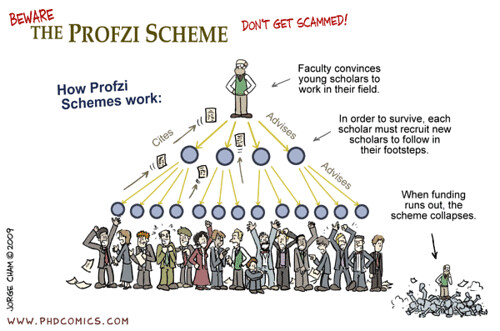
Thursday, March 12, 2009
Miscellany.
* Republicans have successfully transitioned from passively rooting for Obama to fail to actively sabotaging the economy. Well done, fellows.
* Views from the other universe: Ricky Gervais v. Elmo.
* Lots of people are linking to "the fifteen strangest college courses in America." Maybe this just demonstrates how far out of the mainstream Duke Lit is, but most of these seem perfectly cromulent to me.
* The economics of March Madness: how excessive spending on sports is a money-loser for nearly every Division I school. Marc Bousquet was right!
Tuesday, March 10, 2009
When I say to my fellow academics “aim low” and stick to your academic knitting or counsel do your job and don’t try to do someone else’s or warn against the presumption of trying to fashion a democratic citizenry or save the world, I am encouraging (or so McLennen says) a hunkering down in the private spaces of an academic workplace detached from the world’s problems.Somebody told Stanley Fish he's a neoliberal. He doesn't seem to like it much, but he presents no real argument that he isn't. I suppose he may be saving that for part two (about academic leftists boycotting Israeli academics, apparently, because that's the crucial site for neoliberal agon.) (Thanks, Russ!)
And when I define academic freedom as the freedom to do the academic job, not the freedom to expand it to the point where its goals are infinite, my stance “forecloses the possibility of civic engagement and democratic action.” (McClennen)
Monday, March 09, 2009
Higher education and the recession: thirteen reasons colleges are in this mess. (Requires subscription or university IP.) My upcoming review of How the University Works for Polygraph 21 tackles some of these points as well, particularly "1. Took on Risky Investments." When it shows up online, I'll link to it.
Tuesday, March 03, 2009
Grad school vs. the recession. The short version is "Don't go," but you knew that already. Via Marginal Revolution.
1. Grad school pointlessly delays adulthood.Check and mate. I'm out of here.
The best thing you can do for yourself is take time to figure out who you are and where you fit in the world. No one teaches you that in school. You need to do it yourself. Grad school is a way to delay this process, rather than move you forward, according to Thomas Benton of the Chronicle of Higher Education. So instead of dodging tough questions by going back to school, try being lost. It’s normal, and honest, and you will end up with more self-knowledge and less debt than your grad-school counterparts, and in many cases, you will be similarly qualified for your next big job.
2. PhD programs are pyramid schemes
It’s very hard to get a job teaching at a university. And if you are not going to teach, why are you getting a degree? You don’t need a piece of paper to show that you are learning. Go read books after work. Because look: In the arts, you would have a better chance of surviving the Titanic than getting a tenure-track position; and once you adjust for IQ, education, and working hours, post-PhD science jobs are among the most low-paying jobs you could get.
Tuesday, January 13, 2009
Kugelmas all but shuts down The Kugelmass Episodes with some tough talk for academic bloggers:
Criticism is alive and well; there is a burgeoning market for it, and it has been greatly bolstered by the blogging revolution, which is a source of publicity for any smart piece of analysis strong enough to spread virally. The humanities, on the other hand, are in tatters. Part of the reason for my new focus is that I don’t think there’s much value in continuing to write about teaching in the university until the situation generally improves, and I see even less value in trying to breathe life into theoretical discussions (led by people like Slavoj Zizek) that have mostly served to alienate the public, particularly since the ideas fueling these debates are not genuinely original breakthroughs.Since by and large I'm not an academic blogger—merely someone in academia who blogs—I come at this with two minds. I certainly disagree that How the University Works (a site I absolutely adore) is in any sense the last word on the academy; there are, surely, other things to talk about than our own
I am also uncomfortable with the role that academic blogging seems to have assumed. As far as I can tell, academic blogging does far too much to turn the horrible realities of the job market into an amusing, academic version of Alice in Wonderland: Oh, dear me! Wherever shall I end up next? Academics unwittingly portray themselves (with the generous help of commenters) as eccentrics who are bound to suffer, rather than as knowledge workers who are being exploited. Another way of putting this might be that Marc Bousquet’s How The University Works is probably the only academic blog (mine included) that should earn our admiration rather than our contempt — and it’s already a book.
Furthermore, given the current situation, the democratic ideas behind academic blogging (of bringing conversations usually restricted to campuses to the wide world of the Internet) has perhaps only helped prop up the other, worser idea that what we in the humanities do ought to be done for free, since it’s just book hobbyism if it isn’t serious, bare-bones instruction in writing.
But Kugelmass is right that "academic blogging" is functioning as a loose community rather than as a collective, and that it isn't really driving anything other than itself. With the university famously in ruins™, that's a fairly serious failing, and a place to start.
Tuesday, December 16, 2008
A pair of links about the academy from my Internets today.
* Inside Higher Ed has stats on the adjunctification of English. (Via Meredith.)
* Only 42 percent of all faculty members teaching English in four-year colleges and universities and only 24 percent in two-year colleges hold tenured or tenure-track positions.* Minding the Campus suggests tenure may be doomed. All it needs is a few more years, baby. (Via Critical Mass.)
* Part-time faculty members now make up 40 percent of the faculty teaching English in four-year institutions and 68 percent in two-year institutions. (Part timers are only a subset of those off the tenure track since, for several years now, an increasing share of the adjunct population works full time at a single institution.)
* Huge gaps exist in salaries between tenured and non-tenure track faculty members teaching English, although full-time adjuncts have seen salary growth in recent years. Per-course payments for part-time instructors have been relatively flat over the last eight years.
In early December, the Board of Regents of the Kentucky Community and Technical College system agreed to vote in a few months on a proposal that may have far-reaching effects on higher education. The proposal would end the practice of offering tenured or tenure-track posts to new faculty hires. Is this a crack in the tenure dam that will produce a cascade of other schools eradicating tenure from the ranks?
Tuesday, December 02, 2008
The trend in academia is to hire adjuncts instead of full faculty, but here and there there are exceptions. Consider, if you will, North Carolina's own Elon University, which has gone from a 50-50 split during the 1990s to a 3-1 pro-tenure split today.


 Posts


