The news from the economy remains pretty grim.
Showing posts with label labor. Show all posts
Showing posts with label labor. Show all posts
Friday, November 06, 2009

Monday, October 12, 2009
This week's blog icon is a photo I took at Detroit's amazing Labor Legacy Monument. More photos from my trip to come after I get home.
Wednesday, September 09, 2009
Karl Marx visits the Crayola factory. Via Boing Boing.
Try to imagine how wide the splatter pattern would be when Karl Marx's head explodes at the idea of a privately held corporate marketing theme park that performed a simulacrum of the labor-alienating process of industrialized manufacturing; in order to approximate a distant childhood experience of watching a television show which romanticized the original, actual alienating manufacturing process; which nostalgia is induced to stimulate consumption of the corporation's product; which is, in fact, an endless array of craft supplies for children, the very embodiment of the much-praised artisan and the educational ideal of creativity and self-expression; which all happen to be available for sampling and experimentation right here at the theme park, which by now is revealed to be a sprawling demand generation engine, and damned if you're gonna drive this far and not get something to take home besides memories and a couple of gloppy paintings made with giant rubber fish...
Sunday, August 30, 2009
Michael Pollan has denounced the Whole Foods boycott at New Majority.
John Mackey’s views on health care, much as I disagree with them, will not prevent me from shopping at Whole Foods. I can understand why people would want to boycott, but it’s important to play out the hypothetical consequences of a successful boycott. Whole Foods is not perfect, however if they were to disappear, the cause of improving Americans’ health by building an alternative food system, based on more fresh food, pastured and humanely raised meats and sustainable agriculture, would suffer.He took a rather different attitude towards the chain in The Omnivore's Dilemma back in 2006, when his criticism of Whole Foods led to a twenty-five page reply from Mackey and then this reply to the reply from Pollan.
After spending time with you and reading your letter, I've wondered if perhaps I did, as you imply in your letter, present a unfair caricature of Whole Foods in The Omnivore's Dilemma, suggesting a store where organic, local and artisanal food is just window dressing to help sell a much more ordinary industrial product. Indeed, nothing would please me more than to conclude I owe you and the company an apology. I'm not quite there yet. But I sincerely hope you will prove my portrait of Whole Foods wrong, that the company has not thrown its lot in with the industrialization, globalization and dilution of organic agriculture, but rather stands for something better. For my own part, I stand ready to write that apology, and look forward to doing it.The two met on a stage at Berkeley to continue the discussion in February the next year.
Thursday, August 13, 2009
More on that John Mackey editorial and the possibility of a nationwide Whole Foods boycott from TPM, Pandagon, Ezra Klein, Daily Kos, Daily Kos, Daily Kos, Facebook, and the Whole Foods forums. This backlash has been a long-time coming; their anti-union politics are bad enough.
But I can't decide whether my new "boycotting Whole Foods since earlier this morning" tagline is a joke or not; being honest, where else are we supposed to shop for food? It's not as if Food Lion and Harris Teeter are known for their commitment to fair labor practices, progressive causes, and sustainability.
Durhamites, where do you shop for food?
Thursday, August 06, 2009
Links for a Thursday without joy.
* Don't forget about him: John Hughes has died.
* Margaret Atwood, Twitterer.
* The Big Picture visits Hiroshima 64 years ago today.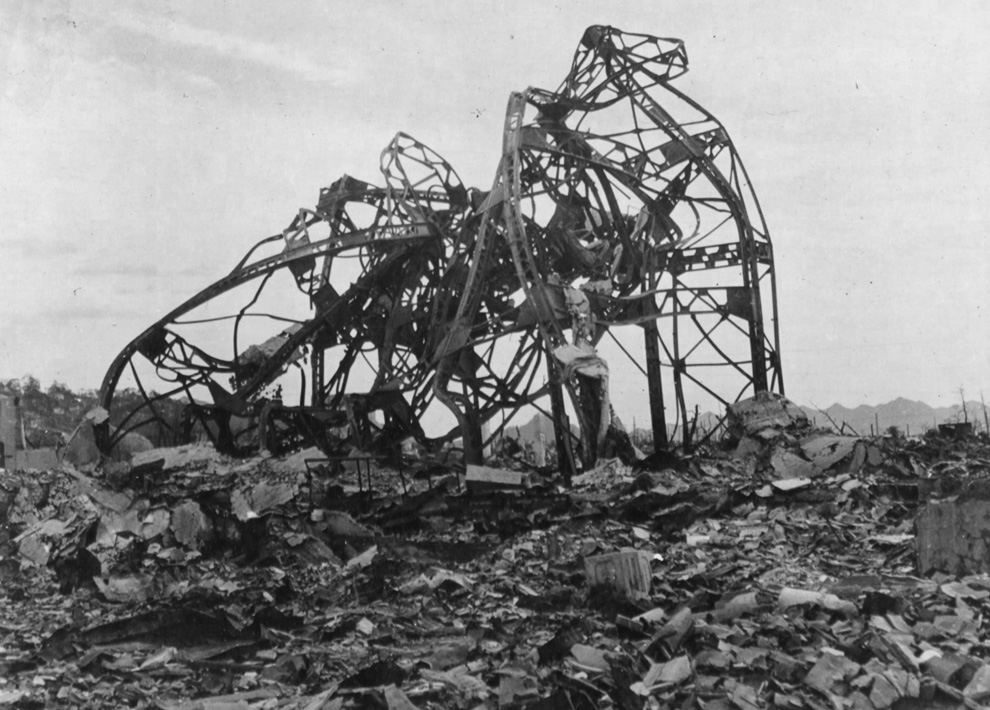
* Long Vanity Fair profile of Mad Men and Matthew Weiner. Best show on TV. Via Kottke.
“Matt wants real,” said Charlie Collier, president of AMC. For Weiner, Collier continued, “it’s not television; it’s a world.” Perhaps the only other producer as committed to the rules of his imagined universe is George Lucas. “Perfectionism” is a word the show’s writers tossed around when I asked a group of them about working with Weiner. “Fetishism” was another. Alan Taylor, who has directed four episodes of Mad Men, labeled Weiner’s attention to detail “maniacal.” Call it what they will, it is a charge that is largely embraced. “We’re all a little bit touched with the O.C.D.,” Robin Veith, one of the writers, told me, describing how she and her colleagues have researched actual street names and businesses in Ossining, the suburb where Don and Betty live; checked old commuter-train schedules, so that they know precisely which train Don would take to the city; pored over vintage maps to learn which highways he would drive on.* Towards a four-day work week.
* And Sonia Sotomayor has been confirmed, 68-31, making her the first Latina woman racist on the Supreme Court.
Sunday, July 19, 2009
 The blog Infinite Thought beat me to the punch in announcing the publication of Polygraph 21: Study, Students, Universities, which contains a short book review by me of the indispensable Marc Bousquet's indispensable How the University Works that concerns in part university endowments in the wake of the financial crisis. Here's a bit from the beginning of my review:
 Bousquet begins with a pointed rejection of the Lapsarian myth-making that typically characterizes discussions about what has happened to the University in recent decades, a notion that due to pernicious external influence or betrayal from within the purity of the University has somehow been corrupted. Bousquet’s University is not the victim of late capitalism; it is its agent. As Bousquet puts it: “Late capitalism doesn’t just happen to the university; the university makes late capitalism happen.” An analysis of the student as already a worker forms an important part of this picture, as we will see—but it is worth taking a moment to simply peruse Bousquet’s prodigious list of intersections between university capital and late capitalism writ large:
apparel sales; sports marketing; corporate-financed research, curriculum, endowment, and building; job training; direct financial investment via portfolios, pensions, and cooperative venture; the production and enclosure of intellectual property; the selection of vendors for books, information technology, soda pop, and construction; the purchase and provision of nonstandard labor; and so forth.
That’s an awful lot being monetized at “not-for-profit” institutions. And most of these functions have little or nothing to do with humanistic paeans to the “value” of a liberal education or the fantasy of the pure pursuit of knowledge for its own sake; in fact, the intellectual mission of the University rapidly recedes into the background as a type of side business, if not, indeed, a kind of hobby. There’s more truth than we might at first admit to the truistic assertion that NYU (to pick for a moment on the corporate entity responsible, among other things, for the publication and distribution of Bousquet’s critique) is a real-estate trust running a college for tax purposes.
Tuesday, April 28, 2009
The netroots blogs are already talking about a primary challenge to Specter, despite apparent party-boss promises to the contrary. Right now most of the talk centers around the Employee Free Choice Act, which Specter recently decided he opposed back when he was still trying to protect his right flank from Pat Toomey. There's been speculation that Specter's reference to EFCA in his statement earlier today referred only to voting against the bill itself, and that he'd vote to invoke cloture—but it's looking now as if he won't vote for cloture either. In that case put money on the idea of a "miraculous compromise" on EFCA that modifies the language just enough to give Specter cover to flip-flop back. A Ned-Lamont-style primary challenge backed by Labor and the netroots would otherwise be almost inevitable, Rendell's promises notwithstanding, and unlike Connecticut Pennsylvania has a "sore loser" law that would prevent a Liebermanesque run as an independent.
P.S.: Don't miss Steele's response to all this invoking the ugly specter of Arlen Specter's mama.
Monday, April 27, 2009
Graduate education is the Detroit of higher learning. Most graduate programs in American universities produce a product for which there is no market (candidates for teaching positions that do not exist) and develop skills for which there is diminishing demand (research in subfields within subfields and publication in journals read by no one other than a few like-minded colleagues), all at a rapidly rising cost (sometimes well over $100,000 in student loans).To save the university we must destroy it.
Widespread hiring freezes and layoffs have brought these problems into sharp relief now. But our graduate system has been in crisis for decades, and the seeds of this crisis go as far back as the formation of modern universities. Kant, in his 1798 work “The Conflict of the Faculties,” wrote that universities should “handle the entire content of learning by mass production, so to speak, by a division of labor, so that for every branch of the sciences there would be a public teacher or professor appointed as its trustee.”
It once again falls to Marc Bousquet to explain what the actual problem is; it's the labor system, stupid. Via MeFi.
Sunday, April 19, 2009
 Other stuff.
* Jaimee has a piece in the Indy Green Guide this week comparing dueling energy initiatives in the North Carolina State Legislature.
* Begging as labor: Alex Greenberg thinks it over.
* Science fiction's most evil corporations.
* Hope for Dollhouse? 'Prison Break return disappoints,' scoring 75% of Dollhouse's regular audience in the Friday night death slot.
* Making Samuel Beckett.
* The Brick Testament has reached The Book of Revelations.
* "Metaphysics in a Time of Terrorism," by Terry Eagleton. Via MeFi.
The distinction between Hitchens or Dawkins and those like myself comes down in the end to one between liberal humanism and tragic humanism. There are those who hold that if we can only shake off a poisonous legacy of myth and superstition, we can be free. Such a hope in my own view is itself a myth, though a generous-spirited one. Tragic humanism shares liberal humanism’s vision of the free flourishing of humanity, but holds that attaining it is possible only by confronting the very worst. The only affirmation of humanity ultimately worth having is one that, like the disillusioned post-Restoration Milton, seriously wonders whether humanity is worth saving in the first place, and understands Swift’s king of Brobdingnag with his vision of the human species as an odious race of vermin. Tragic humanism, whether in its socialist, Christian, or psychoanalytic varieties, holds that only by a process of self-dispossession and radical remaking can humanity come into its own. There are no guarantees that such a transfigured future will ever be born. But it might arrive a little earlier if liberal dogmatists, doctrinaire flag-wavers for Progress, and Islamophobic intellectuals got out of its way.*Think Progress says "Obama’s Immunity For CIA Agents Still Leaves Prosecutions Of Senior Bushies On The Table." People need to accept that Obama's going to let us down on this. He told us he would. He will.
* Your taxes at work. See also.
* A major EPA ruling this week declared carbon dioxide a pollutant under the Clean Air Act. More analysis at the Oil Drum.
* Imagine finding yourself aboard a burning ocean liner. An increasing number of people are trying to put it out -- and they stand a good chance, if they can get access to the fire axes and hoses. Unfortunately, some rich old fat guys are sitting in deck chairs blocking the equipment, enjoying drinks and appetizers, and every time the other passengers try to get them to move, the rich old fat guys say they don't really believe in the fire, and even if it does exist, it probably can't be put out so we should just trust in the new lifeboat being built. And, sure enough, there on the deck is a guy is a brilliant, somewhat unworldly professor, busily sketching a design for a new lifeboat as the smoke billows in larger and larger clouds.
That's a pretty fair analogy for the situation in which we find ourselves, and for the role geoengineering is playing in the climate debate.
* The Wire series bible.
Friday, February 20, 2009
The Big Picture, Blog of the Year 2008 by almost any measure, makes an early bid for Blog of the Year 2009 with pictures of people at work.

Thursday, December 18, 2008
Random.
* The Cleveland Plain Dealer doesn't like it when big-shot New Yorkers take shits on our beloved city.
* I thought I was raised in a country where we were all free to vote for the Lizard Person of our choice. I was wrong.
* By the way, it looks like Franken may actually win.
* Labor leaders like Obama's labor pick.
* "Area Woman Becomes Republican Vice Presidential Candidate." The Onion continues its Year-in-Review.
* James Howard Kunstler's "10 Ways to Prepare for a Post-Oil Society."
Thursday, December 11, 2008
With cheers and chants that echoed President-elect Barack Obama's campaign of change, jubilant workers agreed to a $1.75 million settlement that ends their six-day occupation of a shuttered Chicago factory that became a symbol of the plight of labor nationwide.
Monday, December 08, 2008
Weekend Updates.
* Obama supports the sit-in in Chicago.
* Krugman says he was misquoted: Urk. I gather that there’s a report on the wires quoting me as saying that the US auto industry would disappear. What I actually said was that the concentration of the industry around Detroit would disappear. That proposition sounds significantly more reasonable than the original version, but still, I'm very skeptical. People are not going to just let (completely) Detroit die.
* The conspiracy goes all the way to the top: The Supreme Court has refused to hear the case on Barack Obama's citizenship.
Sunday, December 07, 2008
Workers in Chicago have occupied a closing Republic Windows & Doors factory demanding $1.5 million in severance and vacation pay they are are owed by management. Via Vu as a followup to this morning's post about the "Occupy, Resist, Produce" movement in Argentina—two out of three, Chicago...
Something very close to what Marx meant by "the revolution" has been happening for years in Argentina, where workers "have been responding to rampant unemployment and capital flight by taking over businesses that have gone bankrupt and reopening them under democratic worker management."
The principles are so simple, so elementally fair, that they seem more self-evident than radical when articulated by one of the workers: "We formed the co-operative with the criteria of equal wages and making basic decisions by assembly; we are against the separation of manual and intellectual work; we want a rotation of positions and, above all, the ability to recall our elected leaders."Via Boing Boing.
The movement of recovered companies is not epic in scale - some 170 companies, around 10,000 workers in Argentina. But six years on, and unlike some of the country's other new movements, it has survived and continues to build quiet strength in the midst of the country's deeply unequal "recovery". Its tenacity is a function of its pragmatism: this is a movement that is based on action, not talk. And its defining action, reawakening the means of production under worker control, while loaded with potent symbolism, is anything but symbolic. It is feeding families, rebuilding shattered pride, and opening a window of powerful possibility.
Like a number of other emerging social movements around the world, the workers in the recovered companies are rewriting the script for how change is supposed to happen. Rather than following anyone's ten-point plan for revolution, the workers are darting ahead of the theory - at least, straight to the part where they get their jobs back. In Argentina, the theorists are chasing after the factory workers, trying to analyse what is already in noisy production.
These struggles have had a tremendous impact on the imaginations of activists around the world. At this point, there are many more starry-eyed grad papers on the phenomenon than there are recovered companies. But there is also a renewed interest in democratic workplaces from Durban to Melbourne to New Orleans.
That said, the movement in Argentina is as much a product of the globalisation of alternatives as it is one of its most con tagious stories. Argentinian workers borrowed the slogan "Occupy, Resist, Produce" from Latin America's largest social movement, Brazil's Movimiento Sin Terra, in which more than a million people have reclaimed unused land and put it back into community production. One worker told us that what the movement in Argentina is doing is "MST for the cities". In South Africa, we saw a protester's T-shirt with an even more succinct summary of this new impatience: "Stop Asking, Start Taking".
Tuesday, August 05, 2008
Upon seeing the top 15 "green brands", my first response was "There's no such thing as a green brand." But that's not true—there really are companies with superior products and decent practices, it's just that consumers have no ready access to reliable information about them. And the high social importance of ecology in recent years has actually made matters worse, not better, with the greenwashing that is increasingly common across all industries only further muddying the waters.
Apple, for instance, and despite its many other virtues, may be greener than it used to be but it's still not especially green. But it feels green, so it makes the list.
This is a failure of the culture, and really a failure of our government—in both cases by design. Simple labels work; they worked in Britain for nutrition, and they could work here, not only with regard to health but along any number of ecological and social-justice vectors as well.
It may be that consumers would still make bad choices even if they were well-informed, but the evidence from Britain suggests otherwise. I think you'd see a significant shift in consumption practices almost immediately.
Wednesday, July 30, 2008
Essentially, the contention is that our currently dominant power systems cannot long survive in space; beyond a certain technological level a degree of anarchy is arguably inevitable and anyway preferable.The Biology in Science Fiction blog introduces me to Iain M. Bank's ultra-Utopian enunciation of The Culture. Of course, as with any Utopia, labor turns out to be a pivotal concern:
Briefly, nothing and nobody in the Culture is exploited. It is essentially an automated civilisation in its manufacturing processes, with human labour restricted to something indistinguishable from play, or a hobby.Banks isn't coy; what he's talking about is a vision of interstellar socialism made possible by the concurrent elimination of both scarcity and hierarchy:
No machine is exploited, either; the idea here being that any job can be automated in such a way as to ensure that it can be done by a machine well below the level of potential consciousness; what to us would be a stunningly sophisticated computer running a factory (for example) would be looked on by the Culture's AIs as a glorified calculator, and no more exploited than an insect is exploited when it pollinates a fruit tree a human later eats a fruit from.
Where intelligent supervision of a manufacturing or maintenance operation is required, the intellectual challenge involved (and the relative lightness of the effort required) would make such supervision rewarding and enjoyable, whether for human or machine. The precise degree of supervision required can be adjusted to a level which satisfies the demand for it arising from the nature of the civilisation's members. People - and, I'd argue, the sort of conscious machines which would happily cooperate with them - hate to feel exploited, but they also hate to feel useless. One of the most important tasks in setting up and running a stable and internally content civilisation is finding an acceptable balance between the desire for freedom of choice in one's actions (and the freedom from mortal fear in one's life) and the need to feel that even in a society so self-correctingly Utopian one is still contributing something. Philosophy matters, here, and sound education.
Let me state here a personal conviction that appears, right now, to be profoundly unfashionable; which is that a planned economy can be more productive - and more morally desirable - than one left to market forces.Note too that it'll take both:
...
Of course, there is a place for serendipity and chance in any sensibly envisaged plan, and the degree to which this would affect the higher functions of a democratically designed economy would be one of the most important parameters to be set... but just as the information we have stored in our libraries and institutions has undeniably outgrown (if not outweighed) that resident in our genes, and just as we may, within a century of the invention of electronics, duplicate - through machine sentience - a process which evolution took billions of years to achieve, so we shall one day abandon the grossly targeted vagaries of the market for the precision creation of the planned economy.
The Culture, of course, has gone beyond even that, to an economy so much a part of society it is hardly worthy of a separate definition, and which is limited only by imagination, philosophy (and manners), and the idea of minimally wasteful elegance; a kind of galactic ecological awareness allied to a desire to create beauty and goodness.
The one thing that won't be enough is getting to a post-scarcity society; a statistically valid number of us have lived in something very like that for the past decade and a bit and we still collectively behaved like slavering morons, so it'll take more than just having more toys than we know what to do with to make us truly civilised.There's more at io9 and, of all places, CNN.
Tuesday, November 13, 2007
A few links before I head back to class, all but the last from the good people at MetaFilter:
* 'Striking Out': On the surprising failure of labor stoppage in America. (thread)
* The lie at the bottom of the fantasy goes something like this: serious college football players go to college for some reason other than to play football. These marvelous athletes who take the field on Saturdays and generate millions for their colleges are students first, and football players second. They are like Franciscan monks set down in the gold mine. Yes, they play football, but they have no interest in the money. What they’re really living for is that degree in criminology.
Of course, no honest person who has glimpsed the inside of a big-time college football program could actually believe this. (thread)
* Elena Dorfman photographs the strange worlds of cosplay and RealDolls. (thread)
* John Scalzi goes inside the Creation Museum. Here are photos. (thread)
* The Obama speech that's got everyone Baracking again.
Monday, November 05, 2007
Strike! The Writers Guild of America has pulled the trigger and gone on strike. More power to them. In solidarity, I won't be writing any scripts today either.


 Posts
Posts


