My blog has moved!

You should be automatically redirected to the new home page in 60 seconds. If not, please visit
http://gerrycanavan.com
and be sure to update your bookmarks. Sorry about the inconvenience.

Showing posts with label addiction. Show all posts

Monday, August 24, 2009

The salience of this particular moment fades a bit as we get further and further from Friday's spoiler-line, but I feel compelled to comment briefly on the conversation between Marathe and Steeply that begins on page 638. How can I, or anyone who has chosen a life in academia, read this week's material without feeling interpolated by it? How could any academic, would-be or otherwise, avoid asking him- or herself more than once just what it is that separates us from Steeply's M*A*S*H-obsessed father beyond the razor-thin veneer of professional legitimacy? It's my job, allegedly, to develop intricate and sometimes bizarre readings of pop-culture artifacts, which means it's perfectly okay for me to (still) spend all my time reading science-fiction novels and watching science-fiction movies just like I did when I was twelve. Heck, I wouldn't be doing my work if I didn't! And if I can just trick somebody into paying me to do it I'll never have to stop.

Herman Blume:What's the secret, Max?
Max Fischer: The secret?
Herman Blume: Yeah, you seem to have it pretty figured out.
Max Fischer: The secret, I don't know... I guess you've just gotta find something you love to do and then do it for the rest of your life. For me, it's going to Rushmore.
Intellectually, of course, I've always been able to recognize the tragic irony of this exchange—Rushmore, you'll remember, doesn't offer a post-graduate year—but I wonder sometimes whether deep down I've ever really come to terms with it.

Is this addiction? Does pursuing a academic career studying literature and pop culture—a preoccupation which over the years has diverted me from any number of more financially lucrative pursuits—mark me as the writerly equivalent of a functional alcoholic? Do I even qualify as functional? And it occurs to me now, reading this section against not only my own life and those of my grad student associates but against the life of anyone who has ever been a "fan" of anything—anyone, that is, who can recognize themselves in the way Steeply's father looked at M*A*S*H—that the danger DFW is highlighting is central to the construction of modern subjectivity. If everything is at least potentially bad for us—even/especially the things that give us pleasure, the things that make life appear to be worth living—just what is it we're supposed to be doing? Where is the authentic, healthy, free life, if there was ever such a thing to begin with? When even the things we love conspire to destroy us, what is left?

Friday, August 07, 2009

The spoiler line sometimes makes it difficult to write these Infinite Summer posts; the thoughts for this one have been percolating for a few weeks but we were never quite where I wanted to be in the book before discussing them. Like Daryl Houston, a lot of my thoughts on this second reading of Infinite Jest are crystalizing around the Steeply/Marathe discussions of the Entertainment, which now seem to me to be organization points for many of the book's broader philosophical themes.

One of the major existential problems being confronted in IJ is the tragedy of embodied consciousness. It's laid out explicitly for us in this week's section beginning on 470, which discusses the (real-life) experiments surrounding the discovery of the p-terminal in the brain:

'Older's earliest subjects were rats, and the results were apparently sobering. The Nu—the Canadians found that if they rigged an auto-stimulation lever, the rat would press the lever to stimulate his p-terminal over and over, thousands of times an hour, over and over, ignoring food and female rats in heat, completely fixated on the lever's stimulation, day and night, stopping only when the rat finally died of dehydration or simple fatigue."
That pleasure resides inside the brain is, of course, the materialist nexus that links the MacGuffin-like search for the Entertainment with DFW's ruminations on the nature of addiction—both hypertrophic stimulations of the pleasure center that cause abject misery and death.

Scientific materialism sticks a dagger through the heart of humanism, a spike in all our brains. If we are (just) brains, then we are (mere) machines. Highly, indescribably complex machines, sure, but machines. And this can only be understood as a deeply dehumanizing loss for a culture that is so steeped in its own sense of spiritual exceptionalism. It is the ultimate reduction in status. The things that make us feel human—love, music, passion, art—now threaten to recede to nothing after a century of materialist triumph, replaced instead with raw mammalian instinct: a new vision of the human as oversized rat running a maze to pull a lever and get a treat.

Atheism, which is necessarily materialist, necessarily carries with it the bleak and terrible suspicion that you might not even exist in any meaningful sense—a suspicion that, if we are lucky, we don't find ourselves dwelling on for all that much of the time. It's this baseline existential dread that fuels our contemporary anxieties about Pavlovian behaviorism, brainwashing, pharmacological happiness, and soulless bodysnatchers—concepts which threaten us with frightening dehumanization only insofar as we admit they have us pegged.

Isn't happiness-in-a-tube still happiness? Why not chemically synthesize love? Are not the bodysnatched content, better at being us than we are, with none of our squishy excess?

Why not watch the Entertainment?

It's the sublime terror at the Nothing at the core of our existence that plagues Gately whenever he tries to get his hands around the Higher Power demanded by AA (see 443 [on which, Daryl notes, Gately feels like a rat] and 467). Wallace, in the oft-quoted Kenyon commencement speech, seems to really believe that belief in some sort of Higher Power is necessary for any sense of fulfillment, though he tries to leave the details as open as AA does:
In the day-to-day trenches of adult life, there is actually no such thing as atheism. There is no such thing as not worshipping. Everybody worships. The only choice we get is what to worship. And an outstanding reason for choosing some sort of God or spiritual-type thing to worship---be it J. C. or Allah, be it Yahweh or the Wiccan mother-goddess or the Four Noble Truths or some intangible set of ethical principles---is that pretty much anything else you worship will eat you alive. If you worship money and things---if they are where you tap meaning in life---then you will never have enough. Never feel you have enough. It's the truth. Worship your own body and beauty and sexual allure and you will always feel ugly, and when time and age start showing, you will die a million deaths before they finally plant you. On one level, we all know this stuff already---it's been codified as myths, proverbs, cliches, bromides, epigrams, parables: the skeleton of every great story. The trick is keeping the truth up-front in daily consciousness. Worship power---you will feel weak and afraid, and you will need ever more power over others to keep the fear at bay. Worship your intellect, being seen as smart---you will end up feeling stupid, a fraud, always on the verge of being found out. And so on.
For Wallace, the only way out of the trap of embodied consciousness—of being a rat pulling its pleasure lever—is to reassert the existence of transcendent value not as a matter of proven epistemic certainty but as a radical and rational choice against basic human frailty. The speech goes on:
Look, the insidious thing about these forms of worship is not that they're evil or sinful; it is that they are unconscious. They are default-settings. They're the kind of worship you just gradually slip into, day after day, getting more and more selective about what you see and how you measure value without ever being fully aware that that's what you're doing. And the world will not discourage you from operating on your default-settings, because the world of men and money and power hums along quite nicely on the fuel of fear and contempt and frustration and craving and the worship of self. Our own present culture has harnessed these forces in ways that have yielded extraordinary wealth and comfort and personal freedom. The freedom to be lords of our own tiny skull-sized kingdoms, alone at the center of all creation. This kind of freedom has much to recommend it. But of course there are all different kinds of freedom, and the kind that is most precious you will not hear much talked about in the great outside world of winning and achieving and displaying. The really important kind of freedom involves attention, and awareness, and discipline, and effort, and being able truly to care about other people and to sacrifice for them, over and over, in myriad petty little unsexy ways, every day. That is real freedom. The alternative is unconsciousness, the default-setting, the "rat race" -- the constant gnawing sense of having had and lost some infinite thing.

I know that this stuff probably doesn't sound fun and breezy or grandly inspirational. What it is, so far as I can see, is the truth with a whole lot of rhetorical bullshit pared away. Obviously, you can think of it whatever you wish. But please don't dismiss it as some finger-wagging Dr. Laura sermon. None of this is about morality, or religion, or dogma, or big fancy questions of life after death. The capital-T Truth is about life before death. It is about making it to 30, or maybe 50, without wanting to shoot yourself in the head.
Of course the tragedy informing all our readings this summer is that DFW didn't make it to 50. He died when he was 46. And when we read Infinite Jest I think we must do so with the recognition that we have lost the infinite thing and it is not coming back. I don't equate this recognition with unconsciousness or automatism—because the sad truth is that even when you set out to worship transcendence you cannot escape the fear that the thing you worship is actually tiny, and a lie, and just inside your head. I don't think we can just fool ourselves into living as though God had never died; I don't think we can play pretend. As an atheist in that nihilistic Gately sense—as someone who does not worship and cannot believe, not even as a life-saving performative choice—it seems to me the terrible first step is to face things as they are, in all their unhappy finitude. The miracle of life comes not just despite this, but out of it.

Tuesday, July 28, 2009

On the question of irony—where I left off last time, and where Infinite Zombies' Daryl Houston starts off in his latest post—it's a little difficult for me to know exactly how to read this week's section on the Reaganesque presidency of Johnny Gentle, Famous Crooner. The signposts for reading this section as a satire are all there, not just in Gentle's OCD and Howard-Hughes-style obsession with cleanliness but also in the complete vacuity of C.U.S.P.'s political agenda—but it is difficult to tell whether the narrative's apparent contempt for environmentalist thinking is an aspect of the satire or the motivation for it. Gentle's political party, the Clean U.S. Party—an unlikely political coalition comprised of "ultra-right jingoist hunt-deer-with-automatic-weapons types and far-left macrobiotic Save-the-Ozone, -Rain-Forests, -Whales, -Spotted-Owel-and-High-pH-Waterways ponytailed granola-crunchers" whose first platform was organized around the ingenious plan "Let's Shoot Our Wastes Into Space"—is organized around an anti-ecological version of supposed environmentalism that understands "American renewal" as "an essentially aesthetic affair" (382). This is, then, a fairly pitch-perfect satire of ecology as ideology, the empty apolitics of the sort "we can all agree to" that looks for consumer-friendly solutions to the environmental catastrophe caused by consumerism itself. This is our moment: "a dark time when all landfills got full and all grapes were raisins and sometimes in some places the falling rain clunked instead of splattered" (382).

I can think here of nothing so much as a DFW quote on addiction Daryl highlighted in his own post:

An activity is addictive if one’s relationship to is lies on that downward-sloping continuum between liking it a little too much and really needing it. Many addictions, from exercise to letter-writing, are pretty benign. But something is malignantly addictive if (1) it causes real problesm for the addict, and (2) it offers itself as a relief from the very problem it causes.
Consumerism, I think, clearly qualifies, as Wallace shows throughout this section.

In IJ, it's our malignant addiction to a consumer lifestyle that leads to Gentle's experialist mandate, the outsourcing of environmental costs to Indian reservations and our partner "enemy-allies" (385) in O.N.A.N. It's this malignant addiction that leads us to build wasteful and inefficient fusion reactors even though they have the "generating-massive-amounts-of-high-R-waste part down a lot more pat than the "consuming-the-waste-in-a-nuclear-process-whose-own-waste-was-the-fuel-for-the-first-waste-intensive-phase-of-the-circle-of-reactions part" (1029n150).

In the end it leads even to the forcible gifting of most of New England to Canada as the Great Concavity/Convexity, hollowed out and glass-walled with giant fans blowing our toxic air northward (385). There's a fair critique of NIMBYism here, as well as the perpetually empty promise of near-future technological millennialism that has been so deftly exploited by the partisan right-wing and their corporate allies to preempt all environmentalist reforms over the decades. There's a critique of the politics of Othering, too, the need for "some people beside each other of us to blame" (384) and the national ennui that apparently comes from a post-Soviet, post-Jihad era with no "Foreign Menace" to distract us from the problems of our own making (382). (What, we skipped China?) And there's, yes, a critique of the left-wing, more-eco-than-thou granola set in (among other things) Gentle's addictive obsessive-compulsive cleaniness and C.U.S.P.'s easy consumerist ethos, though frankly this critique seems much more of the strawman variety than most of Wallace's jokes.

But is this scattershot, unstable irony all there is here? A pox on everybody's house? Is there any place for the reader of Infinite Jest to imagine a non-hypocritical, anti-consumerist politics? Do we really have no stable interpretive ground on which to stand? History seems in this novel to have somehow calcified into an inevitable trajectory of decadent disposability, and the only suggested response for the educated observer of these trends seems accordingly to be a bitter, smug withdrawal. I want to see DFW as getting past mere smugness into something more viable, but he doesn't make it easy. The only way out of this trap of hopeless cynicism that I can see so far lies in the unstable irony inherent in the novel's own presentation, its cartoonish and over-the-top hyperbole. Here, it's the fact that all this information is literally being conveyed to us through the well-respected and politically responsible medium of video puppet show, organized around Mario and his father's penchant for the "parodic device of mixing real and fake news-summary cartridges, magazine articles, and historical headers" (391). But I'm not sure irony alone is enough to get us out of smugness—I'm just not sure yet if the novel gives us much hope for escape from the surreal banality of turn-of-the-millennium American life, hope for something after or beyond consumer culture. We've already seen in IJ the transcendental existential threat of the Entertainment, which clogs entirely our ability to want anything besides it. Elsewhere, as with Gately, we see that addictions can in fact be broken, that renewal is difficult but still possible—but where is that hope here?

The use of the phrase "years right around the millennium" in the same footnote I cited above contains, I think, an important ambiguity for all this—from what point in the future, and from what cultural assumptions, are we to understand this book actually being composed? Is it a moment where this sort of perpetual-motion fusion suddenly somehow works—a time in which the miracle works? A moment in which the Entertainment, or something like it, has destroyed the culture entirely? Or, perhaps, a moment that is not "a terrible U.S. time for waste" for other, more politically hopeful reasons—a moment where, beyond belief, we have somehow managed to change?

Can addictions only be beaten when they originate in an individual's excess? When an addiction is communal—when it is ideological and so totally normalized—what is our prescription for hope?

Monday, July 13, 2009

Rather short Infinite Summer post from me this time around as I put together all the things that need to be put together for my late-summer stint as an instructor at the Duke University Institute for Gifted Youngsters. Like last year, posting will be somewhat slow the next three weeks; I'll mostly be posting only in the very early morning, at night, and on weekends, with occasional daytime posts here and there whenever I'm able to commit a little time theft.

With IGY on my mind, I was really struck by footnote 76, which provides as good a summary as you'll find of the inner life of anyone stamped "gifted" when they are young, not just Hal Incandenza but also my IGY students and me and most of the people who have become my close friends over the years and maybe you as well:

Hal Incandenza had been thought for a while as a toddler to have some sort of Attention Deficit Disorder—partly because he read so fast and spent so little time on each level of various pre-CD-ROM video games, partly because just about any upscale kid even slightly to port or starboard of the bell curve's acme was thought at that time to have A.D.D.—and for a while there'd been a certain amount of specialist-shuttling, and many of the specialists were veterans of Mario and were preconditioned to see Hal as also damaged, but thanks to the diagnostic savvy of Brandeis's Child Development Center the damage assessments were not only retracted but reversed way out to the other side of the Damaged-to-Gifted spectrum, and for much of the glabrous part of his childhood Hal'd been classified as somewhere between "Borderline Gifted" and "Gifted"—though part of this high cerebral rank was because B.C.D.C.'s diagnostic tests weren't quite so keen when it came to distinguishing between raw neural gifts and the young Hal's monomaniacally obsessive interest and effort, as if Hal were trying as if his very life were in the balance to please some person or persons, even though no one had ever even hinted that his life depended on seeming gifted or precocious or even exceptionally pleasing—and when he'd committed to memory entire dictionaries and vocab-check software and syntax manuals and then had gotten some chance to recite some small part of what he'd pounded into his RAM for a proudly nonchalant mother or even a by-this-time-as-far-as-he-was-concerned-pretty-much-out-there father, at these times of public performance and pleasure—the Weston M.A. school district in the early B.S. 1990s had had interschool range-of-reading-and-recall spelling-beeish competitions called "Battle of the Books," which these were for Hal pretty much of a public turkey-shoot and approval-fest—when he'd extracted what was desired from memory and faultlessly pronounced it before certain persons, he'd felt almost that same pale sweet aura that an LSD afterglow conferred, some milky corona, like almost a halo of approved grace, made all the milkier by the faultless nonchalance of a Moms who made it clear that his value was not contingent on winning first or even second prize, ever.
The incredibly slippery slope from this sort of childhood precociousness to adult dysfunction is something we've talked about here once or twice before in connection with the films of Wes Anderson, whose thematically similar The Royal Tenenbaums pops up around the fringes of IJ discussion quite a bit. And we can see now what a hard-luck case I really am: thirty years old and I'm still a student, still chasing the same damn high.

Most of the rest of what I'd have to say about today's spoiler line was already covered in my post last week on DFW, addiction, and suicide, for which Joelle is something of an exemplary case. This weekend's pages were pretty much all Joelle, all the time, not that I'm complaining. She's an interesting character and somehow able to bring us closer to the mind of Himself than anyone else we've met thus far.

Friday, July 10, 2009

(This one turned out a little longer than expected.)

There have been two references so far in Infinite Jest to "the M.I.T. language riots of B.S. 1997," a reference so slight it hardly seems worth the trouble of tracking down. The first we find in James O. Incandenza's massive filmography on pg. 987n24, linked from pg. 64:

Union of Theoretical Grammarians in Cambridge. B.S. Meniscus Films, Ltd. Documentary cast; 35 mm.;26 minutes; color; silent with heavy use of computerized distortion in facial close-ups. Documentary and closed-caption interviews with participants in the public Steven Pinker-Avril M. Incandenza debate on the political implications of prescriptive grammar during the infamous Militant Grammarians of Massachusetts convention credited with helping incite the M.I.T. language riots of B.S. 1997.
Forty footnotes later, on 996n60, we get this about "the near-new M.I.T. student union" (184):
Replacing the old neo-Georgian J. A. Stratton Student Center, right off Mass. Ave. and gutted with C4 during the so-called M.I.T. Language Riots of twelve years past.
Glossing over the difference in capitalization, taken together these two footnotes place the "present" of the novel as exactly now: 2009.

We don't know much about what has happened in the intervening decade, and as was discussed in the comments to the last post I don't think Infinite Jest is productively read as predictive fiction. (Instead it should be understood as always twenty minutes into the future.) We get, for instance, a quiet reference to the Kemp administration on pg. 177, a moderately reasonable prognostication for DFW to make in 1996 (though Jack Kemp was widely considered a failure as Dole's running mate at the time)—but it's paired with a no-chance-in-hell Limbaugh administration that is clearly satiric. (Both references are somewhat suspect, in any event, as they originate in-dialogue from a character at the Ennet House who euphemistically admits they have "some trouble recalling certain intervals" during these periods. So maybe it's a joke within a joke.) We know Vermont has become the Great Concavity—where feral hamsters rule unchecked!—and that videophones have come and gone, and that broadcast television has ended in favor of TPs, apparently some sort of on-demand service not unlike Netflix.

But we don't know much, because these sorts of predictions just aren't the point.

So enough of that—back to the M.I.T. language riots. This is an allusion to Don DeLillo's Ratner's Star (1976), a novel which shares some affinities with Infinite Jest, including a boy-genius plotline, multivocal narrative, deep suspicion about the reliability of both personal subjectivity and bureaucratic institutions, and intense theoretical interest in the inner workings of language. The riots are covered in their entirely on pages 31-33 of Ratner's Star in a short bit of dialogue from J. Graham Hummer, "widely known as the instigator of the MIT language riots":
"Tell us about the MIT business," Mimsy said. "I've never heard the details."

"There are no details."

"Did people really throw stones at each other and overturn cars and the like? I mean was there actual killing in the streets?"

"I was simply trying to assert that what there is in common between a particular fact and the sentence that asserts this fact can itself be put into a sentence."

"And this led to rioting?"
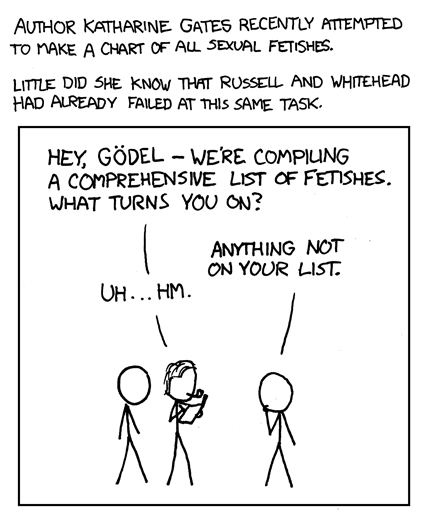
This weird, obscure moment, which could be slotted into Infinite Jest itself without a tremendous amount of revision, introduces the problem of cognitive reflexivity that structures a lot of both Ratner's Star and IJ. It centers around what is in essence, the Gödel paradox, the problematic fact that statements-about-statements are themselves statements, that there is no self-consistent exterior vantage point from which we can look objectively at our own subjective experiences of the world—that as soon as we attempt to think or speak about the way we think and speak we become hopelessly lost in paradox, in indecidability, and in confusing and shadowy incompleteness. And I hope it isn't too much of a stretch to assert that this is exactly the problem we face when we confront addict subjectivity:
That most Substance-addiction people are also addicted to thinking, meaning they have a compulsive and unhealthy relationship with their own thinking. That the cute Boston AA term for addictive-type thinking is Analysis-Paralysis.

...That 99% of compulsive thinkers' thinking is about themselves; that 99% of this self-directed thinking consists of imagining and then getting ready for things that are going to happen to them; and then, weirdly, that if they stop to think about it, that 100% of the things they spend 99% of their time and energy imagining and trying to prepare for all the contingencies and consequence of are never good. That this connects interestingly with the early-sobriety urge to pray for the literal loss of one's mind. In short that 99% of the head's thinking activity consists of trying to scare the everliving shit out of oneself... (203-204)
The strange compulsion towards endlessly looping cognitive reflexivity—thinking about thinking about thinking about thinking...—leads in the end to that terrible desire that is central to addiction, the desire for one's consciousness to be obliterated altogether:
...a little-mentioned paradox of Substance addiction is: that once you are sufficiently enslaved by a Sustance to need to quit the substance in order to save your life, the enslaving Substance has become so deeply important to you that you will all but lose your mind when it is taken away from you. Or that sometime after your Substance has just been taken away from you in order to save your life, as you hunker down for required A.M. and P.M. prayers, you will find yourself beginning to pray to be allowed literally to lose your mind, to be able to wrap your mind in an old newspaper or something and leave it in an alley to shift for itself, without you. (201)
This is, that is, the desire for suicide that haunts so much of Infinite Jest, that in the wake of 9/13/08 threatens to consume the book altogether. Reading The Bell Jar is like this; knowing that Sylvia Plath committed suicide a month after its publication destroys our ability to believe its assertions of an apparently happy ending for its Sylvia-stand-in, Esther. Knowing what happened to DFW—what he did to himself—deeply unsettles our ability to believe "[t]hat no single, individual moment is in and of itself unendurable" (204), which seems now, in retrospect, less like truth, and more like the prayer of a person who hopes they might someday believe it.