Today's coolest ten-year-old in the world.*
* award subject to revocation if it turns out his parents put him up to it
Showing posts with label hope. Show all posts
Showing posts with label hope. Show all posts
Monday, November 16, 2009

Tuesday, July 28, 2009
 On the question of irony—where I left off last time, and where Infinite Zombies' Daryl Houston starts off in his latest post—it's a little difficult for me to know exactly how to read this week's section on the Reaganesque presidency of Johnny Gentle, Famous Crooner. The signposts for reading this section as a satire are all there, not just in Gentle's OCD and Howard-Hughes-style obsession with cleanliness but also in the complete vacuity of C.U.S.P.'s political agenda—but it is difficult to tell whether the narrative's apparent contempt for environmentalist thinking is an aspect of the satire or the motivation for it. Gentle's political party, the Clean U.S. Party—an unlikely political coalition comprised of "ultra-right jingoist hunt-deer-with-automatic-weapons types and far-left macrobiotic Save-the-Ozone, -Rain-Forests, -Whales, -Spotted-Owel-and-High-pH-Waterways ponytailed granola-crunchers" whose first platform was organized around the ingenious plan "Let's Shoot Our Wastes Into Space"—is organized around an anti-ecological version of supposed environmentalism that understands "American renewal" as "an essentially aesthetic affair" (382). This is, then, a fairly pitch-perfect satire of ecology as ideology, the empty apolitics of the sort "we can all agree to" that looks for consumer-friendly solutions to the environmental catastrophe caused by consumerism itself. This is our moment: "a dark time when all landfills got full and all grapes were raisins and sometimes in some places the falling rain clunked instead of splattered" (382).
I can think here of nothing so much as a DFW quote on addiction Daryl highlighted in his own post:
An activity is addictive if one’s relationship to is lies on that downward-sloping continuum between liking it a little too much and really needing it. Many addictions, from exercise to letter-writing, are pretty benign. But something is malignantly addictive if (1) it causes real problesm for the addict, and (2) it offers itself as a relief from the very problem it causes.Consumerism, I think, clearly qualifies, as Wallace shows throughout this section.
 In IJ, it's our malignant addiction to a consumer lifestyle that leads to Gentle's experialist mandate, the outsourcing of environmental costs to Indian reservations and our partner "enemy-allies" (385) in O.N.A.N. It's this malignant addiction that leads us to build wasteful and inefficient fusion reactors even though they have the "generating-massive-amounts-of-high-R-waste part down a lot more pat than the "consuming-the-waste-in-a-nuclear-process-whose-own-waste-was-the-fuel-for-the-first-waste-intensive-phase-of-the-circle-of-reactions part" (1029n150).
 In the end it leads even to the forcible gifting of most of New England to Canada as the Great Concavity/Convexity, hollowed out and glass-walled with giant fans blowing our toxic air northward (385). There's a fair critique of NIMBYism here, as well as the perpetually empty promise of near-future technological millennialism that has been so deftly exploited by the partisan right-wing and their corporate allies to preempt all environmentalist reforms over the decades. There's a critique of the politics of Othering, too, the need for "some people beside each other of us to blame" (384) and the national ennui that apparently comes from a post-Soviet, post-Jihad era with no "Foreign Menace" to distract us from the problems of our own making (382). (What, we skipped China?) And there's, yes, a critique of the left-wing, more-eco-than-thou granola set in (among other things) Gentle's addictive obsessive-compulsive cleaniness and C.U.S.P.'s easy consumerist ethos, though frankly this critique seems much more of the strawman variety than most of Wallace's jokes.
 But is this scattershot, unstable irony all there is here? A pox on everybody's house? Is there any place for the reader of Infinite Jest to imagine a non-hypocritical, anti-consumerist politics? Do we really have no stable interpretive ground on which to stand? History seems in this novel to have somehow calcified into an inevitable trajectory of decadent disposability, and the only suggested response for the educated observer of these trends seems accordingly to be a bitter, smug withdrawal. I want to see DFW as getting past mere smugness into something more viable, but he doesn't make it easy. The only way out of this trap of hopeless cynicism that I can see so far lies in the unstable irony inherent in the novel's own presentation, its cartoonish and over-the-top hyperbole. Here, it's the fact that all this information is literally being conveyed to us through the well-respected and politically responsible medium of video puppet show, organized around Mario and his father's penchant for the "parodic device of mixing real and fake news-summary cartridges, magazine articles, and historical headers" (391). But I'm not sure irony alone is enough to get us out of smugness—I'm just not sure yet if the novel gives us much hope for escape from the surreal banality of turn-of-the-millennium American life, hope for something after or beyond consumer culture. We've already seen in IJ the transcendental existential threat of the Entertainment, which clogs entirely our ability to want anything besides it. Elsewhere, as with Gately, we see that addictions can in fact be broken, that renewal is difficult but still possible—but where is that hope here?
The use of the phrase "years right around the millennium" in the same footnote I cited above contains, I think, an important ambiguity for all this—from what point in the future, and from what cultural assumptions, are we to understand this book actually being composed? Is it a moment where this sort of perpetual-motion fusion suddenly somehow works—a time in which the miracle works? A moment in which the Entertainment, or something like it, has destroyed the culture entirely? Or, perhaps, a moment that is not "a terrible U.S. time for waste" for other, more politically hopeful reasons—a moment where, beyond belief, we have somehow managed to change?
Can addictions only be beaten when they originate in an individual's excess? When an addiction is communal—when it is ideological and so totally normalized—what is our prescription for hope?
Saturday, June 20, 2009
Hodgman at tonight's Radio & Television Correspondents Dinner: Part 1, Part 2. UPDATE: It's by no means a full Colbert, but there is a remarkable moment Colbert-like near the end:
You are clearly not exactly the person we hoped you would be. And perhaps it was wrong and impractical and unrealistic of us to lay such hopes upon you.Still not sure whether the "Colbert" was pulled on Obama or on his disenchanted supporters. I think both.
Saturday, February 14, 2009
All the material and intellectual forces which could be put to work for the realization of a free society are at hand. That they are not used for that purpose is to be attributed to the total mobilization of existing society against its own potential for liberation.Every so often, when I can, I like to share snippets of what I'm reading for my exams. Yesterday it was Herbert Marcuse's "The End of Utopia," in which he argues that a functionally limitless technological horizon which finally eliminates the realm of necessity demands in turn an aesthetic-erotic revolution in values. This one's short and good. Check it out.
Even on the left the notion of socialism has been taken too much within the framework of the development of productive forces, of increasing the productivity of labor, something which was not only justified but necessary at the level of productivity at which the idea of scientific socialism was developed but which today is at least subject to discussion. Today we must try to discuss and define--without any inhibitions, even when it may seem ridiculous--the qualitative difference between socialist society as a free society and the existing society. And it is precisely here that, if we are looking for a concept that can perhaps indicate the qualitative difference in socialist society, the aesthetic-erotic dimension comes to mind almost spontaneously, at least to me. Here the notion "aesthetic" is taken in its original sense, namely as the form of sensitivity of the senses and as the form of the concrete world of human life. Taken in this way, the notion projects the convergence of technology and art and the convergence of work and play. It is no accident that the work of Fourier is becoming topical again among the avant-garde left-wing intelligentsia. As Marx and Engels themselves acknowledged, Fourier was the only one to have made clear this qualitative difference between free and unfree society. And he did not shrink back in fear, as Marx still did, from speaking of a possible society in which work becomes play, a society in which even socially necessary labor can be organized in harmony with the liberated, genuine needs of men.
Monday, December 01, 2008
Kyle Smith in the New York Post has some fun with the new Springsteen single, "Working on a Dream," which he feels augurs a frightful new era of songs in which Bruce is happy with the world as it is.
There is a bracing consistency in Springsteenian gloom, from the Ford years ("The street's on fire, a real death waltz") to Carter's ("Lately there ain't been much work on account of the economy") to Reagan's ("This old world is rough, it's just getting rougher") to the first Bush's ("Ain't no mercy on the streets of this town, ain't no bread from heavenly skies") to Clinton's ("Oh brother are you gonna leave me wastin' away on the streets of Philadelphia?") to the second Bush's ("Woke up Election Day, skies gunpowder and shades of gray"). If the Boss has a motto, it has always been this: No hope, no change, no way.The song's now available on iTunes. Here's the live debut from an Obama event last month, which frankly I think sounds significantly better than the single. (I love him, but the Boss tends to overproduce the studio albums. It's true.)
What's his next song going to be called - "Goodlands"? Will universal pre-K childcare give us "Junglegymland?" I for one am not looking forward to "Tenth Avenue Love-In," "Happy Heart" or "57 Channels (and a Lot of It Is Really Interesting Interviews with Cabinet Members About How They're Going to Improve Everyone's Job, School, and Personal Dignity)." Instead of looking for inspiration to John Steinbeck to make "Ghost of Tom Joad" or to Pete Seeger for covers of one of the old let's-make-a-union-that'll-one-day-destroy-the-car-industry songs, could Bruce take a Lauperian turn and surmise that we're all just "Born to Have Fun"?
Tuesday, November 25, 2008
A judge on Tuesday ruled that a strict Florida law that blocks gay people from adopting children is unconstitutional, declaring there was no legal or scientific reason for sexual orientation alone to prohibit anyone from adopting. Yes, yes, yes. No moral reason, no practical reason, no good reason, no reason, period.
Monday, November 10, 2008
Image of the day: a small crowd gathers around the Lincoln Memorial last Tuesday night to listen to Obama's acceptance speech on transistor radio. Via Kottke. Here's the description of the scene from the photographer.
Sunday, November 09, 2008
I stole the blog icon for this week from this io9 post asking "Does Obama's Win Mean A Dark Knight Oscar?" I take it up because this dichotomy has been fascinating me for the last few weeks: what does it mean that the two most important pop-culture icons of 2008 have been Barack Obama on the one hand and Heath Ledger's Joker on the other? What does this remarkable level of cognitive dissonance say about us, and our moment? I don't know if I've got the time to write it—I'm supposed to be reading for my exams—but there's definitely a paper in there somewhere. As the tag says, it's been a funny year.
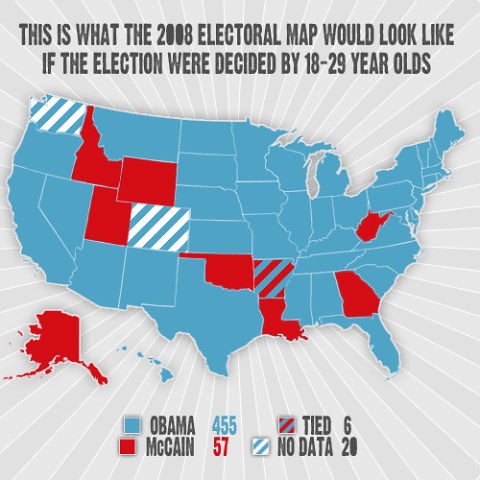 MyDD crunches some numbers on the youth vote.
CIRCLE now estimates that:It's my last year in this particular demographic, so I'm very glad to see what we pulled off. Republican strategists can't be happy with the way that map looks.* 23 million young voters cast a ballot on Tuesday, an increase of 3.4 million over 2004.The big story still remains Obama's staggering 66 - 32% margin among youth...
* Youth turnout will likely top off at 52 - 53%. That would rival the 1992 turnout, and fall just short of the all time record of 55.4% set in 1972.
* Young voters accounted for 60% of the overall turnout increase. That for the whole electorate.
* CIRCLE still estimates that young voters made up 18% of the total electorate.
Friday, November 07, 2008
Yes we can update for a Friday night.
* Obama wins Omaha.
* Franken fairly likely to win Minnesota.
An Associated Press analysis of the nearly 25,000-vote difference in presidential and Senate race tallies shows that most ballots lacking a recorded Minnesota Senate vote were cast in counties won by Democrat Barack Obama.Waive the recount, Norm! For the good of the nation.
...
"These numbers present a roadmap for a Franken challenge," he said. "It suggests there are about 10,000 votes in the largest Democratic counties that are potentially going to tilt in Franken's direction."
* Uncounted votes may push Begich past Stevens.
* "Revolution as Fulfillment," or "It was a creed written into the founding documents": how America perpetually repositions its revolutionary breaks as continuity with the past.
The black belt rhetorical jiu jitsu of the “I Have A Dream” speech is that King pulls it off. He convinced the better part of a nation that dismantling segregation was not so scary, not so radical, but really what they’d all meant to do all along. They just hadn’t gotten around to it, like the laundry I need to sort, or those slaves Jefferson never quite got to freeing. … And this is an old and hallowed American trick. On July 4th, 1852, Frederick Douglass blistered the ears of his white audience with prophesy … Douglass reveals that, “interpreted as it ought to be interpreted,” the Constitution is in fact “a GLORIOUS LIBERTY DOCUMENT.” He embraces and celebrates the Constitution as a bulwark against slavery. … At Seneca Falls in 1848, Elizabeth Cady Stanton cribbed Jefferson’s words for her Declaration of Rights and Sentiments, the intimation being that “of course” the patriarchs of 1776 must have intended equal rights for women. … And so on and so on down through history, with every kind of American reformer looking backward to move forward, couching their goals as nothing more radical than America’s alleged founding ideals.* From 52 to 48 with love: Ze Frank lets the healing begin.
Michael Lind's striking post at Salon argues that the historic election of Barack Obama this week represents the start of a fourth American Republic to match the First (1788-1860), the Second (1860-1932), and the Third (1932-2004ish), a 72-year structural pattern that will likely catapult Obama into the pantheon of truly great American presidents: Washington, Lincoln, and Roosevelt, each in their own way founders of the nation.
Policy shifts, more than public opinion polls or election results, suggest that a truly transformative moment may be upon us. The first three American republics display a remarkably similar pattern. Their 72-year life span is divided into two 36-year periods (again, give or take a year -- this is not astrology). During the first 36-year period of a republic, ambitious nation-builders in the tradition of Alexander Hamilton strengthen the powers of the federal government and promote economic modernization. During the second 36-year phase of a republic, there is a Jeffersonian backlash, in favor of small government, small business and an older way of life. During the backlash era, Jeffersonians manage to modify, but never undo, the structure created by the Hamiltonians in the previous era.In this calculus Obama is the new, progressive Hamiltonian, whose reinvigorating vision the nation will dominate American politics for decades. And Bush is likewise the last Republic's final Jeffersonian:
George W. Bush was not only the final president of the Jeffersonian backlash period of Roosevelt's Third Republic, but the last president of the 1932-2004 Third Republic itself. The final president of a republic tends to be a failed, despised figure. The First Republic, which began with George Washington, ended with James Buchanan, a hapless president who refused to act as the South seceded after Lincoln's election. The Second Republic, which began with Abraham Lincoln, ended with the well-meaning but reviled and ineffectual Herbert Hoover. The Third Republic, founded by Franklin Roosevelt, came to a miserable end under the pathetic George W. Bush.Provocative stuff. Now Obama just has to live up to it.
Wednesday, November 05, 2008
Voter turnout is the highest since the enfranchisement of women, with the youth vote at the highest level since 1972.
 The rout of the Republican Party, and the accompanying gains by Democrats in Congress, mean that Barack Obama will assume office with vastly more influence in the nation’s capital than most of his recent predecessors have wielded.
The only exceptions suggest the magnitude of the moment. Power flowed in unprecedented ways to George W. Bush in the year after the Sept. 11, 2001, attacks. It flowed likewise to Lyndon B. Johnson after his landslide in 1964.
Beyond those fleeting moments, every president for more than two generations has confronted divided government or hobbling internal divisions within his own party.
The Democrats’ moment with Obama, as a brilliant campaigner confronts the challenges of governance, could also prove fleeting. For now, the results — in their breadth across a continent — suggest seismic change that goes far beyond Obama's 4 percent margin in the popular vote.
The evening recalled what activist Eldridge Cleaver observed of the instant when Rosa Parks refused to move to the back of the bus and a movement followed: “Somewhere in the universe a gear in the machinery shifted.”
Page from a history textbook in the future.
Chapter 43: The Bad Years (2000-2008)
Chapter 44: Yes We Can (2009- )
Mr. President.
If there is anyone out there who still doubts that America is a place where all things are possible; who still wonders if the dream of our founders is alive in our time; who still questions the power of our democracy, tonight is your answer.
It’s the answer told by lines that stretched around schools and churches in numbers this nation has never seen; by people who waited three hours and four hours, many for the very first time in their lives, because they believed that this time must be different; that their voice could be that difference.
It’s the answer spoken by young and old, rich and poor, Democrat and Republican, black, white, Latino, Asian, Native American, gay, straight, disabled and not disabled – Americans who sent a message to the world that we have never been a collection of Red States and Blue States: we are, and always will be, the United States of America.
It’s the answer that led those who have been told for so long by so many to be cynical, and fearful, and doubtful of what we can achieve to put their hands on the arc of history and bend it once more toward the hope of a better day.
It’s been a long time coming, but tonight, because of what we did on this day, in this election, at this defining moment, change has come to America.
I just received a very gracious call from Senator McCain. He fought long and hard in this campaign, and he’s fought even longer and harder for the country he loves. He has endured sacrifices for America that most of us cannot begin to imagine, and we are better off for the service rendered by this brave and selfless leader. I congratulate him and Governor Palin for all they have achieved, and I look forward to working with them to renew this nation’s promise in the months ahead.
I want to thank my partner in this journey, a man who campaigned from his heart and spoke for the men and women he grew up with on the streets of Scranton and rode with on that train home to Delaware, the Vice President-elect of the United States, Joe Biden.
I would not be standing here tonight without the unyielding support of my best friend for the last sixteen years, the rock of our family and the love of my life, our nation’s next First Lady, Michelle Obama. Sasha and Malia, I love you both so much, and you have earned the new puppy that’s coming with us to the White House. And while she’s no longer with us, I know my grandmother is watching, along with the family that made me who I am. I miss them tonight, and know that my debt to them is beyond measure.
To my campaign manager David Plouffe, my chief strategist David Axelrod, and the best campaign team ever assembled in the history of politics – you made this happen, and I am forever grateful for what you’ve sacrificed to get it done.
But above all, I will never forget who this victory truly belongs to – it belongs to you.
I was never the likeliest candidate for this office. We didn’t start with much money or many endorsements. Our campaign was not hatched in the halls of Washington – it began in the backyards of Des Moines and the living rooms of Concord and the front porches of Charleston.
It was built by working men and women who dug into what little savings they had to give five dollars and ten dollars and twenty dollars to this cause. It grew strength from the young people who rejected the myth of their generation’s apathy; who left their homes and their families for jobs that offered little pay and less sleep; from the not-so-young people who braved the bitter cold and scorching heat to knock on the doors of perfect strangers; from the millions of Americans who volunteered, and organized, and proved that more than two centuries later, a government of the people, by the people and for the people has not perished from this Earth. This is your victory.
I know you didn’t do this just to win an election and I know you didn’t do it for me. You did it because you understand the enormity of the task that lies ahead. For even as we celebrate tonight, we know the challenges that tomorrow will bring are the greatest of our lifetime – two wars, a planet in peril, the worst financial crisis in a century. Even as we stand here tonight, we know there are brave Americans waking up in the deserts of Iraq and the mountains of Afghanistan to risk their lives for us. There are mothers and fathers who will lie awake after their children fall asleep and wonder how they’ll make the mortgage, or pay their doctor’s bills, or save enough for college. There is new energy to harness and new jobs to be created; new schools to build and threats to meet and alliances to repair.
The road ahead will be long. Our climb will be steep. We may not get there in one year or even one term, but America – I have never been more hopeful than I am tonight that we will get there. I promise you – we as a people will get there.
There will be setbacks and false starts. There are many who won’t agree with every decision or policy I make as President, and we know that government can’t solve every problem. But I will always be honest with you about the challenges we face. I will listen to you, especially when we disagree. And above all, I will ask you join in the work of remaking this nation the only way it’s been done in America for two-hundred and twenty-one years – block by block, brick by brick, calloused hand by calloused hand.
What began twenty-one months ago in the depths of winter must not end on this autumn night. This victory alone is not the change we seek – it is only the chance for us to make that change. And that cannot happen if we go back to the way things were. It cannot happen without you.
So let us summon a new spirit of patriotism; of service and responsibility where each of us resolves to pitch in and work harder and look after not only ourselves, but each other. Let us remember that if this financial crisis taught us anything, it’s that we cannot have a thriving Wall Street while Main Street suffers – in this country, we rise or fall as one nation; as one people.
Let us resist the temptation to fall back on the same partisanship and pettiness and immaturity that has poisoned our politics for so long. Let us remember that it was a man from this state who first carried the banner of the Republican Party to the White House – a party founded on the values of self-reliance, individual liberty, and national unity. Those are values we all share, and while the Democratic Party has won a great victory tonight, we do so with a measure of humility and determination to heal the divides that have held back our progress. As Lincoln said to a nation far more divided than ours, “We are not enemies, but friends…though passion may have strained it must not break our bonds of affection.” And to those Americans whose support I have yet to earn – I may not have won your vote, but I hear your voices, I need your help, and I will be your President too.
And to all those watching tonight from beyond our shores, from parliaments and palaces to those who are huddled around radios in the forgotten corners of our world – our stories are singular, but our destiny is shared, and a new dawn of American leadership is at hand. To those who would tear this world down – we will defeat you. To those who seek peace and security – we support you. And to all those who have wondered if America’s beacon still burns as bright – tonight we proved once more that the true strength of our nation comes not from our the might of our arms or the scale of our wealth, but from the enduring power of our ideals: democracy, liberty, opportunity, and unyielding hope.
For that is the true genius of America – that America can change. Our union can be perfected. And what we have already achieved gives us hope for what we can and must achieve tomorrow.
This election had many firsts and many stories that will be told for generations. But one that’s on my mind tonight is about a woman who cast her ballot in Atlanta. She’s a lot like the millions of others who stood in line to make their voice heard in this election except for one thing – Ann Nixon Cooper is 106 years old.
She was born just a generation past slavery; a time when there were no cars on the road or planes in the sky; when someone like her couldn’t vote for two reasons – because she was a woman and because of the color of her skin.
And tonight, I think about all that she’s seen throughout her century in America – the heartache and the hope; the struggle and the progress; the times we were told that we can’t, and the people who pressed on with that American creed: Yes we can.
At a time when women’s voices were silenced and their hopes dismissed, she lived to see them stand up and speak out and reach for the ballot. Yes we can.
When there was despair in the dust bowl and depression across the land, she saw a nation conquer fear itself with a New Deal, new jobs and a new sense of common purpose. Yes we can.
When the bombs fell on our harbor and tyranny threatened the world, she was there to witness a generation rise to greatness and a democracy was saved. Yes we can.
She was there for the buses in Montgomery, the hoses in Birmingham, a bridge in Selma, and a preacher from Atlanta who told a people that “We Shall Overcome.” Yes we can.
A man touched down on the moon, a wall came down in Berlin, a world was connected by our own science and imagination. And this year, in this election, she touched her finger to a screen, and cast her vote, because after 106 years in America, through the best of times and the darkest of hours, she knows how America can change. Yes we can.
America, we have come so far. We have seen so much. But there is so much more to do. So tonight, let us ask ourselves – if our children should live to see the next century; if my daughters should be so lucky to live as long as Ann Nixon Cooper, what change will they see? What progress will we have made?
This is our chance to answer that call. This is our moment. This is our time – to put our people back to work and open doors of opportunity for our kids; to restore prosperity and promote the cause of peace; to reclaim the American Dream and reaffirm that fundamental truth – that out of many, we are one; that while we breathe, we hope, and where we are met with cynicism, and doubt, and those who tell us that we can’t, we will respond with that timeless creed that sums up the spirit of a people:
Yes We Can. Thank you, God bless you, and may God Bless the United States of America.
Tuesday, November 04, 2008
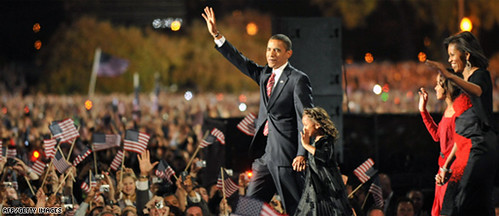
Looking through my personal Three Guys archives for what I was writing on Election Day in '04, I came across a post from the next afternoon I hardly remember writing at all:
Obama '08?I was wrong about anointing a front-runner—it's clear in retrospect that the long primary helped Democrats tremendously this year, perhaps even making the difference between victory and defeat on the one hand and victory and landslide on the other—but beyond that I think I called it fairly well. Of course, it doesn't match the eloquence of my first-ever post about Barack Obama, but what could?
Maybe I'll write Barack Obama a letter tonight. If he wants to form a North Carolina presidential exploratory committee tomorrow, I'll do whatever it needs.
I think we need to anoint someone as the front-runner for 2008 as soon as humanly possible, and, as my good friend Jenny T was saying earlier today, watch their back for the next four years. I'd very much like it to be Obama, rather than Hillary. And given how angry I am that the homophobia brigade swung last night's election, I'm not exactly sympathetic to the notion that "America just isn't ready for a black president yet" right now.
All I can say is, America better get ready. For a lot of things. We lost to a incumbent wartime president -- a man who had 90% approval ratings in September 2001 -- in a squeaker. And we did it with "the most liberal man in the Senate," a weak-kneed Francophile outofthemainstream "flip-flopper" from Taxachusetts.
Last night, 49% of the country firmly rejected the Bushist agenda. That 49% isn't wavering. We're steadfast. We're resolute. We're not letting these people drag our country back to the dark ages.
We have 49%. We only need 1 more.
Monday, October 27, 2008
A 109-year-old woman, the daughter of a man born into slavery, has cast her ballot for Barack Obama.
They're calling this photo "America, 2008." Not quite, but closer than I might have thought a year ago.
 Busy week ahead, so posting will be comparatively light except insofar as I allow the Internets to distract me from my work. We'll see how I do.
A few links:
* The U.S. has apparently launched not-at-all-October-Surprise forays into Syria and Pakistan.
* Barack draws a record 100,000+ crowd in Denver. (See photo.)
* NBC numbers man Chuck Todd is having an increasingly difficult time keeping "objectivity" in the face of Obama's overwhelming advantages; here he is on Meet the Press talking about the early voting explosion and the possibility of African-American voter participation in the neighborhood of 95-100%.
* More early voting buzz: the latest official numbers show Democrats taking a lead over Republicans in the votes already cast, 871,251 to 818,799. As early voting tends to favor Republicans due to the disproportionate absentee balloting of military voters and the elderly, this is good news.
* Jewish voters in Pennsylvania have been warned by the state GOP not to make the same mistake their German ancestors did in the 1930s and '40s. There is so much wrong with this, I don't even know where to begin.
* Who will replace Obama as the senator from Illinois? Jesse Jackson, Jr., wants the job, despite fears that he may be unelectable statewide.
* The Ann Arbor News endorses *nobody* for president. Well done, sirs.
* And the Internet has created its most bizarrely Dada meme yet: Robocop on a Unicorn.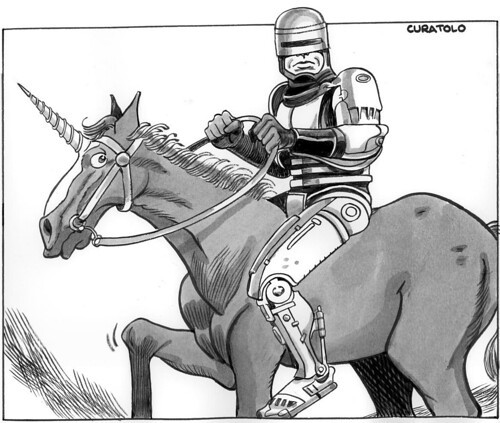


 Posts
Posts


