My blog has moved!

You should be automatically redirected to the new home page in 60 seconds. If not, please visit
http://gerrycanavan.com
and be sure to update your bookmarks. Sorry about the inconvenience.

Showing posts with label The Joker. Show all posts

Friday, August 14, 2009

Friday night! Let's linkdump.

* If you sent a letter to Whole Foods about the John Mackey Wall Street Journal editorial, you probably got a response tonight. I'd post what I received, but the small print at the bottom instructs me I cannot:

This email contains proprietary and confidential material for the sole use of the intended recipient. Any review, use, distribution or disclosure by others without the permission of the sender is strictly prohibited. If you are not the intended recipient (or authorized to receive for the recipient), please contact the sender by reply email and delete all copies of the message.
I certainly appreciate their crafting a non-apology apology for my sole use. I don't know how Daily Kos got a hold of it.

* NJ-GOV blogging: TPM, TPM, FiveThirtyEight.com.

* Also in Jersey news: Bob Dylan hassled by local NJ cop.

* NC-SEN blogging: Everyone hates Richard Burr.

* Airlock Alpha speaks the truth: it's obviously too early for another Battlestar Galactica reboot.

* 'Amusing Ourselves to Death': Huxley vs. Orwell.


* From Betsy to Rush to Sarah Palin to Chuck Grassley to your own old relatives forwarding you crazy shit.

* SF on HBO?

* Joe Siegel's heirs have won rights to a few more early Superman stories.

* Whitney Phillips at Confessions of an Aca/Fan tracks down the provenance of the recent Obama/Joker/SOCIALISM graffiti. Of course, it was 4chan.

* Obama sips it. Paris Hilton loves it. Mary J. Blige won't sing without it. How did a plastic water bottle, imported from a military dictatorship thousands of miles away, become the epitome of cool?

Thursday, June 11, 2009

Thursday night, how I love you.

* Jason Zengerle at the Plank undertakes a much more full-throated defense of Letterman than the one I offered last night, reminding us about Bristol Palin's recent publicity tour (which I guess I'd blocked out) and questioning the logic of the Palins making their own joke about their daughter being assaulted. For what it's worth, I still think the joke was borderline and shouldn't have been told, but it was plainly not about the fourteen-year-old.

* The headline reads: 'Tiny chance' of planet collision.

* Game theory and Batman villains. Isn't it well-established by now that the Joker would never kill Batman?

* New element added to the periodic table. Canavanium?

Saturday, February 14, 2009

V-Day links.

* I feel stimulated, and I bet you do too. Here's Arlen Specter with your partisan post-mortem.

"When I came back to the cloak room after coming to the agreement a week ago today," said Specter, "one of my colleagues said, 'Arlen, I'm proud of you.' My Republican colleague said, 'Arlen, I'm proud of you.' I said, 'Are you going to vote with me?' And he said, 'No, I might have a primary.' And I said, 'Well, you know very well I'm going to have a primary.'" [...]

"I think there are a lot of people in the Republican caucus who are glad to see this action taken without their fingerprints, without their participation," he said.
Your modern Republican party.

* The headline reads, "Large Banks Are on the Brink of Insolvency." You heard it from Brad Miller first.

* Heath Ledger fans want the Joker retired in honor of Ledger's turn in the makeup.
"When Michael Jordan retired, they withdrew the number 23 jersey as an honor. It’s the same thing with Heath.”
Yes, it's exactly the same.

* Space debris. Via Cynical-C.

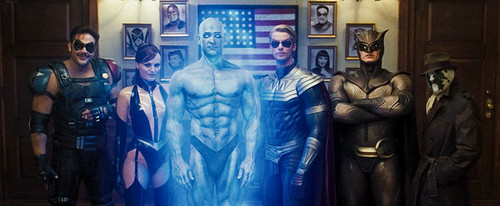
* Images from Watchmen. Clock's at 11:59...


* Paul Auster, science fiction writer.

* Joss Whedon, cultural humanist.

* And Henry David Thoreau, vegetarian.
Vegetarian ideas figured prominently in 19th-century intellectual circles. Though practicing vegetarians remained outside the mainstream, as they do today, vegetarianism itself was intriguing, its arguments compelling. Thoreau, for instance, was not a strict vegetarian, but he did believe that the vegetarian diet was “the destiny of the human race.” Not because animals were cute and fuzzy and therefore ought to be saved from brutality, but because they were dirty and difficult and expensive. “The practical objection to animal food in my case was its uncleanness,” he wrote in Walden, “and besides, when I had caught and cleaned and cooked and eaten my fish, they seemed not to have fed me essentially. It was insignificant and unnecessary, and cost more than it came to. A little bread or a few potatoes would have done as well, with less trouble and filth.” You can stand around in the forest, waiting to spear, skin, and roast a bunny for your next meal, but…why?

Friday, January 30, 2009

Successfully made it up to New Haven in time for my talk today. Aside from some technical snafus—my PowerPoint doesn't seem to want to play embedded movies at an audible volume—I think it went over reasonably well. The conference's title is "The Politics of Superheroes: Renegotiating the Super-Hero in Post 9/11 Cinema" and my talk was called "Person of the Year: Barack Obama, The Joker, Capitalism, and Schizophrenia." Essentially I try to make a few types of claims:

1) That although from a structural perspective he is obviously staged as the villain, in terms of The Dark Knight's narrative energy the Joker is unquestionably its central figure and creative engine, even (from a certain perspective) its hero;

2) that the film foregrounds the extent to which Batman (as a kind of stand-in for capitalism) and the Joker (creative destruction) need each other, that neither one can exist without the other;

3) that the Joker is therefore best understood not as a "terrorist" but as a kind of Deleuzean force of pure code-scrambling that (again despite the narrative framing) speaks to a revolutionary creative force ("schizophrenia") that is both capitalism's enemy and its limit;

4) that there exist certain theoretical similarities between the Joker and 2008's most important buzzword, CHANGE;

5) that taking all of the above to heart to the extent that Obama becomes a champion of continuity rather than change we supporters must be prepared to be the Joker to his Batman.
That's pretty reductive of a twenty-plus-minute presentation, but something close to the point.

I really enjoyed writing this one, but I'm really not sure where it goes from here. It doesn't seem exactly publishable; it's located very much in this particular moment right at the cusp of Obama's presidency—if it were to appear in an anthology or even a journal it would need to take a rather different and much more historical perspective on all this. I don't know. I'll think it over.

Sunday, January 25, 2009

On Guantánamo: Matt Yglesias has a great post summing up the various absurd turns the Guantánamo debate has taken since Obama has taken office. For me it begins and ends with the new 'supervillain' line, the notion that the people currently imprisoned at Guantánamo Bay are so cunning and all-powerful that we dare not trust them to any domestic prison for fear that they will somehow escape, Joker-like, and run amuck.


I think it's time to start bringing that "reality-based community" line back.

Friday, January 09, 2009

This year's Eustace Tilley contest has a comics flair.

Wednesday, January 07, 2009

Captain Marvel and the zeitgeist: You can have Heath Ledger's Joker or you can have Billy Batson in Shazam!, but you can't have both.

The irony here is that the comics version of Captain Marvel can actually get fairly dark: witness a lobotomized Captain Marvel as a stooge for Lex Luthor in Kingdom Come, the quasi-reformed Black Adam committing genocide in 52, or what they've done to poor Mary Marvel. And that's not even getting started on Miracleman.

Via io9.

Thursday, December 18, 2008

I've said for years there's only one man who can follow Heath Ledger's Joker, and that's Eddie Murphy as the Riddler. Shia Labeouf as Robin is a nice touch.

Sunday, November 09, 2008

I stole the blog icon for this week from this io9 post asking "Does Obama's Win Mean A Dark Knight Oscar?" I take it up because this dichotomy has been fascinating me for the last few weeks: what does it mean that the two most important pop-culture icons of 2008 have been Barack Obama on the one hand and Heath Ledger's Joker on the other? What does this remarkable level of cognitive dissonance say about us, and our moment? I don't know if I've got the time to write it—I'm supposed to be reading for my exams—but there's definitely a paper in there somewhere. As the tag says, it's been a funny year.

Thursday, August 21, 2008

Game theory in The Dark Knight. Fun article analyzing the Joker's opening heist in the context of the pirate game, an interesting situation with a nicely counter-intuitive result:

Three pirates (A, B, and C) arrive from a lucrative voyage with 100 pieces of gold. They will split up the money according to an ancient code dependent on their leadership rules. The pirates are organized with a strict leadership structure—pirate A is stronger than pirate B who is stronger than pirate C.

The voting process is a series of proposals with a lethal twist. Here are the rules:

1. The strongest pirate offers a split of the gold. An example would be: “0 to me, 10 to B, and 90 to C.”
2. All of the pirates, including the proposer, vote on whether to accept the split. The proposer holds the casting vote in the case of a tie.
3. If the pirates agree to the split, it happens.
4. Otherwise, the pirate who proposed the plan gets thrown overboard from the ship and perishes.
5. The next strongest pirate takes over and then offers a split of the money. The process is repeated until a proposal is accepted.

Pirates care first and foremost about living, then about getting gold. How does the game play out?
If everyone acts maximally rationally, A comes away with 99 of the 100 coins, which is pretty fantastically unexpected.

Wednesday, July 30, 2008

Voldemort, Jokerized: The first trailer for Harry Potter and the Half-Blood Prince is out, and clearly it's got The Dark Knight on the mind...

Friday, July 25, 2008

Everyone is getting all political over Dark Knight.

* Andrew Klavan in the Wall Street Journal finds the movie a grand apologia for Bush:

There seems to me no question that the Batman film "The Dark Knight," currently breaking every box office record in history, is at some level a paean of praise to the fortitude and moral courage that has been shown by George W. Bush in this time of terror and war. Like W, Batman is vilified and despised for confronting terrorists in the only terms they understand. Like W, Batman sometimes has to push the boundaries of civil rights to deal with an emergency, certain that he will re-establish those boundaries when the emergency is past.

And like W, Batman understands that there is no moral equivalence between a free society -- in which people sometimes make the wrong choices -- and a criminal sect bent on destruction. The former must be cherished even in its moments of folly; the latter must be hounded to the gates of Hell.
* But Ezra Klein and Matt Yglesias want to trouble this understanding, where Matt makes what I thought was an interesting point about the leap from comic to film:
Shifting a bit away from the issues of the day, though, one interesting thing about the film is what a difference it makes to rip Batman out of the context of the broader DC universe. The DCU's other anchor character, Superman, is far more powerful than Batman. And of course Superman's hardly alone in this regard -- Green Lantern, Wonder Woman, etc. all wield vast power and even lesser lights like the Flash outpace Batman by far.

In that context, Batman rather uniquely doesn't suffer from a substantial legitimacy problem. You don't look at Batman and say "no man should wield this much power" in a world where Superman can see through walls. It's those other guys who have legitimacy problems and Batman is one of the important checks on them -- especially on Superman, who specifically entrusts a kryptonite ring to Batman for that purpose.
* But it's Kugelmass who has probably the best review I've seen thus far.
The reverse is also true, though—The Joker can’t kill Batman, because, he says, “you’re just too much fun.” That’s what we have to understand first before we can pick up on Ledger’s mannerisms and bizarre intonations. The Joker feels about Batman the way Shakespeare might feel if performances of Hamlet were being blocked in court by Thomas Kyd. In the previous film, Batman has taken the crucial plunge by deciding that his own personal neuroses have a global significance and relate in some meaningful way to the ebb and flow of order (law) and chaos (crime) in Gotham City. As a result, the whole city of Gotham has to play along with Batman, pretending as though shining the Bat Signal into the clouds and having one man karate chop his way around the city is the best way to fight crime. Being Batman is an incredibly excessive, libidinal kinkiness, but it is also a sort of splendor, without which the impetus to fight crime is lacking. It may seem ridiculous to assert that we have to let people dress up as sleeker versions of furries in order to persuade them to wield the baton, but in truth The Dark Knight is just illuminating the fantasies that play themselves out more tamely in normal professional lives. The Joker understands this so well that he’s out to climb the ladder and throw it away, by which I mean that he wants to turn the battle between criminals and vigilantes into a non-stop morality spectacular in which every normal ferry trip becomes a live, game show version of the prisoner’s dilemma. His polymorphous perversity is an end run around Batman’s incompletely sublimated fantasies. It’s not necessarily disappointing to him that the people on the ferries don’t detonate each other—I mean, isn’t that wonderful? They got to prove they were good people—Eichmann on the one boat, Bigger Thomas on the other. The Joker claps when Gary Oldman is made commissioner, perfectly well aware that this scene of goodness rewarded is only possible because he (the Joker) killed Commissioner #1. Ladies and gentleman, we are tonight’s entertainment.

That’s why it’s ridiculous to criticize The Dark Knight on the grounds that it is a children’s film or infantile; it is about infantility, and raises questions about how much we can really escape from apparently embarrassing wishes. Part of the problem with a fiction like Enchanted or Harry Potter is that it allows adults to feel themselves at a safe distance from kids’ stuff through (respectively) ironic misdirection and misty, head-patting sentimentality.
* And for the fanboys in the audience, via Jacob, 8 great villains we want in the next Batman movie.

Saturday, July 19, 2008

Jacob's pushing of an old Neil Gaiman Riddler story in the comments of my Dark Knight post has me wondering if perhaps I've sold E. Nigma a little short. Here's the Mindless Ones blog defending the Platonic concept of the Riddler against those who would write him badly in "Rogue's Review" #5:

Remove the focus on the Riddler as a man, absorb him into the text and you get something else entirely: a quintessential (perhaps the quintessential) Bat-threat: the mystery waiting to be solved. Think about it, there should be no greater challenge to the World’s Greatest Detective’s deductive abilities than the Riddler, no tougher puzzles to crack. As Bane is to physicality the Riddler should be to mystery. What I’m proposing here isn’t particularly radical. As I’ve noted above, the Riddler’s presence has a long and venerable history of being articulated without his body. The notion that the Riddler should infect all the panels of a given comic is simply the recognition that his puzzles are as much part of him as his arms and legs, and that puzzles are non-local in that they permeate the stories that house them. In detective fiction the real antagonist is always the mystery at hand - I’m proposing a deliberate and carefully articulated blurring of the lines of distinction between the character and games he sets in motion. A Riddler that literally embodies mystery.
I remain unpersuaded that even this ideal Riddler wouldn't still be just a second-rate substitute for one aspect of the Joker.

Regardless—and I don't know whether it'll be Mindless-Ones-approved Good Riddler or Gerry-denigrated Bad Riddler—if the hints Gary Oldman is dropping are right we're getting the Riddler in the third movie whether we like it or not.

Friday, July 18, 2008

Comic Book Resources has your brief history of the Joker. Part II is here.

If The Dark Knight is the greatest superhero movie of all time—and I think it probably is—it is entirely on the back of Heath Ledger's immaculate turn as the Joker. Ledger is utterly, utterly, utterly perfect in this role—so perfect in fact that it is impossible to imagine either anyone else ever playing the Joker or any other villain stepping in to carry a sequel.

(Who's even still on the bench at this point? The Penguin? Riddler? King Tut? Catwoman can't carry a movie all by herself. The best bet, it seems to me, would be to go forward with the long-teased Batman vs. Superman project; it'd be something of a genre mismatch for the Christian Bale franchise, but at least it'd spare us all another round of movie nonsense with the highly overrated Riddler.)

There's no question about it: Ledger's performance is simply stunning. His sociopathic Joker is so good that it's hard to say that the movie is actually enjoyable to watch—I feel exhausted after seeing it, disturbed and just a little bit broken. In this sense The Dark Knight isn't really a superhero movie at all, but a horror movie, a slasher flick, and really—with Ledger so famously dead by suicide* just after shooting—a snuff film. As David Denby put the point in the New Yorker:

When Ledger wields a knife, he is thoroughly terrifying (do not, despite the PG-13 rating, bring the children), and, as you’re watching him, you can’t help wondering—in a response that admittedly lies outside film criticism—how badly he messed himself up in order to play the role this way. His performance is a heroic, unsettling final act: this young actor looked into the abyss.
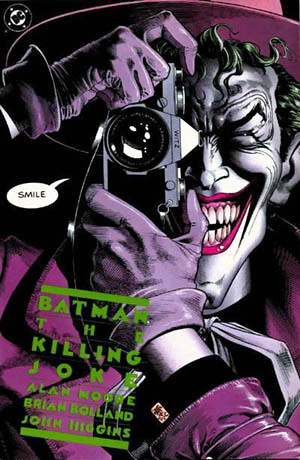
This is in all respects an astoundingly dark movie that's hardly suitable for adults, much less children. And if The Dark Knight doesn't quite possess the necessary sense of self-awareness to be the Watchmen of superhero film, it may well be its Dark Knight Returns (wiki)—or, perhaps more directly, the story from which it draws its most direct inspiration, Alan Moore's definitive Joker story, The Killing Joke (wiki).

What Moore gets, of course, is what the film is only able to hint at: the extent to which Batman and the Joker (to mix my supervillain metaphors) are two sides of the same coin. It is not just that they are both insane, but that they are both equally insane and insane in exactly the same way—just in opposite directions.

--
* Abe rightly points out in the comments that Ledger's death by overdose probably wasn't a suicide. Obviously I'm not watching enough entertainment television.

Tuesday, July 08, 2008

The first six minutes of The Dark Knight are now online.

Tuesday, January 22, 2008

Heath Ledger, dead at 28. It's completely too soon to ask how this affects the Batman sequel, but that hasn't stopped people from going there almost immediately...

Monday, December 17, 2007

IGN considers the visual evolution of the Joker. Via MeFi.