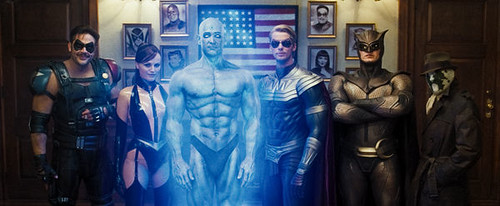
Not even God-Man can escape the trend of "dark" superheroes.
Showing posts with label The Dark Knight. Show all posts
Showing posts with label The Dark Knight. Show all posts
Wednesday, April 29, 2009

Saturday, February 14, 2009
V-Day links.
* I feel stimulated, and I bet you do too. Here's Arlen Specter with your partisan post-mortem.
"When I came back to the cloak room after coming to the agreement a week ago today," said Specter, "one of my colleagues said, 'Arlen, I'm proud of you.' My Republican colleague said, 'Arlen, I'm proud of you.' I said, 'Are you going to vote with me?' And he said, 'No, I might have a primary.' And I said, 'Well, you know very well I'm going to have a primary.'" [...]Your modern Republican party.
"I think there are a lot of people in the Republican caucus who are glad to see this action taken without their fingerprints, without their participation," he said.
* The headline reads, "Large Banks Are on the Brink of Insolvency." You heard it from Brad Miller first.
* Heath Ledger fans want the Joker retired in honor of Ledger's turn in the makeup.
"When Michael Jordan retired, they withdrew the number 23 jersey as an honor. It’s the same thing with Heath.”Yes, it's exactly the same.
* Space debris. Via Cynical-C.
* Images from Watchmen. Clock's at 11:59...
* Paul Auster, science fiction writer.
* Joss Whedon, cultural humanist.
* And Henry David Thoreau, vegetarian.
Vegetarian ideas figured prominently in 19th-century intellectual circles. Though practicing vegetarians remained outside the mainstream, as they do today, vegetarianism itself was intriguing, its arguments compelling. Thoreau, for instance, was not a strict vegetarian, but he did believe that the vegetarian diet was “the destiny of the human race.” Not because animals were cute and fuzzy and therefore ought to be saved from brutality, but because they were dirty and difficult and expensive. “The practical objection to animal food in my case was its uncleanness,” he wrote in Walden, “and besides, when I had caught and cleaned and cooked and eaten my fish, they seemed not to have fed me essentially. It was insignificant and unnecessary, and cost more than it came to. A little bread or a few potatoes would have done as well, with less trouble and filth.” You can stand around in the forest, waiting to spear, skin, and roast a bunny for your next meal, but…why?
Thursday, February 12, 2009
I had a nasty case of food poisoning or something last night—fever, chills, the whole bit. But now I'm back and quite literally better than ever. A few links to celebrate my recovery:
* Early reviews of Dollhouse remain mixed. We'll know tomorrow....
* This YouTube clip (via MeFi) captures just the barest sliver of the greatness of the Conan DVD commentary. It is our civilization's highest cultural achievement.
* The trailer for the new Tarantino is out.
* How to teach non-canonical material responsibly in a composition class: lesson plans from Scott Eric Kaufman on Dark Knight and Watchmen.
* Two satellites have collided in orbit. Apparently that's never happened before. More from MeFi.
* Happy birthday, Charles Darwin. More from Satisfactory Comics.
Friday, January 30, 2009
Successfully made it up to New Haven in time for my talk today. Aside from some technical snafus—my PowerPoint doesn't seem to want to play embedded movies at an audible volume—I think it went over reasonably well. The conference's title is "The Politics of Superheroes: Renegotiating the Super-Hero in Post 9/11 Cinema" and my talk was called "Person of the Year: Barack Obama, The Joker, Capitalism, and Schizophrenia." Essentially I try to make a few types of claims:
1) That although from a structural perspective he is obviously staged as the villain, in terms of The Dark Knight's narrative energy the Joker is unquestionably its central figure and creative engine, even (from a certain perspective) its hero;That's pretty reductive of a twenty-plus-minute presentation, but something close to the point.
2) that the film foregrounds the extent to which Batman (as a kind of stand-in for capitalism) and the Joker (creative destruction) need each other, that neither one can exist without the other;
3) that the Joker is therefore best understood not as a "terrorist" but as a kind of Deleuzean force of pure code-scrambling that (again despite the narrative framing) speaks to a revolutionary creative force ("schizophrenia") that is both capitalism's enemy and its limit;
4) that there exist certain theoretical similarities between the Joker and 2008's most important buzzword, CHANGE;
5) that taking all of the above to heart to the extent that Obama becomes a champion of continuity rather than change we supporters must be prepared to be the Joker to his Batman.
I really enjoyed writing this one, but I'm really not sure where it goes from here. It doesn't seem exactly publishable; it's located very much in this particular moment right at the cusp of Obama's presidency—if it were to appear in an anthology or even a journal it would need to take a rather different and much more historical perspective on all this. I don't know. I'll think it over.
Thursday, January 08, 2009
Son of news roundup.
* Burger King is pushing the viral marketing hard lately, following up its gag body spray with a Facebook application that gives you a free hamburger for every 10 people you unfriend.
* Speaking of body spray, here's an interesting study suggesting it's not about the smell.
And a new study in the U.K...found that men who used Lynx deodorant, Axe's British-brand cousin, were seen as more attractive by females than men who used a "placebo" deodorant with no fragrance.
But: the women just saw videos of the guys in the study—they couldn't smell them. Meaning that Axe actually works by making you feel more attractive. If you feel more attractive after soaking yourself in an aerosol version of car air freshener, you may not be the most urbane man to begin with, which leads to the second part of the study's results:
Women rated the fragranced men as more attractive when the sound on the videos was off, but had no statistically significant preference when the sound was on.
 * Obama to team up with Spider-Man. Which wanted criminal will he pall around with next?
* Zipcar comes to Duke. More here.
* Larry Flynt says porn needs a bailout. Via MeFi.
* Creative billboards.
* Malcolm X on a Canadian game show.
* The cell-phone novel, or keitai shosetsu, is the first literary genre to emerge from the cellular age. For a new form, it is remarkably robust. Maho i-Land, which is the largest cell-phone-novel site, carries more than a million titles, most of them by amateurs writing under screen handles, and all available for free. According to the figures provided by the company, the site, which also offers templates for blogs and home pages, is visited three and a half billion times a month.
* It took me almost another decade after graduate school to figure out what writing really is, or at least what it could be for me; and what prompted this second lesson in language was my discovery of certain remaindered books—mostly of fiction, most notably by Barry Hannah, and all of them, I later learned, edited by Gordon Lish—in which virtually every sentence had the force and feel of a climax, in which almost every sentence was a vivid extremity of language, an abruption, a definitive inquietude. These were books written by writers who recognized the sentence as the one true theater of endeavor, as the place where writing comes to a point and attains its ultimacy. As a reader, I finally knew what I wanted to read, and as someone now yearning to become a writer, I knew exactly what I wanted to try to write: narratives of steep verbal topography, narratives in which the sentence is a complete, portable solitude, a minute immediacy of consummated language—the sort of sentence that, even when liberated from its receiving context, impresses itself upon the eye and the ear as a totality, an omnitude, unto itself. Gary Lutz on the sentence, via the too-sporadically-updated Black Garterbelt.
* And will The Dark Knight win Best Picture? Eli Glasner says it just might.
Wednesday, January 07, 2009
 Captain Marvel and the zeitgeist: You can have Heath Ledger's Joker or you can have Billy Batson in Shazam!, but you can't have both.
The irony here is that the comics version of Captain Marvel can actually get fairly dark: witness a lobotomized Captain Marvel as a stooge for Lex Luthor in Kingdom Come, the quasi-reformed Black Adam committing genocide in 52, or what they've done to poor Mary Marvel. And that's not even getting started on Miracleman.
Via io9.
Thursday, December 18, 2008
I've said for years there's only one man who can follow Heath Ledger's Joker, and that's Eddie Murphy as the Riddler. Shia Labeouf as Robin is a nice touch.
Wednesday, December 10, 2008
Busy, busy, busy, as the Bokononists say.
* Sci-Fi has put out a "Catch the Frak Up" video for the last four seasons of Battlestar Galactica.
* All about Patrick Fitzgerald, the man everybody wants to put in charge of everything.
* Daily Routines: how writers, artists, and other interesting people organize their days. Via MeFi, which has some greatest hits.
* In 1945, after the atomic destruction of two Japanese cities, J. Robert Oppenheimer expressed foreboding about the spread of nuclear arms. “They are not too hard to make,” he told his colleagues on the Manhattan Project at Los Alamos, N.M. “They will be universal if people wish to make them universal.” How the bomb spread (and didn't) around the world.
* The Los Angeles Film Critics Association has named WALL-E the best film of the year. It's a bit of a strange choice against Dark Knight and Synecdoche, among others, but WALL-E was a hell of a good film, potentially a very important one, and damnit if I don't love Pixar.
* No book more deeply and revealingly explains the spasm of madness through which the United States has passed in recent years than Moby Dick. For generations, it has been considered a masterpiece of world literature, but now can it be seen as an eerily prophetic allegory about 21st-century America. It is now truly the nation's epic. * The Barack Obama of 2018 has been playing video games all his life.
* Everybody loves Silent Star Wars.
* Pharyngula has been having an awful lot of fun with found images lately.
* Has Greenpeace been rating Apple unfairly?
* Will we nationalize the auto companies?
* And the good news: Gabriel García Márquez is still writing after all.
Thursday, August 21, 2008
 Game theory in The Dark Knight. Fun article analyzing the Joker's opening heist in the context of the pirate game, an interesting situation with a nicely counter-intuitive result:
Three pirates (A, B, and C) arrive from a lucrative voyage with 100 pieces of gold. They will split up the money according to an ancient code dependent on their leadership rules. The pirates are organized with a strict leadership structure—pirate A is stronger than pirate B who is stronger than pirate C.If everyone acts maximally rationally, A comes away with 99 of the 100 coins, which is pretty fantastically unexpected.
The voting process is a series of proposals with a lethal twist. Here are the rules:
1. The strongest pirate offers a split of the gold. An example would be: “0 to me, 10 to B, and 90 to C.”
2. All of the pirates, including the proposer, vote on whether to accept the split. The proposer holds the casting vote in the case of a tie.
3. If the pirates agree to the split, it happens.
4. Otherwise, the pirate who proposed the plan gets thrown overboard from the ship and perishes.
5. The next strongest pirate takes over and then offers a split of the money. The process is repeated until a proposal is accepted.
Pirates care first and foremost about living, then about getting gold. How does the game play out?
Sunday, August 10, 2008
Three for Sunday.
* Superbugs: all about the new generation of treatment-resistant infections.
“My basic premise,” Wetherbee said, “is that you take a capable microörganism like Klebsiella and you put it through the gruelling test of being exposed to a broad spectrum of antibiotics and it will eventually defeat your efforts, as this one did.” Although Tisch Hospital has not had another outbreak, the bacteria appeared soon after at several hospitals in Brooklyn and one in Queens. When I spoke to infectious-disease experts this spring, I was told that the resistant Klebsiella had also appeared at Mt. Sinai Medical Center, in Manhattan, and in hospitals in New Jersey, Pennsylvania, Cleveland, and St. Louis.*Will the next Christopher Nolan movie be a straight-up adaptation of Frank Miller's The Dark Knight Returns?
By leaving the Joker (literally) hanging at the end of The Dark Knight, Nolan left open-ended a story that begs to be finished. Even Tim Burton knew he had to kill Jack Nicholson at the "end". Nolan himself killed Ra's at the end of Batman Begins and he even tied-up a loose end regarding the Scarecrow in The Dark Knight. These are both clear signals Nolan knows the story has to have an end and has some idea for that end already in mind.More discussion of the idea, which I can personally guarantee will never, ever happen, at io9.
Nolan further foreshadows the future in The Dark Knight's climatic moments as well. Remember when the Joker tells Batman the two of them can "do this for years"? Filmmakers of Nolan's talent don't throw away lines like that, especially in a moment like that. That was the director signaling to the audience that he understands one of "The Dark Knight Returns'" main themes - that the Joker's very existence is primarily to be Batman's nemesis and their fates were inevitably intertwined, as well as a signal that their final showdown will in fact come years down the road.
Which brings us back to the three-act structure: Act One (Batman Begins) was the first Batman story. Act Two (The Dark Knight) was a classic tragic turning point.
So what does this demand Act Three be?
Well, not only the final battle of Batman and the Joker, but also the last Batman story, of course.
* A not-quite-complete list of Kramer's business ideas. Not quite complete, because Wikipedia has even more.
Thursday, August 07, 2008
Never say Hollywood can't learn from its mistakes. The producers have figured out how to please everyone: maintain earnestness regardless of the inherent absurdity of the genre, be 'topical' by way of empty allegory, be spectacularly violent, never stop moralizing. Meet these requirements, and a great deal of variety is possible: one has free reign to be jokey or serious, bright or gloomy, undisguisedly sexist, racist, homophobic, or none of the above, 'critical,' or 'wish fulfillment.' Or all of the above. These labels are simply not the creator's responsibility. Restore the superhero's propaganda function, in short, and in so doing prove Sontag's thesis that "pure camp" is always so for the future and not the present.** The comic book-loving nerds of my generation are now faced with the dubious realization of our pubescent dreams: the nerds have taken over Hollywood, and the responsibility thus falls to the Figure of the Superhero to 'teach us' something about the "human condition."Good news for culturemonkeys: Ryan has a great post on superhero cinema over there. (And here too.) It's more or less the definitive post on Dark Knight. But a few quick thoughts. First, I think Acephalous's attempt to rehabilitate the film from attempts to understand it solely as a "balls-out obvious apolog[y] for the authoritarian, repressive 'excesses' of global capitalism" is instructive, and definitely worth reading.
Second, Ryan writes that we are currently experiencing the"repetition-as-farce of the '50s"—but this doesn't strike me as a new phenomenon. Isn't it more the case that post-war American culture is perpetually returning to the '50s as a site of degrading, doomed unity?
This is to say that Jameson's claim that WWII is the moment of highest American nostalgia par excellence is, I think, fundamentally correct, with the revision that it's more the period from Dec. 1941 to August 29, 1949, the day the Russians exploded their first atomic bomb. The '50s are the memory of "the good '40s" combined with and juxtaposed against the reality of 8/29/49—they are the dawning but perpetually unfinished recognition of how it all will go / is going / has already gone wrong. In other words, the '50s themselves were a repetition-as-farce the first time around of the ideologically unacceptable, apocalyptic shock at the end of the previous decade—and we find ourselves going back to the '50s for answers whenever we get shocked again.
That's why, when 1973 is the year of disaster for American capitalism, Happy Days premieres in January 1974.
Monday, August 04, 2008
Completely unserious links.
* Ask yourself: What would Don Draper do? What would Joan Holloway do?
* Take the Zombie Survival Quiz. I got a Z+.
* Behold the Hand Drawn Map Association.
* Three's a trend: Is The Dark Knight cursed?
* Two good posts from Cosmic Variance: Obama backing off of plans to cut NASA’s budget and what will the Large Hadron Collider find?
* And is Michael Cera the greatest comic mind of this generation, "the Bob Newhart of the 21st century"? You know where I stand on this.
Wednesday, July 30, 2008
Voldemort, Jokerized: The first trailer for Harry Potter and the Half-Blood Prince is out, and clearly it's got The Dark Knight on the mind...
Friday, July 25, 2008
Everyone is getting all political over Dark Knight.
* Andrew Klavan in the Wall Street Journal finds the movie a grand apologia for Bush:
There seems to me no question that the Batman film "The Dark Knight," currently breaking every box office record in history, is at some level a paean of praise to the fortitude and moral courage that has been shown by George W. Bush in this time of terror and war. Like W, Batman is vilified and despised for confronting terrorists in the only terms they understand. Like W, Batman sometimes has to push the boundaries of civil rights to deal with an emergency, certain that he will re-establish those boundaries when the emergency is past.* But Ezra Klein and Matt Yglesias want to trouble this understanding, where Matt makes what I thought was an interesting point about the leap from comic to film:
And like W, Batman understands that there is no moral equivalence between a free society -- in which people sometimes make the wrong choices -- and a criminal sect bent on destruction. The former must be cherished even in its moments of folly; the latter must be hounded to the gates of Hell.
Shifting a bit away from the issues of the day, though, one interesting thing about the film is what a difference it makes to rip Batman out of the context of the broader DC universe. The DCU's other anchor character, Superman, is far more powerful than Batman. And of course Superman's hardly alone in this regard -- Green Lantern, Wonder Woman, etc. all wield vast power and even lesser lights like the Flash outpace Batman by far.* But it's Kugelmass who has probably the best review I've seen thus far.
In that context, Batman rather uniquely doesn't suffer from a substantial legitimacy problem. You don't look at Batman and say "no man should wield this much power" in a world where Superman can see through walls. It's those other guys who have legitimacy problems and Batman is one of the important checks on them -- especially on Superman, who specifically entrusts a kryptonite ring to Batman for that purpose.
The reverse is also true, though—The Joker can’t kill Batman, because, he says, “you’re just too much fun.” That’s what we have to understand first before we can pick up on Ledger’s mannerisms and bizarre intonations. The Joker feels about Batman the way Shakespeare might feel if performances of Hamlet were being blocked in court by Thomas Kyd. In the previous film, Batman has taken the crucial plunge by deciding that his own personal neuroses have a global significance and relate in some meaningful way to the ebb and flow of order (law) and chaos (crime) in Gotham City. As a result, the whole city of Gotham has to play along with Batman, pretending as though shining the Bat Signal into the clouds and having one man karate chop his way around the city is the best way to fight crime. Being Batman is an incredibly excessive, libidinal kinkiness, but it is also a sort of splendor, without which the impetus to fight crime is lacking. It may seem ridiculous to assert that we have to let people dress up as sleeker versions of furries in order to persuade them to wield the baton, but in truth The Dark Knight is just illuminating the fantasies that play themselves out more tamely in normal professional lives. The Joker understands this so well that he’s out to climb the ladder and throw it away, by which I mean that he wants to turn the battle between criminals and vigilantes into a non-stop morality spectacular in which every normal ferry trip becomes a live, game show version of the prisoner’s dilemma. His polymorphous perversity is an end run around Batman’s incompletely sublimated fantasies. It’s not necessarily disappointing to him that the people on the ferries don’t detonate each other—I mean, isn’t that wonderful? They got to prove they were good people—Eichmann on the one boat, Bigger Thomas on the other. The Joker claps when Gary Oldman is made commissioner, perfectly well aware that this scene of goodness rewarded is only possible because he (the Joker) killed Commissioner #1. Ladies and gentleman, we are tonight’s entertainment.* And for the fanboys in the audience, via Jacob, 8 great villains we want in the next Batman movie.
That’s why it’s ridiculous to criticize The Dark Knight on the grounds that it is a children’s film or infantile; it is about infantility, and raises questions about how much we can really escape from apparently embarrassing wishes. Part of the problem with a fiction like Enchanted or Harry Potter is that it allows adults to feel themselves at a safe distance from kids’ stuff through (respectively) ironic misdirection and misty, head-patting sentimentality.
Friday, July 18, 2008
 If The Dark Knight is the greatest superhero movie of all time—and I think it probably is—it is entirely on the back of Heath Ledger's immaculate turn as the Joker. Ledger is utterly, utterly, utterly perfect in this role—so perfect in fact that it is impossible to imagine either anyone else ever playing the Joker or any other villain stepping in to carry a sequel.
(Who's even still on the bench at this point? The Penguin? Riddler? King Tut? Catwoman can't carry a movie all by herself. The best bet, it seems to me, would be to go forward with the long-teased Batman vs. Superman project; it'd be something of a genre mismatch for the Christian Bale franchise, but at least it'd spare us all another round of movie nonsense with the highly overrated Riddler.)
There's no question about it: Ledger's performance is simply stunning. His sociopathic Joker is so good that it's hard to say that the movie is actually enjoyable to watch—I feel exhausted after seeing it, disturbed and just a little bit broken. In this sense The Dark Knight isn't really a superhero movie at all, but a horror movie, a slasher flick, and really—with Ledger so famously dead by suicide* just after shooting—a snuff film. As David Denby put the point in the New Yorker:
When Ledger wields a knife, he is thoroughly terrifying (do not, despite the PG-13 rating, bring the children), and, as you’re watching him, you can’t help wondering—in a response that admittedly lies outside film criticism—how badly he messed himself up in order to play the role this way. His performance is a heroic, unsettling final act: this young actor looked into the abyss.
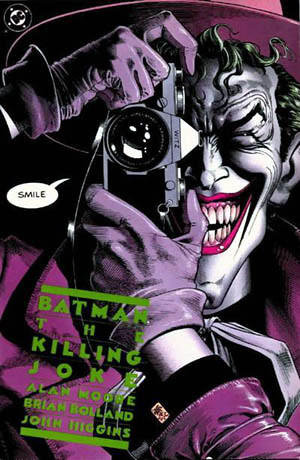 This is in all respects an astoundingly dark movie that's hardly suitable for adults, much less children. And if The Dark Knight doesn't quite possess the necessary sense of self-awareness to be the Watchmen of superhero film, it may well be its Dark Knight Returns (wiki)—or, perhaps more directly, the story from which it draws its most direct inspiration, Alan Moore's definitive Joker story, The Killing Joke (wiki).
What Moore gets, of course, is what the film is only able to hint at: the extent to which Batman and the Joker (to mix my supervillain metaphors) are two sides of the same coin. It is not just that they are both insane, but that they are both equally insane and insane in exactly the same way—just in opposite directions.
--
* Abe rightly points out in the comments that Ledger's death by overdose probably wasn't a suicide. Obviously I'm not watching enough entertainment television.


 Posts
Posts


