My blog has moved!

You should be automatically redirected to the new home page in 60 seconds. If not, please visit
http://gerrycanavan.com
and be sure to update your bookmarks. Sorry about the inconvenience.

Showing posts with label vegetarianism. Show all posts

Wednesday, November 04, 2009

Linkdump #2.

* Why you're still fat: “The message of our work is really simple,” although not agreeable to hear, Melanson said. “It all comes down to energy balance,” or, as you might have guessed, calories in and calories out. People “are only burning 200 or 300 calories” in a typical 30-minute exercise session, Melanson points out. “You replace that with one bottle of Gatorade.” The only real success I've had with weight loss has come through obsessive calorie counting through fitday.com. Nothing else makes a dent.

* Oh, Cleveland. (N.B.)

* More good news from the Obama administration: details of the secret ACTA copyright treaty. Terrible.

* Soviet advertising. More. Still more. Via.

* The New Yorker pushes the vegetarian agenda in a review of Jonathan Safran Foer's Eating Animals.

Foer seems particularly incensed by the suggestion that deciding not to eat meat represents a delusion of innocence or, worse still, sentimentality. “Two friends are ordering lunch,” he writes:
One says, “I’m in the mood for a burger,” and orders it. The other says, “I’m in the mood for a burger,” but remembers that there are things more important to him than what he is in the mood for at any given moment, and orders something else. Who is the sentimentalist?

Thursday, September 24, 2009

Oh, Thursday.

* Water discovered on Moon.

It's not a lot of water. If you took a two-liter soda bottle of lunar dirt, there would probably be a medicine dropperful of water in it, said University of Maryland astronomer Jessica Sunshine, one of the scientists who discovered the water. Another way to think of it is if you want a drink of water, it would take a baseball diamond's worth of dirt, said team leader Carle Pieters of Brown University.
I can't wait to drink bottled moon water. Delicious.

* NeilAlien has some good links about the Kirby heirs' attempt to reclaim their Marvel copyrights in the wake of the Siegel heirs' successful lawsuit against DC.

* Naomi Klein interviews Michael Moore about who hates America more.

* For every newly converted vegetarian, four poor humans start earning enough money to put beef on the table. In the past three decades, the earth's dominant carnivores have tripled our average per capita consumption; in the next four decades global meat production will double to 465 million tons.

* Salon on the end of oil and the era of extreme energy.

* Moammar Gadhafi vs. the World Cup.

Friday, August 28, 2009

'Getting Real About the High Price of Cheap Food.' See also: 'As Waistlines Widen, Brains Shrink.' Both via MeFi (come for the steak, stay for the flamewar).

Saturday, August 01, 2009

Saturday morning linkdump 2: politics edition.

* The Vonnegut-flavored image at right is graffiti fresh from the streets of Burlington, Vermont.

* Vegetarianism, as every school child knows, is evil. I had an upstairs neighbor once who really believed this—he used to tell me all the time how vegetarians were on the fast track to full-on Nazism. Weird guy.

* Birther update: even OpinionJournal's odious "Best of the Web" column says the birthers are nuts. In the L.A. Times, Bill Maher says birtherism is no joke. But you and I know birtherism exists only in the feverish lies of Chris Matthews and Markos Moulitsas.

* Glenn Greenwald has a must-read post on corporate interference at MSNBC and Fox News.

In essence, the chairman of General Electric (which owns MSNBC), Jeffrey Immelt, and the chairman of News Corporation (which owns Fox News), Rupert Murdoch, were brought into a room at a "summit meeting" for CEOs in May, where Charlie Rose tried to engineer an end to the "feud" between MSNBC's Keith Olbermann and Fox's Bill O'Reilly. According to the NYT, both CEO's agreed that the dispute was bad for the interests of the corporate parents, and thus agreed to order their news employees to cease attacking each other's news organizations and employees.

Most notably, the deal wasn't engineered because of a perception that it was hurting either Olbermann or O'Reilly's show, or even that it was hurting MSNBC. To the contrary, as Olbermann himself has acknowledged, his battles with O'Reilly have substantially boosted his ratings. The agreement of the corporate CEOs to cease criticizing each other was motivated by the belief that such criticism was hurting the unrelated corporate interests of GE and News Corp...
* Democrats facing big off-year electoral losses in New Jersey and Virginia?

* In the days leading up to Obama's decision to run, Axelrod prepared a private strategy memo -- dated Nov. 28, 2006 -- that has never been published before. He wrote that an outgoing president nearly always defines the next election and argued that people almost never seek a replica -- certainly not after the presidency of George W. Bush. In 2008, people were going to be looking for a replacement, someone who represented different qualities. In Axelrod's opinion, Obama's profile fit this historical moment far better than did Hillary Rodham Clinton's. If he was right, Obama could spark a political movement and prevail against sizable odds. He also counseled Obama against waiting for a future opportunity to run for president. "History is replete with potential candidates for the presidency who waited too long rather than examples of people who ran too soon. . . . You will never be hotter than you are right now."

* A new study demonstrating that organic food is no healthier than regularly produced food seems to entirely miss the point of organics.

Wednesday, July 01, 2009

Advantage Canavan: 4 Cancers That a Vegetarian Diet Prevents.

Friday, June 19, 2009

Friday links 3. [UPDATE: Comments closed on this post due to harassment from a banned commenter. Looking into solutions. Reopened.]

* How long will the MSM cover up the heroics of time-traveling Ronald Reagan?

* Another take on Mark McGurl’s The Program Era: Postwar Fiction and the Rise of Creative Writing, this time from the Valve, about transnationalism and the American university.

* More on yesterday's unjust Supreme Court decision on the right to DNA evidence from Matt Yglesias, including a link to this striking observation from Jeffrey Toobin on John Roberts's governing judicial philosophy:

The kind of humility that Roberts favors reflects a view that the Court should almost always defer to the existing power relationships in society. In every major case since he became the nation’s seventeenth Chief Justice, Roberts has sided with the prosecution over the defendant, the state over the condemned, the executive branch over the legislative, and the corporate defendant over the individual plaintiff. Even more than Scalia, who has embodied judicial conservatism during a generation of service on the Supreme Court, Roberts has served the interests, and reflected the values, of the contemporary Republican Party.
* Peak Oil, risk, and the financial collapse: some speculative economics from Dmitry Orlov. Via MeFi.

* Mark Penn's superscience proves pessimism is the new microtrend. Via Gawker.

* Freakonomics considers vegetarianism-sharing.

* Possible outcomes in Iran from Gerry Seib in The Wall Street Journal. Via the Plank.
* People power prevails. After some period of extended protest, President Mahmoud Ahmadinejad is shown to be a fraud, his re-election rigged, and Mir Hossein Mousavi and his forces of moderation win a runoff. A long process of changing Iran's system in which real power lies in the hands of clerics operating behind the scenes begins, and the voices demanding an end to Iran's international isolation move to the fore. Such a simple and straightforward outcome seems unlikely, but that's what happened in Ukraine.

* Mr. Ahmadinejad survives, but only by moderating his position in order to steal the thunder of the reformers and beat them at their own game. U.S. officials think it's at least possible the erratic leader decides to survive by showing his critics that he actually is capable of what they claim he isn't, which is reducing Iran's isolation. He stays in power and regains his standing with internal critics by, among other things, showing new openness to discuss Iran's nuclear program with the rest of the world.

* The forces of repression win within Iran, but international disdain compounds, deepening world resolve to stop Iran's nuclear program and its sponsorship of extremists. In other words, Iran doesn't change, but the rest of the world does.

* The protests are simply crushed by security forces operating under the control of spiritual leader Ali Khamenei, the election results stand untouched, and Iran's veneer of democracy ultimately is shown to be totally fraudulent. That makes it clear that the only power that matters at all is the one the U.S. can't reach or reason with, the clerical establishment. There is no recount, no runoff, and the idea that "moderates" and "reformers" can change Iran from within dies forever.

* There is some legitimate recount or runoff, but Iran emerges with Mr. Ahmadinejad nominally in charge anyway. He emerges beleaguered, tense and defensive, knowing he sits atop a society with deep internal divides and knowing the whole world knows as well. His control is in constant doubt. What's the classic resort of such embattled leaders? Distract attention from internal problems with foreign mischief, and use a military buildup (in this case, a nuclear one) to create a kind of legitimacy that's been shown to be missing on the domestic front.

* Mr. Mousavi somehow prevails, perhaps through a runoff, and becomes president, but he operates as a ruler deeply at odds with the clerical establishment that controls the military and security forces, and deeply mistrusted by it. As a result, he's only partly in charge, and in no position to take chances with a real opening to the West. He has always supported Iran's nuclear program anyway and now has to do so with a vengeance to show that, while a reformer, he isn't a front for the West.

Monday, June 15, 2009

Other links.

* Ze Frank wants to sell you some art. Is this The Show slowly coming back?

* The fifty most-looked-up words at The New York Times website.

* Paul McCartney and Yoko Ono unite in service of "meat-free Mondays."

* Top ten comedian Twitterers. Top ten filmmaking Twitterers. Top ten magazines on Twitter. Via Candleblog.

* How Facebook is affecting school reunions. I was remarking just this weekend that Facebook has made the high school reunion completely obsolete. (via Neil, whom Facebook has also made obsolete)

* Fans, vampires, trolls, masters: an academic bestiary.

It's always other people who are 'fans': our own attachments, we like to pretend (to ourselves; others are unlikely to be convinced) have been arrived at by a properly judicious process and are not at all excessive. There's a peculiar shame involved in admitting that one is a fan, perhaps because it involves being caught out in a fantasy-identification. 'Maturity' insists that we remember with hostile distaste, gentle embarrassment or sympathetic condescenscion when we were first swept up by something - when, in the first flushes of devotion, we tried to copy the style, the tone; when, that is, we are drawn into the impossible quest of trying to become what the Other is it to us. This is the only kind of 'love' that has real philosophical implications, the passion capable of shaking us out of sensus communis. Smirking postmodernity images the fan as the sad geekish Trekkie, pathetically, fetishistically invested in what - all good sense knows - is embarrassing trivia. But this lofty, purportedly olympian perspective is nothing but the view of the Last Man. Which isn't to make the fatuous relativist claim that devotees of Badiou are the same as Trekkies; it is to make the point that Graham has been tirelessly reiterating - that the critique from nowhere is nothing but trolling. Trolls pride themselves on not being fans, on not having the investments shared by those occupying whatever space they are trolling. Trolls are not limited to cyberspace, although, evidently, zones of cyberspace - comments boxes and discussion boards - are particularly congenial for them. And of course the elementary Troll gesture is the disavowal of cyberspace itself. In a typical gesture of flailing impotence that nevertheless has effects - of energy-drain and demoralisation - the Troll spends a great deal of time on the web saying how debased, how unsophisticated, the web is - by contrast, we have to conclude, with the superb work routinely being turned out by 'professionals' in the media and the academy.

In many ways, the academic qua academic is the Troll par excellence. Postgraduate study has a propensity to breeds trolls; in the worst cases, the mode of nitpicking critique (and autocritique) required by academic training turns people into permanent trolls, trolls who troll themselves, who transform their inability to commit to any position into a virtue, a sign of their maturity (opposed, in their minds, to the allegedly infantile attachments of The Fan). But there is nothing more adolescent - in the worst way - than this posture of alleged detachment, this sneer from nowhere. For what it disavows is its own investments; an investment in always being at the edge of projects it can neither commit to nor entirely sever itself from - the worst kind of libidinal configuration, an appalling trap, an existential toxicity which ensures debilitation for all who come into contact with it (if only that in terms of time and energy wasted - the Troll above all wants to waste time, its libido involves a banal sadism, the dull malice of snatching people's toys away from them).
Via Larval Subjects, who adds the Minotaur:
To K-Punks bestiary, I wonder if we shouldn’t add Minotaurs and their Labyrinths. One of the most frustrating things about the trollish figure of the scholar is the manner in which they proceed as minotaurs presiding over labyrinths. For the Minotaur it is never possible for there to be a genuine philosophical difference or a genuine difference in positions among philosophers. Rather, the Minotaur converts every philosophical opposition into a misinterpretation. The text(s) guarded by the Minotaur thus become a Labyrinth from which there is no escape. The Minotaur is even willing to go so far as deny explicit textual evidence to the contrary, speculating about the motives animating the Minos-Master they defend, suggesting that the thinker was either being humble or didn’t really mean such and such or that it is just a manner of speaking.
* Atheists vs. believers: who's funnier? The answer is George Carlin.

Friday, May 22, 2009

Friday night links of variable goofiness.

* Ze Frank has your optical illusion of the night.

* Lateral thinking interview questions from Microsoft.

You have two jars, 50 red marbles and 50 blue marbles. A jar will be picked at random, and then a marble will be picked from the jar. Placing all of the marbles in the jars, how can you maximize the chances of a red marble being picked? What are the exact odds of getting a red marble using your scheme?
* My friend Jay explains the story behind his possession of the world's most badass scar.

* Who ate all the Neanderthals? Oops.

* Which of our own closely held beliefs will our own children and grandchildren by appalled by?

* Also: classic sci-fi box office adjusted for inflation.

* Jacob directs our attention to the growing threat of Transforminators.

* Bo Obama, Dog Superhero.

* Wes Anderson, the YouTube Channel.

Tuesday, April 28, 2009

Cogitamus continues to do great work on the connection between human-animal diseases like the swine flu and unsanitary conditions in the meat industry.

Friday, April 10, 2009

Good Magazine has a feature on how to reduce your water usage. It should surprise no one that the most effective single step to take is, as always, vegetarianism.

Saturday, February 14, 2009

V-Day links.

* I feel stimulated, and I bet you do too. Here's Arlen Specter with your partisan post-mortem.

"When I came back to the cloak room after coming to the agreement a week ago today," said Specter, "one of my colleagues said, 'Arlen, I'm proud of you.' My Republican colleague said, 'Arlen, I'm proud of you.' I said, 'Are you going to vote with me?' And he said, 'No, I might have a primary.' And I said, 'Well, you know very well I'm going to have a primary.'" [...]

"I think there are a lot of people in the Republican caucus who are glad to see this action taken without their fingerprints, without their participation," he said.
Your modern Republican party.

* The headline reads, "Large Banks Are on the Brink of Insolvency." You heard it from Brad Miller first.

* Heath Ledger fans want the Joker retired in honor of Ledger's turn in the makeup.
"When Michael Jordan retired, they withdrew the number 23 jersey as an honor. It’s the same thing with Heath.”
Yes, it's exactly the same.

* Space debris. Via Cynical-C.

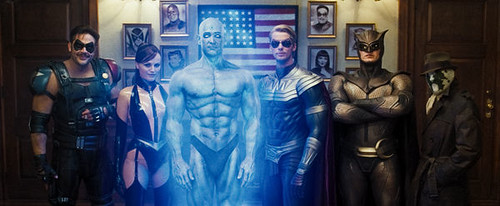
* Images from Watchmen. Clock's at 11:59...


* Paul Auster, science fiction writer.

* Joss Whedon, cultural humanist.

* And Henry David Thoreau, vegetarian.
Vegetarian ideas figured prominently in 19th-century intellectual circles. Though practicing vegetarians remained outside the mainstream, as they do today, vegetarianism itself was intriguing, its arguments compelling. Thoreau, for instance, was not a strict vegetarian, but he did believe that the vegetarian diet was “the destiny of the human race.” Not because animals were cute and fuzzy and therefore ought to be saved from brutality, but because they were dirty and difficult and expensive. “The practical objection to animal food in my case was its uncleanness,” he wrote in Walden, “and besides, when I had caught and cleaned and cooked and eaten my fish, they seemed not to have fed me essentially. It was insignificant and unnecessary, and cost more than it came to. A little bread or a few potatoes would have done as well, with less trouble and filth.” You can stand around in the forest, waiting to spear, skin, and roast a bunny for your next meal, but…why?

Monday, February 02, 2009

Sweet merciful crap, I have a lot of tabs open. Well, I'd better get started.

* Up first: Colbert's "Better Know a Beatle" interview with Sir Paul McCartney from last week, definitely one of his funniest in a while.

* George Saunders remembers John Updike. Saunders also had a typically good story in the New Yorker last week.

* The piece on Caroline Kennedy was pretty good too. I remain persuaded that she would have been a very good Senator but also that she shouldn't have been appointed on anti-dynastic grounds.

* Nor can you lose with a New Yorker story titled "The Invasion from Outer Space" that is actually about an invasion from outer space...

Wednesday, January 14, 2009

Tuesday morning links.

* If movie posters were honest. See also: if covers of marginal SF/fantasy series were honest.

* Who knew full moons had names? Via G-Lens.

* Is California the new Michigan?

* Tough times in the USA: people are eating racoon. This has nothing to do with the recession, apparently—some people are just choosing to eat it because they are gross.

* Potsdam University is offering a graduate how-to course on flirting for computer geeks.

* Arm-Chair Logic has your elementary logic test for the day.

* Solar apocalypse: NASA warns of 'Space Katrina.' My production company has already optioned the rights to this headline, don't even think about it.

* Harper's Index: Bush retrospective mega-edition.

* A task force created by 49 state attorneys general to look into the problem of sexual solicitation of children online has concluded that there really is not a significant problem. That's right: online sexual predators have infiltrated top-level attorneys general offices in 49 states. We must redouble our efforts.

* And Whedonesque asks, appropriately forlorn: Has it really been five years since Angel ended? That is a little hard to believe. The Armchair Critic ranks the twenty-five best episodes, and the five worst, of one of the best (and surely the most underappreciated) SF series of all time.

Monday, December 29, 2008

Recipezaar: more recipes than you require.

Tuesday, September 30, 2008

EcoTuesday!

* Kim Stanley Robinson, hero of the environment.

* People will have to be rationed to four modest portions of meat and one litre of milk a week if the world is to avoid run-away climate change, a major new report warns.

* We're double-saved! 'New Facility Uses Algae to Turn Coal Pollution Into Fuel.'

* Except we've already destroyed the oceans and the rainforests.

Tuesday, September 16, 2008

Playing catch-up.

* Al Giordano reports good news out of Virginia, where Obama has taken an unexpected lead. Flipping VA and NM to Obama and flipping IA to McCain (which admittedly looks unlikely at this point) is, incidentally, one of the many combinations resulting in a 269-269 tie, which would throw the election to the House and cause a legal clusterflunk of epic proportions. (As of right now, we'd win, but it would make 2000 look pretty.)

* Also in politics, people are taking notice of what I've been saying since the primaries: Claire McCaskill is a better surrogate for Obama than just about anybody in the business. Oh, and Obama gave McCain a much-needed bloody nose on the "fundamentals" line.

* The long-neglected art of Iron Man fan fiction has finally been perfected.

* Bad news for veggietopia: eating vegetables shrinks the brain.

* They've found the 20-ft. fence that used to keep the rabble away from Stonehenge.

* I don't trust anyone with a real job in the banking industry, but this shocked even me: Citibank was caught flat-out stealing $14 million from its customers.

* Congratulations, George Takei.

* The Church of England apologizes to Charles Darwin.

* The David Foster Wallace memorial thread I posted to MetaFilter went really well, I thought. So did MetaTalk. Here's something else for the collection—a DFW reading from UC-TV, via my editor at the Indy.


* And the Big Picture has stunning photographs of the 2008 Paralympic Games.

Sunday, September 07, 2008

Veggieocracy: UN says eat less meat to curb global warming.

Tuesday, August 12, 2008

Absolutely the greatest McSweeney's posting of all time: "What We Talk About When We Talk About Mad-Cow Disease."

Dan, Cheryl, and Clare were all vegetarians once but not anymore. We were having a barbecue. Dan and I were standing by the grill while Cheryl and my wife, Clare, were up on the patio, talking.

"The only thing that makes me sad about veal is when it's overcooked," I said. I was trying hard to be funny.

Dan chuckled, though I didn't believe him. "This isn't veal you're grilling," he said. "Tell me it isn't."

I didn't answer but went on: "Those poor baby cows suffered. On a certain level, it's the moral responsibility of the cook to make sure they're delicious. That's why overcooking veal is such a crime."

"I guess I can see that," said Dan. I was half certain he was fucking my wife. We were all alcoholics.

Monday, August 11, 2008

Hooray for Mondays.

* Yesterday we went to New York to see After Nature at the New Museum and Rififi—the film that singlehandedly gave birth to the very idea of French film noir, according to a quote Ryan saw in the newspaper—at the Film Forum's French Crime Wave series. I officially pronounce both things Worth Doing™, with an extra-special deliciousness shout-out to Kate's Joint at 58 Avenue B in the East Village.

* Rest in peace, Isaac Hayes.

* YouTube video tribute to Jack Kirby, king of comics. Via MeFi.

* I've already made what I consider the definitive comment on election polling, but in case you need more I recommend Matthew Yglesias's post today on tracking polls:

Or maybe none of that happened. As everyone knows, there’s sampling error associated with polling. As a result, if you poll 1,000 people on August 1 and then you poll 1,000 different people on August 2 you shouldn’t be surprised to see the results differ by several percentage points even in the absence of any change in the underlying public opinion. Beyond that, doing one poll per day throughout a long campaign would mean that you’d expect to see one or two relatively rare outlier results per month even under circumstances of total stasis. And as Alan Abramowitz points out if you look at the daily results this is actually what you see — incredible volatility with Obama’s lead oscillating violently around an average of 3-4 points. Since it’s not plausible that the public mood is really swinging anywhere near as rapidly as a very naive reading of the Gallup daily results would suggest, people could see that this is basically statistical noise in a stable race.

But Gallup doesn’t report its daily results, they report a multi-day rolling average. Abramowitz notes that if you report a ten day rolling average, you get a chart where nothing happens — Obama maintains a flat lead of 3-4 points. Again, a stable race. But if instead of doing either of those things you do what Gallup actually does and report a three day rolling average, you get these pleasant looking peaks and valleys in the race. The change over time here is large enough in magnitude (unlike on the ten day chart) but also slow enough in pace (unlike on the one day chart) to be plausibly interpreted as public opinion shifting in response to events. And since the human mind is designed to recognize patterns and construct narratives, and since it suits the interests of campaign journalists to write narratives, people interpret the peaks and valleys of the three day average as real shifts in public opinion. But while I have no way of proving that it’s just statistical noise and nothing’s really happening, the “nothing happening” narrative is completely consistent with the data, and it’s telling that the conventional narratives collapse when the data is presented in different ways whereas the “noise” narrative is consistent with multiple ways of displaying the information.
I'll only add that given the extent to which polls serve as a bulwark for functional democracy and accountable elections, the increasing sensationalization of polls as a means to drive news ratings rather than to reliably monitor public opinion is a very, very disturbing trend.

Polls should be boring. They should be so boring no one cares what they say.

* And Jesse Taylor has the best hypothetical history of the presidential primary I've seen:
Any number of things could have swayed the primary. But at the end of the day, Clinton apologizing for her Iraq vote (or just not having voted that way in the first place) would have guaranteed her the nomination. Or her running for Senate in Illinois.
I really think that's right. If she'd decided to run for Senate in Illinois rather than New York, she'd have had it.

Wednesday, July 23, 2008

Apes, legal personhood and the plight of Nim Chimpsky.

Eberhart Theuer: A legal person would be something like a company or a certain society that in itself, or a fund that has certain rights without being a natural person.

Anita Barraud: This is similar to the US in common law notion of a juristic person that can apply to corporations and organisations that they're artificial persons created by the law.

Eberhart Theuer: Exactly.

Paula Stibbe: It's not talking about the rights for non-human animals to go and vote or be able to go to university, that would clearly be inappropriate and ridiculous. This is about recognising that non-human animals share with us sentience, which means that they have the ability to suffer, and that they have interests which can be damaged.
In sci-fi-philosophic terms, this is the distinction between sapience and sentience; while apes likely cannot "think" in the human sense, they and other animals can certainly feel pain, and that capacity is something we are morally obliged to respect.

I say likely because I am by nature extremely wary of the anthropomorphistic tendency to project human emotions and consciousness into animal behavior that is actually instinctual or learned—in general I'm impressed with Daniel Dennett's theory in Kinds of Minds that our dogs appear to "love" us precisely because we've selected for just that impression over millenia of canine domestication. But as an anecdotal matter I must admit this is really evocative:
Paula Stibbe: I've learned what he likes to do most, what food he likes to eat most, though that would include some games. He likes to use charcoal with paper sometimes to draw, or chalk.

Anita Barraud: What does he draw?

Paula Stibbe: They are kind of abstract angular kind of works and he takes the paper and the chalk and he leans against the wall, he bites his bottom lip and concentrates really hard on what he's doing. He won't let himself be distracted while he's drawing.
(cross-posted at culturemonkey)