Not even God-Man can escape the trend of "dark" superheroes.
Showing posts with label Dark Age of Comics. Show all posts
Showing posts with label Dark Age of Comics. Show all posts
Wednesday, April 29, 2009

Friday, July 18, 2008
 If The Dark Knight is the greatest superhero movie of all time—and I think it probably is—it is entirely on the back of Heath Ledger's immaculate turn as the Joker. Ledger is utterly, utterly, utterly perfect in this role—so perfect in fact that it is impossible to imagine either anyone else ever playing the Joker or any other villain stepping in to carry a sequel.
(Who's even still on the bench at this point? The Penguin? Riddler? King Tut? Catwoman can't carry a movie all by herself. The best bet, it seems to me, would be to go forward with the long-teased Batman vs. Superman project; it'd be something of a genre mismatch for the Christian Bale franchise, but at least it'd spare us all another round of movie nonsense with the highly overrated Riddler.)
There's no question about it: Ledger's performance is simply stunning. His sociopathic Joker is so good that it's hard to say that the movie is actually enjoyable to watch—I feel exhausted after seeing it, disturbed and just a little bit broken. In this sense The Dark Knight isn't really a superhero movie at all, but a horror movie, a slasher flick, and really—with Ledger so famously dead by suicide* just after shooting—a snuff film. As David Denby put the point in the New Yorker:
When Ledger wields a knife, he is thoroughly terrifying (do not, despite the PG-13 rating, bring the children), and, as you’re watching him, you can’t help wondering—in a response that admittedly lies outside film criticism—how badly he messed himself up in order to play the role this way. His performance is a heroic, unsettling final act: this young actor looked into the abyss.
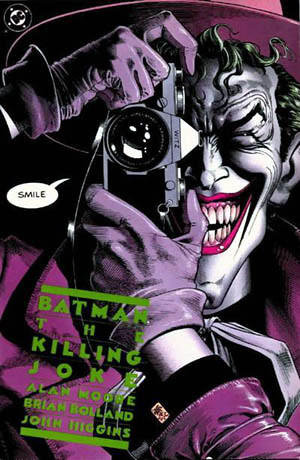 This is in all respects an astoundingly dark movie that's hardly suitable for adults, much less children. And if The Dark Knight doesn't quite possess the necessary sense of self-awareness to be the Watchmen of superhero film, it may well be its Dark Knight Returns (wiki)—or, perhaps more directly, the story from which it draws its most direct inspiration, Alan Moore's definitive Joker story, The Killing Joke (wiki).
What Moore gets, of course, is what the film is only able to hint at: the extent to which Batman and the Joker (to mix my supervillain metaphors) are two sides of the same coin. It is not just that they are both insane, but that they are both equally insane and insane in exactly the same way—just in opposite directions.
--
* Abe rightly points out in the comments that Ledger's death by overdose probably wasn't a suicide. Obviously I'm not watching enough entertainment television.
Monday, July 07, 2008
 This pair of scans_daily posts are by themselves a nearly complete lesson in just what superhero comics have become in the so-called Dark Age—incredibly dark, yes, but also deeply layered and remarkably postmodern. Grant Morrison's current story on the Batbooks requires at least a passing familiarity with the entire sixty-nine-year history of the franchise to make much sense, including long-abandoned plot points like the Batman of Zur-En-Arrh and Bat-Mite and a rather advanced understanding of meta-concepts like continuity and canonicity.
These features, to varying degrees, dominate the major creative output of both DC and Marvel, and have for at least a decade, though Grant Morrison's comics are certainly near the top of the curve.
Personally I think this sort of labyrinthine narrative complexity is always unequivocably wonderful, but opinions on this point definitely vary.


 Posts
Posts


