My blog has moved!

You should be automatically redirected to the new home page in 60 seconds. If not, please visit
http://gerrycanavan.com
and be sure to update your bookmarks. Sorry about the inconvenience.

Showing posts with label pedagogy. Show all posts

Monday, November 09, 2009

Mr. Gorbachev, tear down this Monday.

* Žižek has an op-ed in the New York Times on the 20th anniversary of the fall of the Wall. It's pretty good.

The same rightists who decades ago were shouting, “Better dead than red!” are now often heard mumbling, “Better red than eating hamburgers.” But the Communist nostalgia should not be taken too seriously: far from expressing an actual wish to return to the gray Socialist reality, it is more a form of mourning, of gently getting rid of the past. As for the rise of the rightist populism, it is not an Eastern European specialty, but a common feature of all countries caught in the vortex of globalization...
* Standards for Grading the Life of an Adjunct Composition Professor.

* Our university in the news! Duke Criticized Over Sex Toy Study.

* Two good posts from Josh Marshall consider whether 2010 or 2012 is the next flashpoint for health care reform.

* And who supports marriage equality? The real question is, what's going to happen to me when I turn thirty next week?

Thursday, September 24, 2009

The soon-to-be ex-vice-chancellor of Buckingham University explains in a startlingly ill-conceived article in the Times that female students are a male academic's "perk." Via The Guardian via Dana at The Edge of the American West.

PS: "The fault lies with the females." FYI.

Sunday, August 30, 2009

Closing a few tabs.

* Scientific American considers the cognitive advantages of depression.

* Marginal Revolution has a nature/nuture post on educational outcomes in adoptees.

* Dark Stores of the American recession. More at MeFi, including the British counterpart.

* The Beatles, remastered in mono. Reviews are positive.

* ...last fall, for the first time in 15 years, Ms. McNeill, 42, did not assign “Mockingbird” — or any novel. Instead she turned over all the decisions about which books to read to the students in her seventh- and eighth-grade English classes at Jonesboro Middle School in this south Atlanta suburb.

Among their choices: James Patterson‘s adrenaline-fueled “Maximum Ride” books, plenty of young-adult chick-lit novels and even the “Captain Underpants” series of comic-book-style novels.
You had me until "Captain Underpants." (via Vu)

* Smells of New York.

Monday, August 17, 2009

Lord of the Flies writer William Golding might have fit in well in his own book.

The Nobel laureate Sir William Golding, whose novel Lord of the Flies turned notions of childhood innocence on their head, admitted in private papers that he had tried to rape a 15-year-old girl during his teenage years, it emerged today.

Golding's papers also described how he had experimented, while a teacher at a public school, with setting boys against one another in the manner of Lord of the Flies, which tells the story of young air crash survivors on a desert island during a nuclear war.

Tuesday, August 11, 2009

Three more:

* 25 Twitter projects for the college classroom.

* Are you a decidophobe?

* Behold The King of Crayons.

Monday, August 03, 2009

MMLD #3.

* Oil! More here and here.

* We are rich enough. Economic growth has done as much as it can to improve material conditions in the developed countries, and in some cases appears to be damaging health. If Britain were instead to concentrate on making its citizens' incomes as equal as those of people in Japan and Scandinavia, we could each have seven extra weeks' holiday a year, we would be thinner, we would each live a year or so longer, and we'd trust each other more.

* Continued tough week for MSNBC as the Richard Wolffe scandal piles on the Fox détente scandal. Of course, the roots of corporate media corruption go much deeper than just this pair of incidents. UPDATE: For what it's worth, Olbermann emphatically denied the rumors on his show tonight during his Worst Persons segment, another proud entry in the "not KO's proudest moment" file. UPDATE 2: Olbermann posted a Daily Kos diary on both subjects today as well.

* Duke's Cathy Davidson is profiled at Inside Higher Ed for her plan to schematize student grades.

*PKD rocks Bookslut and the San Francisco Gate.

* And Terry Pratchett, suffering from Alzheimer's, is fighting for his right to die.

Friday, July 31, 2009

There have been some interesting Infinite Summer posts about whether Infinite Jest "counts" as science fiction—see, for instance, these two at Infinite Tasks and this from Chris Forster)—so I thought it might be interesting to run through some of my standard classroom definitions of science fiction and see how the book shapes up. (My notes on this are older than the Wikipedia page and mostly cribbed from Fred Chappell, but most of these definitions appear there as well.)

To begin with, there are a few classic definitions it clearly doesn't meet.

...a charming romance intermingled with scientific fact and prophetic vision.
—Hugo Gernsback
Versions of this notion of "scientific prophecy" pop up whenever science fiction is discussed, and Infinite Jest pretty clearly meets neither criteria; its speculations are philosophical, not scientific, and it is surely a satire, not some coherent futurism.

Another take:
Science fiction is a branch of fantasy identifiable by the fact that it eases the "willing suspension of disbelief" on the part of its readers by utilizing an atmosphere of scientific credibility for its imaginative speculations in physical science, space, time, social science, and philosophy.
—Sam Moskowitz
I would defy anyone to claim that their willing suspension of disbelief is not frequently and fatally challenged by the hyperbolic "hysterical realist" elements throughout IJ. "FREAK STATUE OF LIBERTY ACCIDENT KILLS FED ENGINEER: BRAVE MAN ON CRANE CRUSHED BY 5 TON CAST IRON BURGER" (398) is not a sentence calculated to brace a spirit of credulity.

Still another:
Science fiction is anything published as science fiction.
—Norman Spinrad
This is usually the last definition I offer my students in my introductory SF lecture, and the one I usually argue is the most important. SF is, as much as it is anything else, a discrete, recognizable set of consumer practices and preferences—and here, too, Infinite Jest is clearly not science fiction because it isn't branded as science fiction in the marketplace nor is it consumed as science fiction by "science fiction fans." IJ pulls in dollars under an entirely different brand, mainstream literary fiction—which is a perfectly cromulent brand, if that's what you're into, but it's not SF.

So, then, 0 for 3. Not a great start. But there are other definitions of science fiction that do cast a strong light on Infinite Jest:
Science fiction is the search for definition of man and his status in the universe which will stand in our advanced but confused state of knowledge (science), and is characteristically cast in the Gothic or post-Gothic mold.
—Brian Aldiss
Here science fiction collapses into a special category of existential literature, in which the SF aspects are merely the engine motivating the text's more-central philosophical speculations. The science-fictional elements in Infinite Jest, it seems clear to me, are operating almost entirely on this level—each inventive speculation in the novel drives existential speculation about how we might be able to live in ultratechnological modernity in the shadow of the death of God. (Side question: is Infinite Jest "in the Gothic mold"? I'd have to pull out an entirely different set of quotes to discuss that question fully, but in its massive textual sprawl, its strong tendencies towards melodrama and hyperbolic excess, and its palpable atmosphere of both individual and familial tragedy I think we could have the start of a fairly strong case.)

We come now to the two definitions I use most commonly in my writing and teaching, which are (I concede) are completely in conflict with one another. But I think—I hope—it's a productive tension. First is Darko Suvin, who inspired Fredric Jameson and most of the Utopian school of SF theorists I primarily read:
SF is, then, a literary genre or verbal construct whose necessary and sufficent conditions are the presence and interaction of estrangement and cognition, and whose main formal device is an imaginative framework alternative to the author's empirical environment. —Darko Suvin
There's a lot to pull out there, but the key words are "estrangement," "cognition," and "imaginative framework alternative." What Suvin argues in his work is that the defining characteristic of science fiction is the pwower of defamiliarization that allows us to see our own world more clearly (and maybe for the first time), which is accomplished through the sort of intricate, even obsessive world-building confabulations SF is famous for. In particular, Suvin and his successors argue, SF expresses the desire for another kind of life, whether explicitly (as Utopian fiction) or implicitly (the desire for a plausible alterity expressed in negative in most dystopian, anti-Utopian, and apocalyptic fictions).

Infinite Jest, it seems to me, is pretty deep in the murky swamp that divides this sort of SF from more generic Utopian/dystopian political satire. The trouble for any Suvinian analysis of Infinite Jest, I think, comes in the unstable irony I was going on about earlier in the week; as Infinite Tasks lays out in detail, O.N.A.N.-ite politics is not in any sense a imaginative framework alternative to the present. It's a series of gags. Wallace's world-building just isn't on the level. It's no coincidence, to take but one example, that a close reading of DFW's references to the Gentle administration and the start of Subsidized Time c. the year 2000 would seem to place the "Limbaugh administration" around the year of the novel's composition in the mid-1990s, and therefore somehow impossibly concurrent with the Clinton administration that is also occasionally referenced. Infinite Jest is our cracked self-reflection, not another world.

And finally there's Delany, who rejects political readings of SF in favor of a definition focused on wordplay, and really on the pleasure of the text itself:
In science fiction, "science"—i.e., sentences displaying verbal emblems of scientific discourses—is used to literalize the meanings of other sentences for use in the construction of the fictional foreground. Such sentences as "His world exploded," or "She turned on her left side," as they subsume the proper technological discourse (of economics and cosmology in one; of switching circuitry and prosthetic surgery in the other), leave the banality of the emotionally muzzy metaphor, abandon the triviality of insomniac tossings, and, through the labyrinth of technical possibility, become possible images of the impossible.
—Samuel Delany
This literary-linguistic pleasure, I think, is quite clearly a huge part of the pleasure of IJ for those of us who are enjoying it; the way in which, 400 pages in, we find ourselves now able to parse a sentence like this one:
All this until the erection of O.N.A.N. and the inception, in Clipperton's eighteenth summer, of Subsidized Time, the advertised Year of the Whopper, when the U.S.T.A. became the O.N.A.N.T.A., and some Mexican systems analyst—who barely spoke English and had never once even fondled a ball and knew from exactly zilch except for crunching raw results-data—this guy stepped in as manager of the O.N.A.N.T.A. computer and ranking center in Forest Lawn NNY, and didn't know enough not to treat Clipperton's string of six major junior-tournament championships that spring as sanctioned and real. (431)
There is surely something Delany could recognize in this sentence and the subtle mental acrobatics required to make sense of it; if this isn't quite science fiction, exactly, it seems to me it's something very close.

Wednesday, July 29, 2009

Wednesday afternoon links 2!

* Wikipedia's Rorschach cheat sheet. My contempt for the discipline of psychology really got in the way of my reading this article; I kept thinking, "Wait, people actually take Rorschach tests seriously?"

* For more information on my feelings about the Rorschach test see the story I published in Five Fingers Review #23 (now defunct). Note: I'm not sure this issue ever actually materialized. I never got a copy.

* Two takes on how to improve your teaching: restructure your expectations about college composition and teach naked.

* If I'm reading this article correctly, M&Ms cure spinal injury.

* The only rule at Fox News is that there are no rules.

* NPR considers the uncanny intelligence of crows. Via MeFi, which has more in the comments, including video of crows exploiting traffic patterns in Tokyo to crack nuts.

Monday, July 20, 2009

Monday night 2!

* 61 Essential Postmodern Reads: An Annotated List. (Absalom, Absalom!? Hamlet? Really?)

* Nature's right to exist comes to Shapleigh, Maine. Via MeFi.

* The Harvard Crimson reports that Henry Louis Gates was apparently arrested yesterday for trying to break into his own home. Post-racial America is awesome. (via SEK)

* Also from SEK: scientific proof Powerpoint sucks.

* Inside Blackwater, the corporation so evil they forgot to give it a non-evil name.

Thursday, July 16, 2009

Autism, education, neurodiversity, and the academy.

Thursday, July 02, 2009

Other links:

* This post on the Golden Age of Blogging from 11D is circulating pretty widely, and generally comports with my sense of things as a longtime C-list blogger. The first-mover advantage in the blogosphere is hard to overstate, yet this is one of its more overlooked characteristics; it's still possible to "break through," but much harder, and it's nothing like it was in the glory days of 2001-2003. I often wish I'd started earlier.

* Is C-list too generous? Is there a D-list?

* Of course the real problem with this blog is its utter lack of focus, as will now be demonstrated forthwith.

* 200 Characters from Dick Tracy, 1931-1977.

* U.S. gets second-to-worst grade on emissions from the WWF. The worst? Blame Canada.

* Dear Plagiarist.

* 200-year-old cipher cracked; Jefferson pwned.

* The psychology of scams. Via Schneier on Security, via this AskMe on the Craigslist check kiting scam in Canada, via Neil.

* Worst case scenarios: A bar examinant's $400,000 student loan debt (and admittedly poor history of repayment) has blocked their ability to practice law in the state of New York (and therefore ever hope to pay the loan back). Via Steve.

* And good news from India: Delhi's high court has decriminalized homosexuality. Via MeFi.

Sunday, March 08, 2009

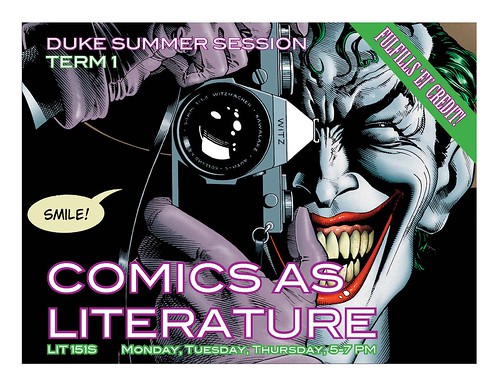
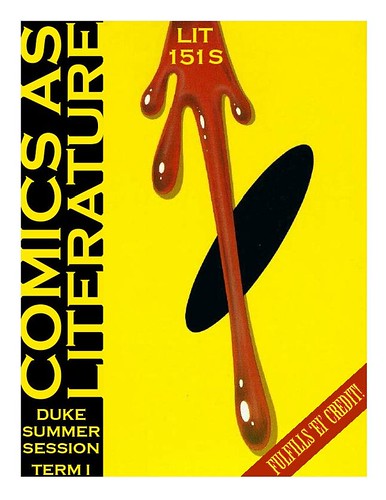
Two more posters for my "Comics as Literature" summer course in Duke's Term 1 this summer, which I've recently found out that UNC student can take for UNC tuition. Tell everyone.

LIT 151S Comics as Literature. Beginning with Batman and Superman, passing through R. Crumb, Harvey Pekar, and Maus, and moving into the contemporary era of Persepolis and Dykes to Watch Out For, this course will survey the history and reception of graphic narrative as the genre moves from a predominantly American, predominantly male fixation on the superhero towards an increasingly popular international art movement that crosses gender, class and ethnic lines. Likely texts will include Siegel and Shuster’s Superman, Frank Miller’s Batman, Stan Lee’s Iron Man, Art Spiegelman’s Maus, Harvey Pekar’s American Splendor, Chris Ware’s Jimmy Corrigan: The Smartest Kid on Earth, Marjane Satrapi’s Persepolis, Alison Bechdel’s Fun Home, Guy Delisle’s Pyongyang, Osamu Tezuka’s Buddha and Alan Moore’s Watchmen, as well as selected excerpts and Scott McCloud’s Understanding Comics.


Monday, February 23, 2009

Beg, borrow, lie, cheat, steal, whatever you have to do to get the money to take my course on comics in Duke's Term 1 this summer. Mondays, Tuesdays, and Thursdays, 5-7 PM.

LIT 151S Comics as Literature. Beginning with Batman and Superman, passing through R. Crumb, Harvey Pekar, and Maus, and moving into the contemporary era of Persepolis and Dykes to Watch Out For, this course will survey the history and reception of graphic narrative as the genre moves from a predominantly American, predominantly male fixation on the superhero towards an increasingly popular international art movement that crosses gender, class and ethnic lines. Likely texts will include Siegel and Shuster’s Superman, Frank Miller’s Batman, Stan Lee’s Iron Man, Art Spiegelman’s Maus, Harvey Pekar’s American Splendor, Chris Ware’s Jimmy Corrigan: The Smartest Kid on Earth, Marjane Satrapi’s Persepolis, Alison Bechdel’s Fun Home, Guy Delisle’s Pyongyang, Osamu Tezuka’s Buddha and Alan Moore’s Watchmen, as well as selected excerpts and Scott McCloud’s Understanding Comics.

Wednesday, February 18, 2009

Things I've enjoyed on the Internet today.

* A Seth tribute to Charles Schulz.

* The ruins of Detroit's abandoned Belle Island Zoo. Via MeFi.

* Spy Vibe, a blog devoted to the '60s spy aesthetic. Also via MeFi.

* Three Jane Austen sci-fi films are apparently in the pipeline: Pride, Prejudice, amp; Zombies; Pride & Predators; and Lost in Austen.. What can account for Austenmania?

* I can't believe putting a totally unqualified action-movie star in charge of the world's fifth largest economy has turned out so badly for California. More on this from Ezra Klein, who actually points the finger not at Arnold but at systemic gridlock, i.e., the California state constitution and deluded Orange County Republicans.

* Why we love gambling: almost winning is almost as good as actually winning, as far as our neurochemistry is concerned.

* Grade inflation is a feedback loop: students now expect a B just for showing up.

* Life as a tie-in novelist.

* Braid, Game of the Year 2008 by all accounts, is finally coming to the PC.

Thursday, February 12, 2009

I had a nasty case of food poisoning or something last night—fever, chills, the whole bit. But now I'm back and quite literally better than ever. A few links to celebrate my recovery:

* Early reviews of Dollhouse remain mixed. We'll know tomorrow....

* This YouTube clip (via MeFi) captures just the barest sliver of the greatness of the Conan DVD commentary. It is our civilization's highest cultural achievement.

* The trailer for the new Tarantino is out.

* How to teach non-canonical material responsibly in a composition class: lesson plans from Scott Eric Kaufman on Dark Knight and Watchmen.

* Two satellites have collided in orbit. Apparently that's never happened before. More from MeFi.

* Happy birthday, Charles Darwin. More from Satisfactory Comics.

Saturday, February 07, 2009

Saturday night's all right for blogging.

* How we kill geniuses. Via MetaFilter.

* Eleanor Clift loses one of her uncountably many demerits in agitating for Howard Dean to HHS.

* The unsustainability of sustainable energy.

* It looks like Michael Steele was the perfect person to head up the Republican party—a week on the job and he's already embroiled in a corruption scandal.

* Yes we can. Yes we did, now leave us alone.

* The University of Ottawa's Denis Rancourt has been suspended from teaching and is facing possible dismissal for promising all students an A+ on the first day of class. I think it was the + that did it—if he'd just promised them As it would have been business as usual... (via Pharyngula)

* Science fiction as religion. Via io9.

Wednesday, February 04, 2009

Wednesday, Wednesday.

* Why is Boing Boing giving valuable blog real estate to global warming denialism? I see Cory has admirably tried to push back against the guest blogger, but still. What a sad day for Boing Boing.

* Michael Bérubé just took the GRE Literature in English subject test again. And lived to tell about it.

* Rethinking plagiarism? Sorry, but this isn't that hard. Students know exactly what they're doing when they plagiarize. Turn them over to Judicial Affairs and don't think twice.

* Ten privacy settings every Facebook user should know.

* Joe the Plumber is now advising the GOP. WTFRepublicans?

* Fimoculous has found Wikipedia's list of lists of fictional things.

* The New Yorker's Hendrik Hertberg was not impressed with Obama's first inaugural. More shocking still is the unabashed anti-Hindu prejudice expressed in a demand that they be listed last in the litany of religious belief, even after hated atheists. Via Edge of the American West.

Tuesday, December 16, 2008

Bruce Fleming says the professionalization of literary studies killed literary study.

The major victory of professors of literature in the last half-century — the Great March from the New Criticism through structuralism, deconstruction, Foucauldianism, and multiculturalism — has been the invention and codification of a professionalized study of literature. We've made ourselves into a priestly caste: To understand literature, we tell students, you have to come to us. Yet professionalization is a pyrrhic victory: We've won the battle but lost the war. We've turned revelation into drudgery, shut ourselves in airless rooms, and covered over the windows.

The good news is that we've created a discipline: literary studies. The bad news is that we've made ourselves rulers of a realm that has separated itself almost completely from the rest of the world.
To the extent he has a point, it seems to me to be a question of pedagogy, not discipline or professionalization. Pedagogically, perhaps, we can do better. But with regard to critical theory and "literary studies" I think we're doing pretty good—it's not drudgery or hermeticism if you're doing it right.

Wednesday, September 24, 2008

More on G.C.S.G. '08.

* It's being widely reported now that McCain is threatening to not show up to the debate if a deal hasn't been reached by Friday. Just who is this supposed to threaten?

* By the way, contrary to reports, Friday's debate will not focus exclusively on foreign affairs—Jim Lehrer informed the campaigns last week that there would be economic questions too.

* From the Dept. of You've Got To Be Shitting Me: Ben Smith reports that the McCain campaign has generously offered to move Friday's presidential debate to next week's VP debate, with the VP debate rescheduled to some unknown date in the future.

* Edge of the American West has an exclusive copy of the email McCain sent to Ole Miss asking for an extension.

On Tuesday, September 23, 2008 at 12:00pm, John McCain wrote:

sorry to bother you and i know this request is late but i have been really busy and i want to call an emergency meeting with the president and understanding all the material is taking up a lot of my time so i find myself woefully underprepared and i am throwing myself on your mercy. can i get an extension over the weekend on the debate so i can present my best work to you? or should i get a dean’s excuse?

thanks,

john
* And slightly lost in the midst of all this is the fact that McCain gave Letterman the finger to do it. Letterman's not happy.
David Letterman tells audience that McCain called him today to tell him he had to rush back to DC to deal with the economy.

Then in the middle of the taping Dave got word that McCain was, in fact just down the street being interviewed by Katie Couric. Dave even cut over to the live video of the interview, and said, "Hey Senator, can I give you a ride home?"

Earlier in the show, Dave kept saying, "You don't suspend your campaign. This doesn't smell right. This isn't the way a tested hero behaves." And he joked: "I think someone's putting something in his Metamucil."

"He can't run the campaign because the economy is cratering? Fine, put in your second-string quarterback, Sarah Palin. Where is she?"

"What are you going to do if you're elected and things get tough? Suspend being president? We've got a guy like that now!"

This year's freshmen are the last group of students I'm likely to have that are older than 1991's Nevermind. I grow old, I grow old, I shall wear the bottoms of my trousers rolled.