For future reference, Linkmachinego has your nerd Venn diagram. (via)
Showing posts with label nerds. Show all posts
Showing posts with label nerds. Show all posts
Tuesday, September 15, 2009

Monday, August 31, 2009

Friday, August 21, 2009
Design failures of the Star Wars universe. (Slashdot pushes back here.)
Friday, July 31, 2009
 There have been some interesting Infinite Summer posts about whether Infinite Jest "counts" as science fiction—see, for instance, these two at Infinite Tasks and this from Chris Forster)—so I thought it might be interesting to run through some of my standard classroom definitions of science fiction and see how the book shapes up. (My notes on this are older than the Wikipedia page and mostly cribbed from Fred Chappell, but most of these definitions appear there as well.)
To begin with, there are a few classic definitions it clearly doesn't meet.
...a charming romance intermingled with scientific fact and prophetic vision.Versions of this notion of "scientific prophecy" pop up whenever science fiction is discussed, and Infinite Jest pretty clearly meets neither criteria; its speculations are philosophical, not scientific, and it is surely a satire, not some coherent futurism.
—Hugo Gernsback
Another take:
Science fiction is a branch of fantasy identifiable by the fact that it eases the "willing suspension of disbelief" on the part of its readers by utilizing an atmosphere of scientific credibility for its imaginative speculations in physical science, space, time, social science, and philosophy.I would defy anyone to claim that their willing suspension of disbelief is not frequently and fatally challenged by the hyperbolic "hysterical realist" elements throughout IJ. "FREAK STATUE OF LIBERTY ACCIDENT KILLS FED ENGINEER: BRAVE MAN ON CRANE CRUSHED BY 5 TON CAST IRON BURGER" (398) is not a sentence calculated to brace a spirit of credulity.
—Sam Moskowitz
Still another:
Science fiction is anything published as science fiction.
—Norman Spinrad
 This is usually the last definition I offer my students in my introductory SF lecture, and the one I usually argue is the most important. SF is, as much as it is anything else, a discrete, recognizable set of consumer practices and preferences—and here, too, Infinite Jest is clearly not science fiction because it isn't branded as science fiction in the marketplace nor is it consumed as science fiction by "science fiction fans." IJ pulls in dollars under an entirely different brand, mainstream literary fiction—which is a perfectly cromulent brand, if that's what you're into, but it's not SF.
So, then, 0 for 3. Not a great start. But there are other definitions of science fiction that do cast a strong light on Infinite Jest:
Science fiction is the search for definition of man and his status in the universe which will stand in our advanced but confused state of knowledge (science), and is characteristically cast in the Gothic or post-Gothic mold.Here science fiction collapses into a special category of existential literature, in which the SF aspects are merely the engine motivating the text's more-central philosophical speculations. The science-fictional elements in Infinite Jest, it seems clear to me, are operating almost entirely on this level—each inventive speculation in the novel drives existential speculation about how we might be able to live in ultratechnological modernity in the shadow of the death of God. (Side question: is Infinite Jest "in the Gothic mold"? I'd have to pull out an entirely different set of quotes to discuss that question fully, but in its massive textual sprawl, its strong tendencies towards melodrama and hyperbolic excess, and its palpable atmosphere of both individual and familial tragedy I think we could have the start of a fairly strong case.)
—Brian Aldiss
We come now to the two definitions I use most commonly in my writing and teaching, which are (I concede) are completely in conflict with one another. But I think—I hope—it's a productive tension. First is Darko Suvin, who inspired Fredric Jameson and most of the Utopian school of SF theorists I primarily read:
SF is, then, a literary genre or verbal construct whose necessary and sufficent conditions are the presence and interaction of estrangement and cognition, and whose main formal device is an imaginative framework alternative to the author's empirical environment. —Darko SuvinThere's a lot to pull out there, but the key words are "estrangement," "cognition," and "imaginative framework alternative." What Suvin argues in his work is that the defining characteristic of science fiction is the pwower of defamiliarization that allows us to see our own world more clearly (and maybe for the first time), which is accomplished through the sort of intricate, even obsessive world-building confabulations SF is famous for. In particular, Suvin and his successors argue, SF expresses the desire for another kind of life, whether explicitly (as Utopian fiction) or implicitly (the desire for a plausible alterity expressed in negative in most dystopian, anti-Utopian, and apocalyptic fictions).
 Infinite Jest, it seems to me, is pretty deep in the murky swamp that divides this sort of SF from more generic Utopian/dystopian political satire. The trouble for any Suvinian analysis of Infinite Jest, I think, comes in the unstable irony I was going on about earlier in the week; as Infinite Tasks lays out in detail, O.N.A.N.-ite politics is not in any sense a imaginative framework alternative to the present. It's a series of gags. Wallace's world-building just isn't on the level. It's no coincidence, to take but one example, that a close reading of DFW's references to the Gentle administration and the start of Subsidized Time c. the year 2000 would seem to place the "Limbaugh administration" around the year of the novel's composition in the mid-1990s, and therefore somehow impossibly concurrent with the Clinton administration that is also occasionally referenced. Infinite Jest is our cracked self-reflection, not another world.
And finally there's Delany, who rejects political readings of SF in favor of a definition focused on wordplay, and really on the pleasure of the text itself:
This literary-linguistic pleasure, I think, is quite clearly a huge part of the pleasure of IJ for those of us who are enjoying it; the way in which, 400 pages in, we find ourselves now able to parse a sentence like this one:In science fiction, "science"—i.e., sentences displaying verbal emblems of scientific discourses—is used to literalize the meanings of other sentences for use in the construction of the fictional foreground. Such sentences as "His world exploded," or "She turned on her left side," as they subsume the proper technological discourse (of economics and cosmology in one; of switching circuitry and prosthetic surgery in the other), leave the banality of the emotionally muzzy metaphor, abandon the triviality of insomniac tossings, and, through the labyrinth of technical possibility, become possible images of the impossible.
—Samuel Delany

All this until the erection of O.N.A.N. and the inception, in Clipperton's eighteenth summer, of Subsidized Time, the advertised Year of the Whopper, when the U.S.T.A. became the O.N.A.N.T.A., and some Mexican systems analyst—who barely spoke English and had never once even fondled a ball and knew from exactly zilch except for crunching raw results-data—this guy stepped in as manager of the O.N.A.N.T.A. computer and ranking center in Forest Lawn NNY, and didn't know enough not to treat Clipperton's string of six major junior-tournament championships that spring as sanctioned and real. (431)There is surely something Delany could recognize in this sentence and the subtle mental acrobatics required to make sense of it; if this isn't quite science fiction, exactly, it seems to me it's something very close.
Saturday, July 18, 2009
Saturday morning links!
* RIP, Walter Cronkite.
* Fox is apparently trying to screw the Futurama voice cast, though there are some hints that this may just be an ill-conceived publicity stunt. For what it's worth Variety seems to think it's legit. Why does Fox hate nerds?
* I think it would be great to have a Kindle, but Amazon keeps making it harder and harder for me to buy one. Yesterday they unpublished two books by George Orwell without warning, deleting the books from the Kindles of those who bought it.
* On teaching Infinite Jest.
* And Pat Buchanan, it must be said, is a terrible human being.
Saturday, June 20, 2009
Hodgman at tonight's Radio & Television Correspondents Dinner: Part 1, Part 2. UPDATE: It's by no means a full Colbert, but there is a remarkable moment Colbert-like near the end:
You are clearly not exactly the person we hoped you would be. And perhaps it was wrong and impractical and unrealistic of us to lay such hopes upon you.Still not sure whether the "Colbert" was pulled on Obama or on his disenchanted supporters. I think both.
Tuesday, May 12, 2009
Sorry about No-Post Monday; my summer course starts tomorrow and I'm scrambling to get everything ready. I have a few links before I declare this No Post Tuesday.
* Eliza Dushku is twittering that Dollhouse renewal talks are going on as we speak. A better indication than if they weren't.
* Miscellaneous Star Trek links:
* A fairly well-known story about TOS and MLK.* The secret history of Jughead's hat.
* Ultimately, then, “Star Trek” was prescient not for its futurism, with the Enterprise crew using communicators that look like flip-phones, but for exploring a universe absorbed with pop-culture history. David Hadju on Star Trek and popular culture.
* Continuity errors as honeypot.
* "Star Trek sucked so bad I can’t even think of a title for my rant."
* Goonies reunion video.
* Larry David is Woody Allen as Larry David in Whatever Works.
* Apocalypse and the academy in The New Yorker.
* And some sad news: Craig Arnold is now believed to have died while traveling in Japan.
Sunday, May 10, 2009
Old theory: The Star Trek franchise has become too permanently associated with hopeless nerdity to ever be commercially viable again.
New theory: The world has been secretly filled with a huge number of closet Star Trek fans all this time, all waiting for the right moment to shed their self-loathing and strut their stuff in public. And now it's here.
UPDATE: I'm switching 50% of my loyalty to Vu's alternative theory:
alternate theory: appropriate amounts of 'hot young talent' will perk up any aging franchise, spurring non-nerds to quickly gain superficial knowledge of the mythology as a way of displaying authenticity.But only 50%; there's some genuine nostalgics mixed in with all these Johnny-come-latelys.
Saturday, May 09, 2009
 Call it the soft bigotry of low expectations or heretofore unexpected reserves of good will for the franchise—or maybe J.J. just nailed it—but I found Star Trek surprisingly good. And "good" is an amazing accomplishment given the self-contradictions inherent to the project:
1) innovate and revitalize a franchise that, let's face it, is built almost entirely on the bedrock of nostalgic repetition;But Abrams strikes a more or less successful balance, aside from a few hamhanded "R2-D2, meet C-3PO" moments and a little too much handholding and lampshade-hanging.
2) do so while further hamstrung by the excruciating prequel format.
As is probably to be expected, the prequelization provides both the worst parts of the movie and its primary source of narrative pleasure. As a certified member of the Nitpicker's Guild I confess I was a bit annoyed to see how little effort was made to stick with the original continuity, even granting the timeline shift. Many of the gadgets had different behaviors and limitations than in the original show; no one knew Romulans were related to Vulcans until part of the way through the original series; Chekhov didn't join the ship until later; Pike wasn't the first captain of the Enterprise; etc, etc, etc. (You can fanwank most or all of these away with "The USS Kelvin Changed Everything," but that's not very satisfying. Clear lines of cause-and-effect matter, especially in time travel stories.)
 That this cherished original continuity is essentially bulldozed permanently by the film is pretty unfortunate and will, I think, permanently damage the franchise in the eyes of its loyal and notoriously defensive fanbase, especially as fifty years of strict adherence to Roddenberry's particular Utopian vision has not prepared them well for our heroes to lose a planet, much less the entire timeline.
But at the same time it is quite fun to see these characters meet each other, and Abrams does an amazing job of capturing the feel of the original series (all the way from aesthetics right down to the level of contrivance and occasionally nonsensical plot points). That the actors playing McCoy and (especially) Spock are very good mimics of the original actors helps things along a lot as well.
It's also astounding how apolitical the film tries to be; I went in with the idea of writing a post about neoliberalism and Star Trek and it just didn't give me much to work with. Now, this is a neoliberal, United Nations fantasy of the future, to be sure, in which difference only exists to be flattened out—but that's really true of almost all Trek, DS9 and some other choice episodes excepted. (There's also a making explicit of the longstanding metaphorical connection between Vulcans and Jews, with a Vulcan Holocaust followed by a choice between diaspora, assimilation, and resettlement in a "new colony," but I don't know what to do with that yet.)
Star Trek (2009) is no better or worse, politically speaking, than what Star Trek's always been: a fantasy of what the world would be like if consumer capitalism had no labor or environmental costs and American military-cultural hegemony was pure, stable, and uncomplicatedly good. It remains our defining ideological fantasy, in other words, the thing that blinds us still to the sort of world we're really living in and the sort of future we're actually creating.
 So it's no surprise that at this point my thoughts turn to the mediocre, to the unchosen, to the radicals and the subaltern and the dissidents. What becomes of difference in this future? We see these people only sometimes, in the background: Sisko's dad, Picard's brother. Usually they exist only to be made Star Fleet officers or good Federation citizens by the end of the episode, and we see no one like this in this movie at all. The lack of flexibility in this narrative template has grown, I think, exhausting, and it's for this reason that over the years I find myself much more drawn to presentist and mundane SF, or apocalyptic futurity, or to anti-Trek futures like Firefly, the first few seasons of BSG, or Samuel Delany's Triton.
But all the same every so often it's nice to come home again.
Just one request: no more product placement, please; there's no money in the future, much less corporations...
Thursday, May 07, 2009
 Nightime links.
* Change we can believe in: 'Obama Administration Set to Fire Its First Gay Military Linguist.' Obama's lack of leadership on gay issues, DADT first and foremost, is really startling—especially given that a majority of Americans already believe DADT should be repealed.
* At one point news of a new Ron Moore sci-fi pilot would have gotten me very excited; I was so young, once. Airlock Alpha says Virtuality most likely won't make it to series.
* Lots of things have been said about A-Rod, but this pitch tipping thing seems like a big, big deal if true. Black Sox scandal big.
* The Complete Book of Space Travel.
* As any nerd can tell you, there's a new Star Trek movie opening this weekend. io9 has your basic primer, while Slate prefers a history of the Klingon language. If you're looking to bone up on Trek, Memory Alpha might be your best bet.
* The MPAA thinks educators shouldn't get a DMCA exemption to use decryption software to show clips in class. Instead, they should use a camcorder to tape the clip off the TV. What could be more easy?
In the words of media literacy researcher Martine Courant Rife, that's like typing up a quote from a book, taking it outside, chiseling the words in a rock, photographing the rock, scanning the photo, and running OCR on it. And for what?
Friday, April 03, 2009
Krugman says he found himself in the science fiction of Isaac Asimov, especially the Foundation series—"It was nerds saving civilization, quants who had a theory of society, people writing equations on a blackboard, saying, 'See, unless you follow this formula, the empire will fail and be followed by a thousand years of barbarism.'"Krugman and I have something in common. (via io9)
Wednesday, March 11, 2009
Where to begin with this bizarre plea from Watchmen's screenwriter to see the movie again whether you liked it or not? The exuberant egotism? The naked commodification of nerd identity? The notion that huge corporate conglomerates deserve your charity and even, perhaps, your love?
Actually not a hard question. You've got to begin with this:
And yet... You'll be thinking about this film, down the road. It'll nag at you. How it was rough and beautiful. How it went where it wanted to go, and you just hung on. How it was thoughtful and hateful and bleak and hilarious. And for Jackie Earle Haley.Ho-lee shit.
Trust me. You'll come back, eventually. Just like Sally.
Might as well make it count for something.
Monday, February 23, 2009
Links.
* 60,000-piece LEGO diorama of the Battle of Hoth. Outstanding.
* David Lynch Twitters.
* Top green moments from the Daily Show and the Colbert Report, at HuffPo.
* Arnold Schwarzenegger, who proudly told the nation in 2004 that he joined the Republican Party because of his deep and abiding respect for Richard Nixon, apparently thought about bolting the party last year.
* And MetaFilter has your updates on quick fixes for global warming.
Thursday, January 22, 2009
Sunday, January 18, 2009
So those are mine. What are your imaginative Urtexts, dear readers?
For me, a few runners-up:
* Superman (really, Superfriends)
* Star Wars (naturally, but less than you'd think)
* the Adam West Batman TV show
* Back to the Future II
and maybe most crucial of all
* the LEGO Space franchise
That last one might be more important than even these.
 Every science fiction fan has a foundation for their nerdity. It is their Urtext. For me—and I take no particular joy in admitting this—there's no question that it is Star Trek. The first movie I ever saw in a theater was Star Trek III: The Search for Spock, and I watched more or less every episode of Star Trek produced before the day I came to understand the show's structural limitations sometime during the mid-'90s.
But if my nerdy nature can have a second foundation, it's undoubtedly Isaac Asimov's Foundation series, which I remember as vividly today as the day I read them a decade and a half ago. It's only partially an exaggeration to say that for me all theories of history are but footnotes to Asimov. (If it's good enough for al Qaeda, it should be good enough for everyone.)
Asimov Wiki
Timeline of the Robots/Foundation Universe
A favorite commentary, and a followup.
Now, I wouldn't recommend that any of you necessarily read these books now; I suspect Asimov's magic only really works on thirteen-year-old boys. But I bring this up because there's word that a Foundation movie is finally going to be made, and it's clearly going to be awful. The director attached, Roland Emmerich, directed Independence Day, the Godzilla remake, The Day after Tomorrow, and 10,000 BC. On his entire IMDb page only Stargate and The Thirteenth Floor (producer's credit) fills me with anything less than total dread. B-movies are great, but Foundation shouldn't be a B-movie. If anything, it should be a HBO series...
Friday, December 05, 2008
xkcd nails every teenage nerd's dating strategy. Rest in peace, Gerry 1992-99.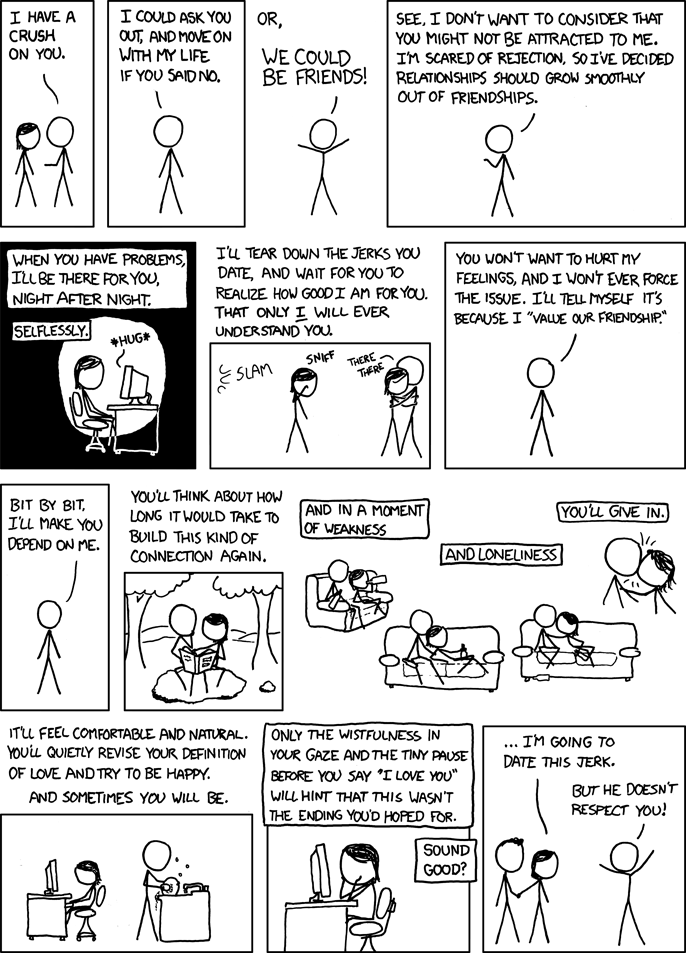
Tuesday, November 18, 2008
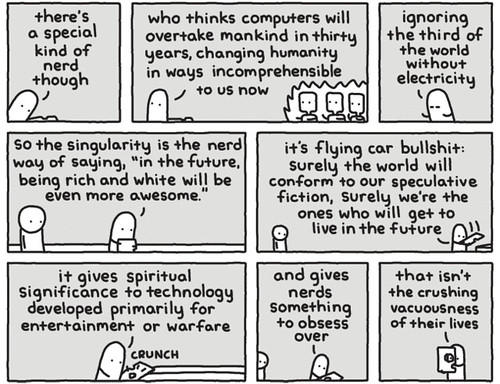
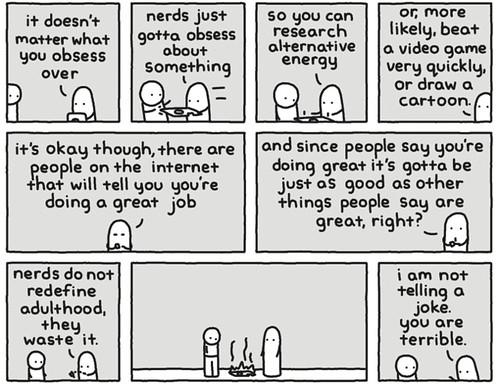
Have I told you about how nerds destroy the world? From Pictures for Sad Children, via grinding.be.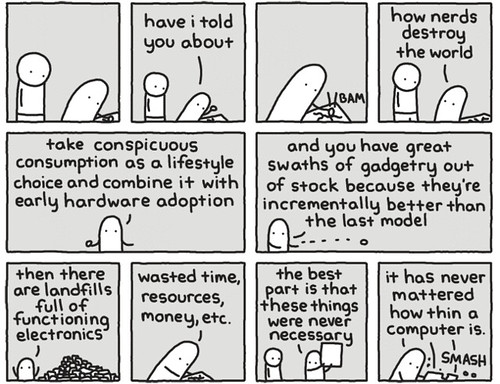
Tuesday, July 22, 2008
Ron at Digital Composting has geeked out with his books in such a way as to make a book geek like myself green with envy.
Monday, June 30, 2008
For a long time now I've ranked Billy as my top choice for the Final Cylon on Battlestar Galactica on the grounds that it would be the writers' only chance to rectify what was surely one of their worst-handled plotlines. Now I see that Ron Moore recently approached actor Paul Campbell about reprising his role as Billy—not as the final Cylon but rather as a dream figure in Roslin's subconscious (a bit from the penultimate episode of the season which ultimately went to Elosha). If the info on io9 is accurate, it seems pretty likely that Billy isn't the Final Cylon, which means I'm now laying all my chits on Cally.
And while we're on the subject, Jane Espenson should really try keeping this under her hat:
When Campbell's lack of availability changed that plan, writer Jane Espenson detailed the amount of work that created to fix the script:It's further worth noting that of course the actual identity of the Final Cylon really doesn't matter in any thematic sense, and indeed the revelation probably won't make any narrative sense at all. But I find it to be a really intriguing problem of television production—after years of build-up, and especially after last year's four-for-one season finale, how could this last plot twist ever be remotely satisfying? I must admit I'm fascinated by the problem the BSG writers have created for themselves, and I'm quite interested to see how they decide to try and solve it.In a hallmark of what I consider really fine writing, I just did a global search and replace on the name. I did not change the lines. The only thing I did... I added 'Cue the celestial trumpets.' That one phrase that Elosha has was all I did to change it.As Moore says in response, "There you go. That's how finely detailed this stuff is."


 Posts
Posts


