My blog has moved!

You should be automatically redirected to the new home page in 60 seconds. If not, please visit
http://gerrycanavan.com
and be sure to update your bookmarks. Sorry about the inconvenience.

Showing posts with label genius. Show all posts

Friday, July 31, 2009

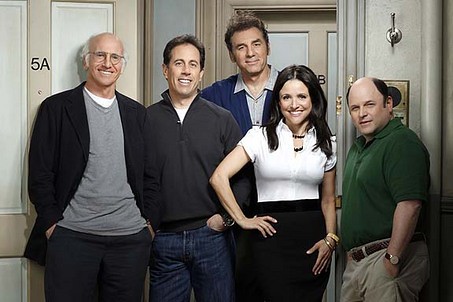
The seventh season of David's improvised HBO comedy, which returns on Sept. 20, will be centered around the TV version of David finally agreeing to do a reunion of the defining '90s sitcom. All four "Seinfeld" castmembers -- Jerry Seinfeld, Jason Alexander, Julia Louis-Dreyfus and Michael Richards -- will play themselves in multiple episodes, and the season finale will feature extensive snippets of the show-within-the-show.
It should be said again: the premise for the new season of Curb Your Enthusiasm is truly inspired.

Saturday, February 07, 2009

Saturday night's all right for blogging.

* How we kill geniuses. Via MetaFilter.

* Eleanor Clift loses one of her uncountably many demerits in agitating for Howard Dean to HHS.

* The unsustainability of sustainable energy.

* It looks like Michael Steele was the perfect person to head up the Republican party—a week on the job and he's already embroiled in a corruption scandal.

* Yes we can. Yes we did, now leave us alone.

* The University of Ottawa's Denis Rancourt has been suspended from teaching and is facing possible dismissal for promising all students an A+ on the first day of class. I think it was the + that did it—if he'd just promised them As it would have been business as usual... (via Pharyngula)

* Science fiction as religion. Via io9.

Thursday, January 08, 2009

Wasn't this an episode of Star Trek? 'Autism test would deprive the world of geniuses.'

I know damn well it was.

Tuesday, October 14, 2008

Late-blooming geniuses. Watch for the shout-out to Neil's old law firm in the first paragraph.

In his first year, Fountain sold two stories. He gained confidence. He wrote a novel. He decided it wasn’t very good, and he ended up putting it in a drawer. Then came what he describes as his dark period, when he adjusted his expectations and started again. He got a short story published in Harper’s. A New York literary agent saw it and signed him up. He put together a collection of short stories titled “Brief Encounters with Che Guevara,” and Ecco, a HarperCollins imprint, published it. The reviews were sensational. The Times Book Review called it “heartbreaking.” It won the Hemingway Foundation/PEN award. It was named a No. 1 Book Sense Pick. It made major regional best-seller lists, was named one of the best books of the year by the San Francisco Chronicle, the Chicago Tribune, and Kirkus Reviews, and drew comparisons to Graham Greene, Evelyn Waugh, Robert Stone, and John le CarrĂ©.

Ben Fountain’s rise sounds like a familiar story: the young man from the provinces suddenly takes the literary world by storm. But Ben Fountain’s success was far from sudden. He quit his job at Akin, Gump in 1988. For every story he published in those early years, he had at least thirty rejections. The novel that he put away in a drawer took him four years. The dark period lasted for the entire second half of the nineteen-nineties. His breakthrough with “Brief Encounters” came in 2006, eighteen years after he first sat down to write at his kitchen table. The “young” writer from the provinces took the literary world by storm at the age of forty-eight.

Thursday, August 07, 2008

Brain science Thursday!

* The neurological roots of genius.

* How magicians control your mind, as explained by Penn and Teller.

* Scientists acknowledge another kind of synaesthesia: a perception of sound caused by flickering images.

Thursday, February 21, 2008

The Suicide of Genius: Owen Wilson and Wes Anderson in Life and Art. At 24LiesaSecond, via The House Next Door.

The subtext of The Royal Tenenbaums is one of collisions. The sanctified world of genius, creativity and art collide with the world of contemporary psychology. Diagnosis, psychosis, breakdown, and divorce emerge like a hydra in the wings of Anderson’s work. And the point of collision is Eli Cash, played by Owen Wilson. Through Cash, Anderson’s tragic-comedic vision reaches its apex and foreshadows its decline into sentimentality and self-apologetic quirk.
Of course, as an unrepentant Wes Anderson fanboy, I don't agree that his later works are failures in this or any other way—but the thesis is interesting. And I think there's something to Lasky's idea that Anderson shifts in Tenenbaums from a model of autonomous, tragedy-laced genius towards a comparatively more hopeless one of psychological and psychochemical dysfunction:
Genius, in their early work, is ineffable, resplendent with the trappings of depressive, rumple-haired Nietzschean eccentricity and Faustian striving and discontent. Anderson as writer/director and Wilson as writer/actor depict the creative spirit that defies diagnosis as it is ratified by its own insatiable drive, as it rebels against social pressures and cultural environments. Conversely, the therapeutic imperative of our contemporary society is to contextualize and diagnose, to encourage radical self-assessment in hopes of propagating permanent stability and happiness. As of late, Anderson’s original vision has been compromised by this imperative: his idea of the troubled genius has lost its romantic cache. Its integrity as a thing of heroism and beauty has been ostensibly diagnosed.
This may go a long way towards explaining why Rushmore is so much better-loved than Zissou.