Other links:
* This post on the Golden Age of Blogging from 11D is circulating pretty widely, and generally comports with my sense of things as a longtime C-list blogger. The first-mover advantage in the blogosphere is hard to overstate, yet this is one of its more overlooked characteristics; it's still possible to "break through," but much harder, and it's nothing like it was in the glory days of 2001-2003. I often wish I'd started earlier.
* Is C-list too generous? Is there a D-list?
* Of course the real problem with this blog is its utter lack of focus, as will now be demonstrated forthwith.
* 200 Characters from Dick Tracy, 1931-1977. * U.S. gets second-to-worst grade on emissions from the WWF. The worst? Blame Canada.
* Dear Plagiarist.
* 200-year-old cipher cracked; Jefferson pwned.
* The psychology of scams. Via Schneier on Security, via this AskMe on the Craigslist check kiting scam in Canada, via Neil.
* Worst case scenarios: A bar examinant's $400,000 student loan debt (and admittedly poor history of repayment) has blocked their ability to practice law in the state of New York (and therefore ever hope to pay the loan back). Via Steve.
* And good news from India: Delhi's high court has decriminalized homosexuality. Via MeFi.
Thursday, July 02, 2009

Thursday, March 19, 2009
Misc.
* The claim that 'independent researcher' Dr. John Casson has discovered six new plays by William Shakespeare (alias Sir Henry Neville alias Christopher Marlowe alias "Tony Nuts" alias Queen Elizabeth alias Harvey the Rabbit) is all over the place today—but my proof that Shakespeare/Newfield is a time-traveling Lizard Person born 3000 A.D. remains completely ignored by the fools in the MSM.
* (South) Indian Superman. I love this video.
* Gynomite! has sitcom maps of New York City and the U.S. There's more from Dan Meth, who started it all off with the trilogy meter from not that long ago.
* WSJ.com has the latest bracketological research into the science of upsets. See also: Nate Silver crunches the numbers on Obama's shameless bias towards universities in swing states.
* Scenes from the recession, at the Big Picture.
* And a short piece at BBC News considers the science in science fiction. Of the four, Paul Cornell's gesture towards satire seems by far richest to me, especially with regard to its Darko Suvinian disdain for fantasy:
The mundane movement is challenging writers to drop ideas that once promised to be scientific ones, but are now considered as fantasy - faster than light travel, telepathy etc - and to concentrate on the problems of the human race being confined to an Earth it is using up.UPDATE: Paul responds in the comments to this notion of disdain:
But this is as much an artistic movement as an ethical one. The existence of such a movement, though, suggests that science fiction feels a sense of mission.
Unlike its cousin, fantasy, it wants to be talking about the real world in ways other than metaphorical.
One of the problems is that where once there was a consensus view, broadly, of what the future was going to be like - bases on the Moon, robots etc - post-Cold War chaos leaves everyone thrashing around, having to invent the future anew.
Artificial intelligence, aliens and easy space travel just haven't shown up. They may never do so.
It's an exciting moment, but the genre needs to be strong to survive it, and see off fantasy's vast land grabs of the territory of the stranded human heart.
Just to be clear: I love fantasy as much as SF, but we asked to talk about some of the current issues facing, specifically, SF. I think fantasy's done really well lately, and that SF has to respond to match it. No anti-fantasy thing going on there with me at all.
Saturday, November 29, 2008
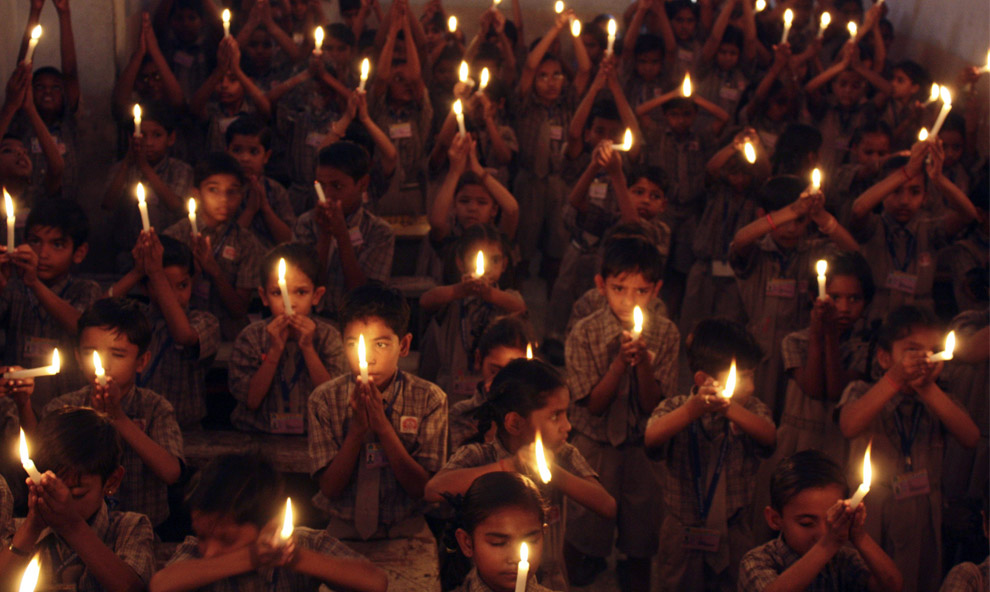
Huffington Post reports that Indian security forces have killed the last gunman in Mumbai, putting an end to the multi-day crisis. Cynical-C linked to the BBC's timeline of the attacks, and the New York Times coverage has been fairly good as well. The photo above comes from The Big Picture, which has some really striking photos.
The big question now seems to be the extent of Pakistan's involvement in the attacks, with varying reports all over. If Pakistan (or Pakistan's security apparatus, acting under its own authority) was involved, that will have very far-reaching consequences for the next few years.
Wednesday, November 26, 2008
The MetaFilter thread is, as usual, as good a source as any for information on the ongoing Mumbai terror attacks. A good and true comment from early on: "Twitter is coming of age here." Very true.
The Wikipedia page has done a good job compiling specific information on the attacks.
Horrible day.
Monday, October 20, 2008
Alastair Reynolds, echoing Ian McDonald, writes that "SF might be on the verge of exhibiting a collective loss of faith in the old dream of space travel beyond our solar system." And that may well be so, but in very real senses the dream lives on: witness the launch of India's first mission to the moon this week, the sixth such national attempt in world history. (via SF Signal)
Monday, June 02, 2008
That photo below reminds me of one of the best pieces on globalization to be found on the Internet, Arundhati Roy's essay on dams: "The Greater Common Good." I must admit I was completely naive about the realities of dam-building before reading this article; dams are actually a tremendously important site for what Marx called primitive accumulation in the contemporary moment and therefore an important location for class struggle.
In the fifty years since Independence, after Nehru's famous "Dams are the Temples of Modern India" speech (one that he grew to regret in his own lifetime), his footsoldiers threw themselves into the business of building dams with unnatural fervour. Dam-building grew to be equated with Nation-building. Their enthusiasm alone should have been reason enough to make one suspicious. Not only did they build new dams and new irrigation systems, they took control of small, traditional systems that had been managed by village communities for thousands of years, and allowed them to atrophy. To compensate the loss, the Government built more and more dams. Big ones, little ones, tall ones, short ones. The result of its exertions is that India now boasts of being the world's third largest dam builder. According to the Central Water Commission, we have three thousand six hundred dams that qualify as Big Dams, three thousand three hundred of them built after Independence. One thousand more are under construction. Yet one-fifth of our population - 200 million people - does not have safe drinking water and two-thirds - 600 million - lack basic sanitation.
Big Dams started well, but have ended badly. There was a time when everybody loved them, everybody had them - the Communists, Capitalists, Christians, Muslims, Hindus, Buddhists. There was a time when Big Dams moved men to poetry. Not any longer. All over the world there is a movement growing against Big Dams. In the First World they're being de-commissioned, blown up. The fact that they do more harm than good is no longer just conjecture. Big Dams are obsolete. They're uncool. They're undemocratic. They're a Government's way of accumulating authority (deciding who will get how much water and who will grow what where). They're a guaranteed way of taking a farmer's wisdom away from him. They're a brazen means of taking water, land and irrigation away from the poor and gifting it to the rich. Their reservoirs displace huge populations of people, leaving them homeless and destitute. Ecologically, they're in the doghouse. They lay the earth to waste. They cause floods, water-logging, salinity, they spread disease. There is mounting evidence that links Big Dams to earthquakes.
Big Dams haven't really lived up to their role as the monuments of Modern Civilisation, emblems of Man's ascendancy over Nature. Monuments are supposed to be timeless, but dams have an all-too-finite lifetime. They last only as long as it takes Nature to fill them with silt. It's common knowledge now that Big Dams do the opposite of what their Publicity People say they do - the Local Pain for National Gain myth has been blown wide open.
For all these reasons, the dam-building industry in the First World is in trouble and out of work. So it's exported to the Third World in the name of Development Aid, along with their other waste like old weapons, superannuated aircraft carriers and banned pesticides.


 Posts
Posts


