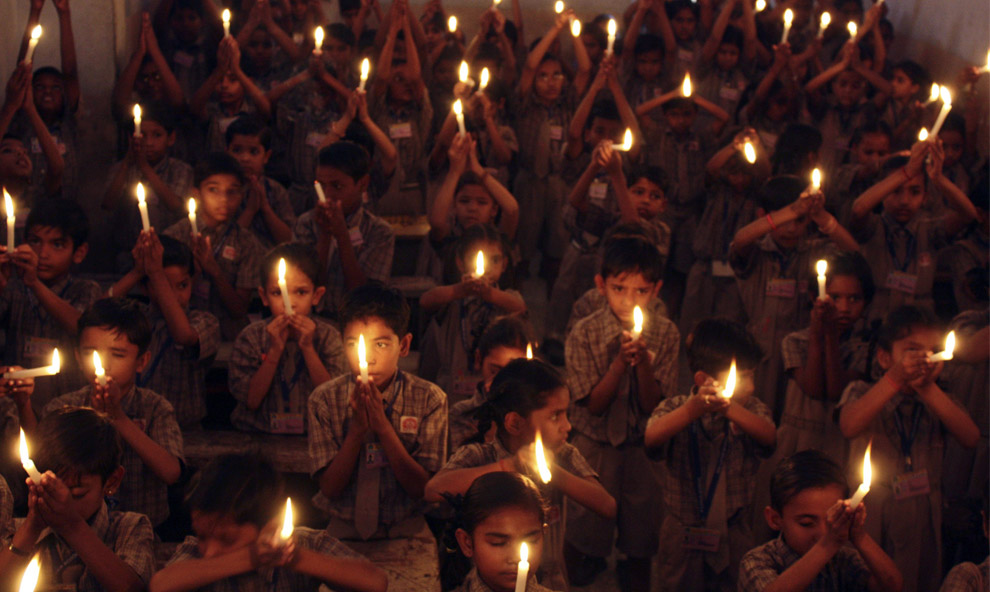
Huffington Post reports that Indian security forces have killed the last gunman in Mumbai, putting an end to the multi-day crisis. Cynical-C linked to the BBC's timeline of the attacks, and the New York Times coverage has been fairly good as well. The photo above comes from The Big Picture, which has some really striking photos.
The big question now seems to be the extent of Pakistan's involvement in the attacks, with varying reports all over. If Pakistan (or Pakistan's security apparatus, acting under its own authority) was involved, that will have very far-reaching consequences for the next few years.
Showing posts with label terror. Show all posts
Showing posts with label terror. Show all posts
Saturday, November 29, 2008

Wednesday, November 26, 2008
The MetaFilter thread is, as usual, as good a source as any for information on the ongoing Mumbai terror attacks. A good and true comment from early on: "Twitter is coming of age here." Very true.
The Wikipedia page has done a good job compiling specific information on the attacks.
Horrible day.
Monday, October 27, 2008
In addition to terrorists, "Twitter has also become a social activist tool for socialists, human rights groups, communists, vegetarians, anarchists, religious communities, atheists, political enthusiasts, hacktivists and others to communicate with each other and to send messages to broader audiences," a new paper from the U.S. Army darkly reports.
Wednesday, October 22, 2008
Tim has some nice thoughts on enmity and honesty in the context of Al Qaeda's supposed endorsement of McCain.
The point here is that the war on terror, in a historically novel way, abrogates the basic conditions of veracity that make politics a meaningful category of human discourse. If the possibility of a "terrorist" uttering a true statement is permanently witheld, there is no real enemy to fight at all--there is only our mirror image of who we are as a people. We are damned to perpetually dream up our own worst enemy--and fight ourselves to the death.We didn't need additional proof that I was a much less sophisticated and much more juvenile thinker than Tim, but my first reference for this incredibly silly argument was the Sicilian in The Princess Bride:
But it's so simple. All I have to do is divine from what I know of you: are you the sort of man who would put the poison into his own goblet or his enemy's? Now, a clever man would put the poison into his own goblet, because he would know that only a great fool would reach for what he was given. I am not a great fool, so I can clearly not choose the wine in front of you. But you must have known I was not a great fool, you would have counted on it, so I can clearly not choose the wine in front of me...
Thursday, September 04, 2008
"President Clinton had opportunities to get Osama bin Laden. President Bush had opportunities to get Osama bin Laden. I know how to do it and I'll do it," he told ABC's "World News" in an interview.Country first, John—call up Bush right now and tell him how. Via kos.
UPDATE: And it's a good thing Sarah Palin will be there beside him to help him with that new Cold War he's been trying to gin up:
GIBSON: Can you honestly say you feel confident having someone who hasn’t traveled outside the United States until last year, dealing with an insurgent Russia, with an Iran with nuclear ambitions, with an unstable Pakistan, not to mention the war on terror?
MCCAIN: Sure. And one of the key elements of America’s national security requirements are energy. She understands the energy issues better than anybody I know in Washington, D.C., and she understands. Alaska is right next to Russia. She understands that.
Monday, July 14, 2008
ACLU: 'Terrorist Watch List Hits One Million Names.' Hecukva job. Via Matt Yglesias.
Wednesday, June 18, 2008
"There is no longer any doubt that the current administration committed war crimes," [Major Gen. Antonio] Taguba says. "The only question is whether those who ordered torture will be held to account."
Saturday, May 31, 2008
The SITE intelligence group, which monitors terrorist Web sites, recently had a big find: images from a terrorist simulation of Washington, D.C. destroyed by a nuclear bomb.
Turns out the image was from Fallout 3.
Thursday, May 08, 2008
Colbert has an update on the superhuge terror list I blogged about a few weeks ago: it turns out notorious freedom-hater Nelson Mandela is on it.
Here's a BBC report with more.
Friday, March 28, 2008
As you can see, I've been slack blogging the last day or so—I've been catching up with other things. Here are a few Friday links to keep us busy:
* I've got a short review in the Indy of Harvey Pekar's new book on the history of Students for a Democratic Society.
* Joseph Romm of Climate Progress has an article at Salon arguing "it won't be easy but we can fix our oil and climate problems at the same time."
Thus we come to one of the biggest questions of our time: Is humanity wise enough not to pursue carbon-intensive alternative fuels, even though pretty much all of them are economically profitable at current oil prices?Wisdom! Curses! Our one weakness!
* A judge has ruled that Wal-Mart doesn't have a trademark on the smiley face.
* Also at Boing Boing, a bed that will protect you from the terrorists.
Wednesday, March 12, 2008
Bad news, 'muricans: there are 900,000 terrorists among us. That's right; 1 in 300 people is a terrorist. I'll let that sink in.
This is why we can't have nice things civil liberties.
Saturday, February 16, 2008
It sounds like the setup for a lame joke, but Jon Stewart and John Hodgman draw on reports of al Qaeda application forms for some actually very funny jokes.
Thursday, January 17, 2008
Things to be outraged about this Thursday night:
* When people say the surge is working, they mean that fewer American troops are dying each month in Iraq. I'm certainly glad this is the case—but I do regret that the accompanying escalation in air strikes that has made this possible has gone so underreported.The U.S.-led coalition dropped 1,447 bombs on Iraq last year, an average of nearly four a day, compared with 229 bombs, or about four each week, in 2006.Lenin's Tomb and Matt Yglesias have more commentary, skepticism, sorrow, and distrust.
...
The greater reliance on air power has raised concerns from human rights groups, which say that 500-pound and 2,000-pound munitions threaten civilians, especially when dropped in residential neighborhoods where insurgents mix with the population. The military assures that the precision attacks are designed to minimize civilian casualties -- particularly as Petraeus's counterinsurgency strategy emphasizes moving more troops into local communities and winning over the Iraqi population -- but rights groups say bombings carry an especially high risk.
* Authorities are investigating the death of a 29-year-old Fridley man shot with a Taser by state troopers, who said he had become "uncooperative" after a rush-hour crash Tuesday evening.
* Almost 9% of money donated by Duke faculty to political campaigns went to Republicans. The rest went to Democrats, overwhelmingly Obama and Edwards. Was it really that much? Outrage!
* Bin Laden's son wants to be a peace activist. I suppose this ought to warm my heart or something, but no, it didn't work.
Saturday, December 29, 2007
Is the wind finally shifting on airport security? I feel as though I've been seeing a lot of articles lately like this one at the Times's new "Jet Lagged" blog:
No matter that a deadly sharp can be fashioned from virtually anything found on a plane, be it a broken wine bottle or a snapped-off length of plastic, we are content wasting billions of taxpayer dollars and untold hours of labor in a delusional attempt to thwart an attack that has already happened, asked to queue for absurd lengths of time, subject to embarrassing pat-downs and loss of our belongings.Read the whole thing. Also via M.Y.
Thursday, December 20, 2007
 About halfway through my reading of Best American Essays I began to feel very sick of David Foster Wallace's taste in writing. About half the fault would seem to lie with the alphabet—for whatever reason the best essays seem to fall at the beginning and end of the alphabet this year—and the other half would seem to lie with Wallace himself. A lot of these just didn't strike me as "the best" of anything, much less of the best of 2007—this is all pretty milquetoast, and I found myself flipping a lot of pages.
But definitely trudge through until you read Elaine Scarry's exemplary "Rules of Engagement," which I found to be one of the better essays I've yet read on the subject of the Bush administration and the laws of war. It's indispensable, really, laying out the justification for the relevant Geneva convention and then walking you through Bush's wholesale abuse of it. Lucky for us, it's online:
So severe is the rule protecting the signs of truce and medical care that it cannot be suspended, even for the sake of escape, a circumstance that often permits a relaxation of the rules. For example, it is permissible, for the purpose of escape, to take off one’s uniform and wear civilian clothes, an act impermissible in any other context. 5 In contrast, it is never permissible for uninjured soldiers to travel in an ambulance, whether they are moving forward into battle or trying to escape from it.It's an important essay. Read it.
The stark prohibition on the false use of the red cross is derived from a logically prior and overarching prohibition: that a Red Cross vehicle or building cannot itself be the target of assault. It is because all participants are obligated to regard the white flag and red cross as inviolable that a secondary obligation arises not to use either sign falsely. As the Air Force manual observes, “The rule prohibiting feigning hors de combat status, such as sickness, distress or death, in order to commit or resume hostilities is only a corollary rule to the principle prohibiting attacks on persons who are hors de combat.”
What, then, are we to make of the joint Army–Navy–Air Force mission to storm al Nasiriyah General Hospital to take back the injured prisoner of war Private Jessica Lynch? The people of the United States were asked by their government to bear collective witness to this mission—to take it, and honor it, as our national war story. If the narrative captivated national attention, it did so in part because the deeds were so fresh, so unheard of—but they were fresh and unheard of because such deeds are not ordinarily performed, and they are not ordinarily performed because to storm a hospital is to be guilty of perfidy: it is a violation of the primary and overarching prohibition from which the perfidy prohibition is derived.
Did anyone present at the planning session for this mission have a handbook of military rules available? Did anyone object to the plan? 6 For the U.S. Special Forces to drive up to the hospital in Nasiriyah in a fleet of ambulances would of course have been a clear act of perfidy. So, too, was it an act of perfidy to arrive at the threshold of the hospital in a fleet of military tanks and helicopters loaded with Navy Seals, Army Rangers, and Air Force pilots, who spilled through the corridors at midnight, breaking down doors and blasting guns. Upon hearing the roar of approaching machinery, the hospital staff, according to their reports, fled to the basement. Inciting members of a medical staff to abandon their posts beside their patients for several hours is a concrete harm, though if they had not abandoned their posts, the United States might now have the slaying of medical personnel and hospital administrators on its hands.
Other highlights:
Jo Ann Beard's "Werner," from Tin House [excerpt]
Mark Greif's "Afternoon of the Sex Children" from n+1 (maybe the best essay I've read on the subject of the late twentieth-century's hypersexualization of children)
George Gessert's "An Orgy of Power" from Northwest Review (on torture, and quite good)
Peter Singer's "What Should a Billionaire Give—and What Should You?" from the New York Times Sunday Magazine
Now let’s look at the incomes of America’s rich and superrich, and ask how much they could reasonably give. The task is made easier by statistics recently provided by Thomas Piketty and Emmanuel Saez, economists at the École Normale Supérieure, Paris-Jourdan, and the University of California, Berkeley, respectively, based on U.S. tax data for 2004. Their figures are for pretax income, excluding income from capital gains, which for the very rich are nearly always substantial. For simplicity I have rounded the figures, generally downward. Note too that the numbers refer to “tax units,” that is, in many cases, families rather than individuals.Jerald Walker, "Dragon Slayers" from The Iowa Review (on writing, particularly African-American writing)
Piketty and Saez’s top bracket comprises 0.01 percent of U.S. taxpayers. There are 14,400 of them, earning an average of $12,775,000, with total earnings of $184 billion. The minimum annual income in this group is more than $5 million, so it seems reasonable to suppose that they could, without much hardship, give away a third of their annual income, an average of $4.3 million each, for a total of around $61 billion. That would still leave each of them with an annual income of at least $3.3 million.
Next comes the rest of the top 0.1 percent (excluding the category just described, as I shall do henceforth). There are 129,600 in this group, with an average income of just over $2 million and a minimum income of $1.1 million. If they were each to give a quarter of their income, that would yield about $65 billion, and leave each of them with at least $846,000 annually.
The top 0.5 percent consists of 575,900 taxpayers, with an average income of $623,000 and a minimum of $407,000. If they were to give one-fifth of their income, they would still have at least $325,000 each, and they would be giving a total of $72 billion.
Coming down to the level of those in the top 1 percent, we find 719,900 taxpayers with an average income of $327,000 and a minimum of $276,000. They could comfortably afford to give 15 percent of their income. That would yield $35 billion and leave them with at least $234,000.
Finally, the remainder of the nation’s top 10 percent earn at least $92,000 annually, with an average of $132,000. There are nearly 13 million in this group. If they gave the traditional tithe — 10 percent of their income, or an average of $13,200 each — this would yield about $171 billion and leave them a minimum of $83,000.
You could spend a long time debating whether the fractions of income I have suggested for donation constitute the fairest possible scheme. Perhaps the sliding scale should be steeper, so that the superrich give more and the merely comfortable give less. And it could be extended beyond the Top 10 percent of American families, so that everyone able to afford more than the basic necessities of life gives something, even if it is as little as 1 percent. Be that as it may, the remarkable thing about these calculations is that a scale of donations that is unlikely to impose significant hardship on anyone yields a total of $404 billion — from just 10 percent of American families.
Edward O. Wilson, "Apocalypse Now" from The New Republic (on environmental catastrophe)
As usual, I wish more of the good essays were online. But then you'd have no reason to buy the book, and it's worth it for these alone even if the overall selection struck me as significantly weaker than it's been in past years.
Friday, November 23, 2007
Meanwhile, what the hell is going on in Afghanistan? [link fixed] Admittedly, I haven't been following things closely in the last few months, but I had no idea it had gotten so bad. The Senlis Commission [100-page pdf] reports that the Taliban now has a "permanent presence" in more than half the country, and a "substantial presence" in nearly the whole thing—and are poised to retake Kabul (!) by 2008. John weekend-blogging at Ezra Klein's place has more.
Wednesday, November 14, 2007
Obviously posting took a backseat to real-life nonsense today. But I did look at the Internets. Here's what I looked at.
* The House Next Door and SF Signal try to figure out whether this season of Heroes is back on track.
* Gang of 100? Via Lenin's Tomb, Columbia president Lee Bollinger receives a "statement of concern" from over 100 faculty members partly in response to his poor behavior during Mahmoud Ahmadinejad's visit.
* Nicholas Guyatt reviews Chris Hedges's American Fascists: The Christian Right and the War on America for London Review of Books. I linked to Hedges a bit on the old blog earlier in the year, when this book was getting a lot of hype—I'm curious why this review comes so late. I'm also surprised to see Guyatt take such a skeptical attitude towards Hedges's thesis. I haven't read American Fascists, but my impression has been that the book is about the (very real) dominionist movement within American evangelicism, not an assertion that all evangelicals are dominionists. And what to make of this:
It would be a mistake to imagine that the religious right has controlled American politics for the past quarter-century. Despite the present spate of books decrying a fundamentalist takeover of the Republican Party, there has been plenty for evangelicals to complain about even since the triumphs of Bush and Karl Rove. As Thomas Frank argued in 2004 in his book What’s the Matter with Kansas?, the striking thing about the Republican alliance with evangelicals has been the thinness of their legislative achievements: abortion is still legal, campaigners for gay rights have made real strides and the wall between church and state remains largely intact in American classrooms. Frank suggested that legislators had pulled off a confidence trick in their courting of evangelicals.The truth is precisely this: the religious right has controlled American politics for the past quarter-century without actually getting any of the things they want. What happens when they finally realize they've been hoodwinked? Hedges has this right; the business wing of the Republican Party is locked into an alliance with powerful and dangerous forces it will not necessarily be able to control forever.
* NYU students would trade their right to vote for an iPod. Can you blame them? In a country so completely gerrymandered on both a macro (Electoral College) and micro (Congressional district) scale, voting is more or less a fraud across the board. The vote of someone living in New York City isn't even worth an iPod; the vote of someone in Florida or Ohio, maybe, but only just.
* Train passengers face routine airline-style bag checks and body searches as part of a new counter-terror crackdown announced by Gordon Brown. Next up, strip searches. Freedom isn't free.
Wednesday, November 07, 2007
The FBI sifted through customer data collected by San Francisco-area grocery stores in 2005 and 2006, hoping that sales records of Middle Eastern food would lead to Iranian terrorists. Via Krugman.
Tuesday, November 06, 2007
Welcome to George Bush's America: The FBI will detain, harass, and deport anyone you accuse of being a terrorist. No evidence required.
The wife didn't want him to travel since she was sick and wanted him to help care for their children, regional daily Sydsvenska Dagbladet said without disclosing the couple's names.Via Boing Boing.
When the husband refused to stay home, his father-in-law wrote an email to the FBI saying the son-in-law had links to al-Qaeda in Sweden and that he was travelling to the US to meet his contacts.
He provided information on the flight number and date of arrival in the US.
The son-in-law was arrested upon landing in Florida. He was placed in handcuffs, interrogated and placed in a cell for 11 hours before being put on a flight back to Europe, the paper said.
Saturday, September 29, 2007
Another busy day, but here are some links:
* Jeff Bigler suggests that the difference between nerds and normals is all about the directionality of the tact filter. Via Geekpress.
* Do you write like a terrorist? Via Backwards City and my dad.
* Vintage photographs of American cities from the middle of the 20th century. Via MeFi.


 Posts


