My blog has moved!

You should be automatically redirected to the new home page in 60 seconds. If not, please visit
http://gerrycanavan.com
and be sure to update your bookmarks. Sorry about the inconvenience.

Showing posts with label paranoia. Show all posts

Sunday, March 08, 2009

I've always secretly believed my cleverness and quick reflexes will protect me in any emergency, which is why I fear airplanes and sudden debilitating strokes far more than driving or muggings. At long last, science has confirmed this phobic hierarchy.

People's reaction times are a far better indicator of their chances of living a long life than their blood pressure, exercise levels or weight, researchers have discovered.

Men and women with the most sluggish response times are more than twice as likely to die prematurely.

Friday, January 09, 2009

Linkdump!

* The headline reads, "Mystery Roar from Faraway Space Detected."

* Probably the stupidest thing ever published in the L.A. Times: a bald anti-science assertion that deadly allergies don't exist.

* 'Going Under': Doctors addicted to drugs. Via MeFi.

* Valuating Facebook in terms of Whoppers.

* I don't know if I'm more worried that my insomnia will lead to paranoia or Exploding Head syndrome.

* News that by this point will surprise no one: Arctic melt 20 years ahead of climate models.

* Legislation has been introduced for a post-Bush truth and reconciliation commission. This is something that is sorely needed, and I hope the Democratic leadership puts its full weight behind it.

* Blago: owned. More discussion here.

* The literary world is abuzz with news of Jack Torrance's latest, All Work and No Play Makes Jack a Dull Boy.

* Cory Doctorow on writing in an age of distraction.

* Things not to do: buying a $1000 house in Detroit. Big ups to Cleveland, which is apparently turning into Detroit.

(Thanks to Bill for some of these!)

Friday, January 02, 2009

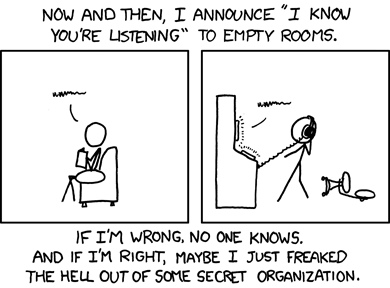
Pascal's Wager came up in at least three different conversations today. That's how I know Randall Munroe is listening to everything I say and do.

Monday, October 27, 2008

In addition to terrorists, "Twitter has also become a social activist tool for socialists, human rights groups, communists, vegetarians, anarchists, religious communities, atheists, political enthusiasts, hacktivists and others to communicate with each other and to send messages to broader audiences," a new paper from the U.S. Army darkly reports.

Friday, July 25, 2008

I'm only now discovering the names for my pathologies: behold Truman Show Delusion. Via Boing Boing.

Saturday, May 31, 2008

The SITE intelligence group, which monitors terrorist Web sites, recently had a big find: images from a terrorist simulation of Washington, D.C. destroyed by a nuclear bomb.


Turns out the image was from Fallout 3.

Wednesday, May 21, 2008

According to a senior government official who served with high-level security clearances in five administrations, "There exists a database of Americans, who, often for the slightest and most trivial reason, are considered unfriendly, and who, in a time of panic, might be incarcerated. The database can identify and locate perceived 'enemies of the state' almost instantaneously." He and other sources tell Radar that the database is sometimes referred to by the code name Main Core. One knowledgeable source claims that 8 million Americans are now listed in Main Core as potentially suspect. In the event of a national emergency, these people could be subject to everything from heightened surveillance and tracking to direct questioning and possibly even detention.
Meanwhile, in George Bush's America, bad things continue to happen. More at MetaFilter and ThinkProgress.

The prize for understated gallows humor goes to the very first comment at the article itself:
I find it very difficult to believe that Dick Cheney would be part of anything that was not in our best interest.

Posted by: escoBam on May 20, 2008 12:22 AM

Thursday, May 08, 2008

Colbert has an update on the superhuge terror list I blogged about a few weeks ago: it turns out notorious freedom-hater Nelson Mandela is on it.


Here's a BBC report with more.

Tuesday, March 25, 2008

Man, I've been slack today. Here are a few things I've been looking at:

* A list of science fiction with a linguist bent.
* 'The Return of the Paranoid Style': How Iraq brought us not John Wayne but Jason Bourne.
* Every bit of spoiler news there is about the upcoming season of Battlestar Galactica.
* New York Governor David Peterson's daily revelations are becoming sort of hilarious.
* Eric Alterman on the death of the American newspaper.
* The end of suburbia, this time in the Boston Review.
* We're #22! We're #22!

Wednesday, March 12, 2008

Bad news, 'muricans: there are 900,000 terrorists among us. That's right; 1 in 300 people is a terrorist. I'll let that sink in.

This is why we can't have nice things civil liberties.

Friday, February 15, 2008

I've been blogging for a few years now, and over that time I've linked to Philip K. Dick related material a whole lot of times. Here, in honor of reading Dr. Bloodmoney this week, are just a few PKD highlights, all to the glory of the man Fredric Jameson once called "the Shakespeare of science fiction":

* "How to Build a Universe That Doesn't Fall Apart Two Days Later." In some ways this is the definitive PKD essay, and it's the one referenced somewhat famously at the end of Waking Life. [+/-]

It was always my hope, in writing novels and stories which asked the question "What is reality?", to someday get an answer. This was the hope of most of my readers, too. Years passed. I wrote over thirty novels and over a hundred stories, and still I could not figure out what was real. One day a girl college student in Canada asked me to define reality for her, for a paper she was writing for her philosophy class. She wanted a one-sentence answer. I thought about it and finally said, "Reality is that which, when you stop believing in it, doesn't go away." That's all I could come up with. That was back in 1972. Since then I haven't been able to define reality any more lucidly.

But the problem is a real one, not a mere intellectual game. Because today we live in a society in which spurious realities are manufactured by the media, by governments, by big corporations, by religious groups, political groups—and the electronic hardware exists by which to deliver these pseudo-worlds right into the heads of the reader, the viewer, the listener. Sometimes when I watch my eleven-year-old daughter watch TV, I wonder what she is being taught. The problem of miscuing; consider that. A TV program produced for adults is viewed by a small child. Half of what is said and done in the TV drama is probably misunderstood by the child. Maybe it's all misunderstood. And the thing is, Just how authentic is the information anyhow, even if the child correctly understood it? What is the relationship between the average TV situation comedy to reality? What about the cop shows? Cars are continually swerving out of control, crashing, and catching fire. The police are always good and they always win. Do not ignore that point: The police always win. What a lesson that is. You should not fight authority, and even if you do, you will lose. The message here is, Be passive. And—cooperate. If Officer Baretta asks you for information, give it to him, because Officer Beratta is a good man and to be trusted. He loves you, and you should love him.

So I ask, in my writing, What is real? Because unceasingly we are bombarded with pseudo-realities manufactured by very sophisticated people using very sophisticated electronic mechanisms. I do not distrust their motives; I distrust their power. They have a lot of it. And it is an astonishing power: that of creating whole universes, universes of the mind. I ought to know. I do the same thing. It is my job to create universes, as the basis of one novel after another. And I have to build them in such a way that they do not fall apart two days later. Or at least that is what my editors hope. However, I will reveal a secret to you: I like to build universes which do fall apart. I like to see them come unglued, and I like to see how the characters in the novels cope with this problem. I have a secret love of chaos. There should be more of it. Do not believe—and I am dead serious when I say this—do not assume that order and stability are always good, in a society or in a universe. The old, the ossified, must always give way to new life and the birth of new things. Before the new things can be born the old must perish. This is a dangerous realization, because it tells us that we must eventually part with much of what is familiar to us. And that hurts. But that is part of the script of life. Unless we can psychologically accommodate change, we ourselves begin to die, inwardly. What I am saying is that objects, customs, habits, and ways of life must perish so that the authentic human being can live. And it is the authentic human being who matters most, the viable, elastic organism which can bounce back, absorb, and deal with the new.

Of course, I would say this, because I live near Disneyland, and they are always adding new rides and destroying old ones. Disneyland is an evolving organism. For years they had the Lincoln Simulacrum, like Lincoln himself, was only a temporary form which matter and energy take and then lose. The same is true of each of us, like it or not.
* Another great essay at Grey Lodge Occult Review: "If You Find This World Bad, You Should See Some of the Others."
We are accustomed to supposing that all change takes place along the linear time axis: from past to present to future. The present is an accrual of the past and is different from it. The future will accrue from the present on and be different yet. That an orthogonal or right-angle time axis could exist, a lateral domain in which change takes place -- processes occuring sideways in reality, so to speak -- this is almost impossible to imagine. How would we perceive such lateral changes? What would we experience? What clues -- if we are trying to test out this bizarre theory -- should we be on the alert for? In other words, how can change take place outside of linear time at all, in any sense, to any degree?
* R. Crumb's comic, "The Religious Experience of Philip K. Dick."

* The first law of kipple is that kipple drives out nonkipple.

* Philip K. Dick and drugs.

* Philip K. Dick on Kurt Vonnegut. [+/-]
Interviewer: What did you think of Vonnegut’s attitude towards his characters (in Breakfast of Champions)?

PKD: Disgusting and an abomination. I think that that book is an incredible drying up of the liquid sap of life in the veins of a person like a dead tree…that’s what I think. I also love Kurt Vonnegut.
* Philip K. Dick and the Kennedy Assassination. (Warning: spoilers for the last book we're going to read this semester, also a Dick novel, Dr. Futurity.)

* Profiles of Philip K. Dick from The New Yorker, The Washington Post, and the Times. Interviews with Philip K. Dick. Lethem on Philip K. Dick. Again. Stanislaw Lem on PKD.

* Jameson on Dr. Bloodmoney.

(cross-posted at culturemonkey)

Saturday, December 29, 2007

Is the wind finally shifting on airport security? I feel as though I've been seeing a lot of articles lately like this one at the Times's new "Jet Lagged" blog:

No matter that a deadly sharp can be fashioned from virtually anything found on a plane, be it a broken wine bottle or a snapped-off length of plastic, we are content wasting billions of taxpayer dollars and untold hours of labor in a delusional attempt to thwart an attack that has already happened, asked to queue for absurd lengths of time, subject to embarrassing pat-downs and loss of our belongings.
Read the whole thing. Also via M.Y.

Sunday, December 23, 2007

The TSA is now as unpopular as the IRS, according to an AP poll, and quite rightly so. Only FEMA is more hated.

Cory Doctorow's comments get at the heart of this:

How does any of this make us safer? Take away our liquids, leave us with our laptop batteries. Screen us before we get to the terminal -- but leave hundreds of people bunched up in the security queue, in a handy, bomb-friendly knot. Short of knocking us out and tying us up, they're not going to render us harmless.
But the point has never been to make us safe, just to make it look like they are, and to make us paranoid about what might happen if we don't carefully examine every person's Ziploc bag of toothpaste and shampoo, if we don't harass and humiliate every person who wants to get on a plane.

I'll know the madness of the Bush years is finally over when I can wear my sneakers through the checkpoint again, drinking a bottle of water. I think it'll be a long, long time, though.