More infodump.
* Tentherism goes even more mainstream.
* Republicans vs. America's changing demographics.
* There's another excerpt from Žižek's First as Tragedy, Then as Farce online, this time at the London Review of Books.
* Why I Am Not A Catholic: "Catholic Church Says It Will Stop Charity Work If D.C. Passes Gay Marriage Law." Steve Benen isn't above quoting the Book of Matthew over this.
* In Obama's America, people wear hats on their feet, hamburgers eat people, and criminals are tried in courts of law. I should note that Glenn Greenwald says this isn't quite the big step forward it appears to be.
* What happened after Kelo vs. City of New London?
* Fantastic Mr. Fox reviews. Oh, to live in New York.
Showing posts with label charity. Show all posts
Showing posts with label charity. Show all posts
Saturday, November 14, 2009

Friday, November 21, 2008
Every year the Greensboro MFA program has a "Will Read for Food" event raising money for local charities. This year's program is now online at the News & Record's site.
Monday, March 17, 2008
My good friend Tim is running his annual fundraising drive to raise funds towards education expenses in a Nicaraguan family.
For the last couple of years, I have been raising money to help send my former host sister in rural Nicaragua to high school. This year, Iveth is set to graduate -- an AMAZING feat considering the odds a woman of her means faces -- and I am determined not only to assist her in her final year of secondary school, but also to begin raising funds for her younger sister, Joselin. Last year the department came together and raised around $450; this year I'm hoping to raise $880.All the details are here...
If you are interested in helping or learning more about this project, please visit my website to read about Iveth and Joselin's story:
http://ivethbetancour.blogspot.com/
Please consider donating. Schooling in Nicaragua is free; we are merely trying to raising the funds they need to cover transportation costs -- about $1.75 a day per student. A donation of $10 sends Iveth or Joselin to school for more than a week.
Friday, December 21, 2007
826NYC is hosting a unique fundraiser: a Scrabble for Cheaters tournament. Each team is allowed to purchase one-use cheats based on the amount of money they raised for the charity:
1. Trade out a letter—$25My money's on Team Hodgmoliver. (Yes, apparently it's really them.) The real question is whether or not the prices for these cheats make sense. I play a lot of Scrabble these days, and I'm pretty sure that "Flip a letter over and make it blank" is way undervalued, while "Passport" and "Consult the dictionary" are way overvalued. (Keep in mind turns are timed at two minutes.) "Reject another team's word" also makes "Invent a word" a very sticky proposition... Via Kottke.
2. Wheel of Fortune: buy a vowel—$50
3. Flip a letter over and make it blank—$100
4. Add 10 to any letter’s value—$150
5. Add Q, Z, or X to any word, anywhere—$200
6. Passport: play a word in any language—$250
7. Consult the dictionary for one turn—$300
8. Consult the Scrabble word list for one turn—$400
9. Reject another team’s word—$450
10. Invent a word (must have a definition)—$500
Thursday, December 20, 2007
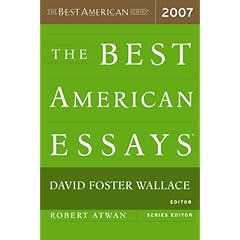 About halfway through my reading of Best American Essays I began to feel very sick of David Foster Wallace's taste in writing. About half the fault would seem to lie with the alphabet—for whatever reason the best essays seem to fall at the beginning and end of the alphabet this year—and the other half would seem to lie with Wallace himself. A lot of these just didn't strike me as "the best" of anything, much less of the best of 2007—this is all pretty milquetoast, and I found myself flipping a lot of pages.
But definitely trudge through until you read Elaine Scarry's exemplary "Rules of Engagement," which I found to be one of the better essays I've yet read on the subject of the Bush administration and the laws of war. It's indispensable, really, laying out the justification for the relevant Geneva convention and then walking you through Bush's wholesale abuse of it. Lucky for us, it's online:
So severe is the rule protecting the signs of truce and medical care that it cannot be suspended, even for the sake of escape, a circumstance that often permits a relaxation of the rules. For example, it is permissible, for the purpose of escape, to take off one’s uniform and wear civilian clothes, an act impermissible in any other context. 5 In contrast, it is never permissible for uninjured soldiers to travel in an ambulance, whether they are moving forward into battle or trying to escape from it.It's an important essay. Read it.
The stark prohibition on the false use of the red cross is derived from a logically prior and overarching prohibition: that a Red Cross vehicle or building cannot itself be the target of assault. It is because all participants are obligated to regard the white flag and red cross as inviolable that a secondary obligation arises not to use either sign falsely. As the Air Force manual observes, “The rule prohibiting feigning hors de combat status, such as sickness, distress or death, in order to commit or resume hostilities is only a corollary rule to the principle prohibiting attacks on persons who are hors de combat.”
What, then, are we to make of the joint Army–Navy–Air Force mission to storm al Nasiriyah General Hospital to take back the injured prisoner of war Private Jessica Lynch? The people of the United States were asked by their government to bear collective witness to this mission—to take it, and honor it, as our national war story. If the narrative captivated national attention, it did so in part because the deeds were so fresh, so unheard of—but they were fresh and unheard of because such deeds are not ordinarily performed, and they are not ordinarily performed because to storm a hospital is to be guilty of perfidy: it is a violation of the primary and overarching prohibition from which the perfidy prohibition is derived.
Did anyone present at the planning session for this mission have a handbook of military rules available? Did anyone object to the plan? 6 For the U.S. Special Forces to drive up to the hospital in Nasiriyah in a fleet of ambulances would of course have been a clear act of perfidy. So, too, was it an act of perfidy to arrive at the threshold of the hospital in a fleet of military tanks and helicopters loaded with Navy Seals, Army Rangers, and Air Force pilots, who spilled through the corridors at midnight, breaking down doors and blasting guns. Upon hearing the roar of approaching machinery, the hospital staff, according to their reports, fled to the basement. Inciting members of a medical staff to abandon their posts beside their patients for several hours is a concrete harm, though if they had not abandoned their posts, the United States might now have the slaying of medical personnel and hospital administrators on its hands.
Other highlights:
Jo Ann Beard's "Werner," from Tin House [excerpt]
Mark Greif's "Afternoon of the Sex Children" from n+1 (maybe the best essay I've read on the subject of the late twentieth-century's hypersexualization of children)
George Gessert's "An Orgy of Power" from Northwest Review (on torture, and quite good)
Peter Singer's "What Should a Billionaire Give—and What Should You?" from the New York Times Sunday Magazine
Now let’s look at the incomes of America’s rich and superrich, and ask how much they could reasonably give. The task is made easier by statistics recently provided by Thomas Piketty and Emmanuel Saez, economists at the École Normale Supérieure, Paris-Jourdan, and the University of California, Berkeley, respectively, based on U.S. tax data for 2004. Their figures are for pretax income, excluding income from capital gains, which for the very rich are nearly always substantial. For simplicity I have rounded the figures, generally downward. Note too that the numbers refer to “tax units,” that is, in many cases, families rather than individuals.Jerald Walker, "Dragon Slayers" from The Iowa Review (on writing, particularly African-American writing)
Piketty and Saez’s top bracket comprises 0.01 percent of U.S. taxpayers. There are 14,400 of them, earning an average of $12,775,000, with total earnings of $184 billion. The minimum annual income in this group is more than $5 million, so it seems reasonable to suppose that they could, without much hardship, give away a third of their annual income, an average of $4.3 million each, for a total of around $61 billion. That would still leave each of them with an annual income of at least $3.3 million.
Next comes the rest of the top 0.1 percent (excluding the category just described, as I shall do henceforth). There are 129,600 in this group, with an average income of just over $2 million and a minimum income of $1.1 million. If they were each to give a quarter of their income, that would yield about $65 billion, and leave each of them with at least $846,000 annually.
The top 0.5 percent consists of 575,900 taxpayers, with an average income of $623,000 and a minimum of $407,000. If they were to give one-fifth of their income, they would still have at least $325,000 each, and they would be giving a total of $72 billion.
Coming down to the level of those in the top 1 percent, we find 719,900 taxpayers with an average income of $327,000 and a minimum of $276,000. They could comfortably afford to give 15 percent of their income. That would yield $35 billion and leave them with at least $234,000.
Finally, the remainder of the nation’s top 10 percent earn at least $92,000 annually, with an average of $132,000. There are nearly 13 million in this group. If they gave the traditional tithe — 10 percent of their income, or an average of $13,200 each — this would yield about $171 billion and leave them a minimum of $83,000.
You could spend a long time debating whether the fractions of income I have suggested for donation constitute the fairest possible scheme. Perhaps the sliding scale should be steeper, so that the superrich give more and the merely comfortable give less. And it could be extended beyond the Top 10 percent of American families, so that everyone able to afford more than the basic necessities of life gives something, even if it is as little as 1 percent. Be that as it may, the remarkable thing about these calculations is that a scale of donations that is unlikely to impose significant hardship on anyone yields a total of $404 billion — from just 10 percent of American families.
Edward O. Wilson, "Apocalypse Now" from The New Republic (on environmental catastrophe)
As usual, I wish more of the good essays were online. But then you'd have no reason to buy the book, and it's worth it for these alone even if the overall selection struck me as significantly weaker than it's been in past years.


 Posts
Posts


