My blog has moved!

You should be automatically redirected to the new home page in 60 seconds. If not, please visit
http://gerrycanavan.com
and be sure to update your bookmarks. Sorry about the inconvenience.

Showing posts with label satire. Show all posts

Monday, October 26, 2009

A few Monday links.

* NJ-GOV Watch: As yet another ethics scandal hits Chris Christie, a poll shows him down 42-33 to Corzine. I think this particular poll is probably an outlier, but nonetheless I think Corzine may actually win this thing.

* Looking through Steve Benen's newsfeed this morning I was struck by how many stories he's found in the last few days about Republicans baldly misreporting clearly labeled satire as fact. Glenn Beck: Nancy Pelosi to ban Fox News! Rush Limbaugh: Obama's nonexistent thesis hates America! Of course, they just make things up, too.

* Airlock Alpha says Battlestar Galactica: The Plan is worse than Razor. That's too bad, because Razor really wasn't very good. The reviewer makes a great point here:

At the same time, the most interesting parts of the Cylon story were cut out or not even considered for this film. Really!

I mean, look at this way. You had the Final Five who show up in the middle of the first Cylon war. They offer the Centurions evolutionary advancement in terms of resurrection and becoming more like their human creators, so the war ends. After the skinjobs are created, the Cylons try to simply live their lives away from the humans, but Cavil wants revenge.

When the Final Five get in his way, he kills them, and then resurrects them, depositing them all over the Twelve Colonies, giving them a front-row seat to the holocaust he's about to unleash.

This is great storytelling by itself. Except we only get the end of this tale in "The Plan." We don't get to see the Final Five arrive, we don't get to see Cavil's betrayal. Instead, we pick up with Cavil already having deposited the Final Five in the Colonies and go from there.
It's very odd to see them go the clip-show route when a better story really was just sitting there unused.

* And via Atrios, Detroit can't give away land. The unemployment and outmigration numbers in Michigan are just staggering. From a policy perspective I have no idea how you fix this.

Saturday, July 11, 2009

Having watched the almost unwatchable, deeply unfunny Brüno in a nearly empty theater tonight, I wonder whether the provocative and offensive original ending might not have made for a more successful film. What this movie really needed was a climactic moment of forced self-reflection that indicts the audience for its willing participation in this drawn-out, ugly spectacle; that, and that alone, might have elevated this long series of banal and childish gross-out pranks to something that actually warrants a comparison to Swift. As Brüno stands, the film has almost no depth, its "critique"—of what?—no actual content.

Tuesday, April 28, 2009

It's Tuesday and I'm feeling just a little bit feverish.

* It's come to this: they're going to remake Drop Dead Fred. Don't ask why.

* Oh, the wisdom of markets: Stephen Dunbar demonstrates that Peak Oil has "peaked" by citing the temporary crash in demand due to the financial crisis and speculative recovery technologies as reported by the Wall Street Journal. Crisis averted!

* Meanwhile, the climate is still totally screwed. See also: The 340 residents of Newtok, Alaska will soon be among the first “climate refugees” in the United States. What's their governor have to say about this?

* Superpoop messes with Texas.

* David Kurtz comes through with your daily dose of swine flu commentary, the first on the rhythm of pandemic and the second on the deep, pervasive rot throughout the global meat industry.

* Science has proved that conservatives don't get Stephen Colbert.

Additionally, there was no significant difference between the groups in thinking Colbert was funny, but conservatives were more likely to report that Colbert only pretends to be joking and genuinely meant what he said while liberals were more likely to report that Colbert used satire and was not serious when offering political statements.
Whenever I hear about this sort of thing I'm just shocked. Not only is the parody on The Colbert Report completely unsubtle—it's so unsubtle I even wouldn't say it counts as satire—but it's not as even as if Colbert is trying to fool anyone. If you didn't get the point just from reading the sidebar during "The Word," he breaks character, both deliberately and undeliberately, all the freaking time. Multiple times every show. He's practically holding the audience's hand.

Let's hope "more likely" still represents a rather small part of the sample...

Thursday, March 19, 2009

Misc.

* The claim that 'independent researcher' Dr. John Casson has discovered six new plays by William Shakespeare (alias Sir Henry Neville alias Christopher Marlowe alias "Tony Nuts" alias Queen Elizabeth alias Harvey the Rabbit) is all over the place today—but my proof that Shakespeare/Newfield is a time-traveling Lizard Person born 3000 A.D. remains completely ignored by the fools in the MSM.

* (South) Indian Superman. I love this video.

* Gynomite! has sitcom maps of New York City and the U.S. There's more from Dan Meth, who started it all off with the trilogy meter from not that long ago.

* WSJ.com has the latest bracketological research into the science of upsets. See also: Nate Silver crunches the numbers on Obama's shameless bias towards universities in swing states.

* Scenes from the recession, at the Big Picture.

* And a short piece at BBC News considers the science in science fiction. Of the four, Paul Cornell's gesture towards satire seems by far richest to me, especially with regard to its Darko Suvinian disdain for fantasy:

The mundane movement is challenging writers to drop ideas that once promised to be scientific ones, but are now considered as fantasy - faster than light travel, telepathy etc - and to concentrate on the problems of the human race being confined to an Earth it is using up.

But this is as much an artistic movement as an ethical one. The existence of such a movement, though, suggests that science fiction feels a sense of mission.

Unlike its cousin, fantasy, it wants to be talking about the real world in ways other than metaphorical.

One of the problems is that where once there was a consensus view, broadly, of what the future was going to be like - bases on the Moon, robots etc - post-Cold War chaos leaves everyone thrashing around, having to invent the future anew.

Artificial intelligence, aliens and easy space travel just haven't shown up. They may never do so.

It's an exciting moment, but the genre needs to be strong to survive it, and see off fantasy's vast land grabs of the territory of the stranded human heart.
UPDATE: Paul responds in the comments to this notion of disdain:
Just to be clear: I love fantasy as much as SF, but we asked to talk about some of the current issues facing, specifically, SF. I think fantasy's done really well lately, and that SF has to respond to match it. No anti-fantasy thing going on there with me at all.

Tuesday, September 09, 2008

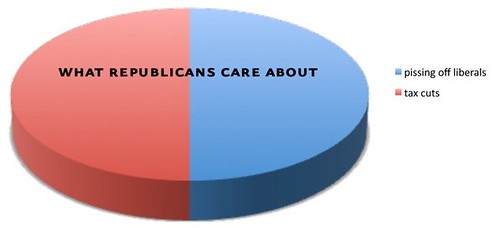
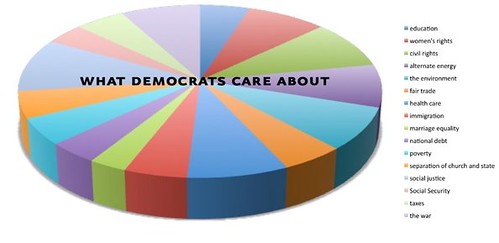
American Politics (in chart form). The charts below are the product of my intense, highly scientific of American partisan politics over the last three election cycles.

This is all you need to know.


(Sadly, we could still go 0 for 3...)

Wednesday, July 23, 2008

Vanity Fair has a clone of the New Yorker cover, this time about John and Cindy McCain and functioning orthogonally to the original. Whereas that was a parody of the right-wing whisper campaign, this is the left-wing whisper campaign, somehow made acceptable (or speakable-in-public) by the controversy over the New Yorker cover. Because it reflects its audience's shared understanding of reality, as opposed to mocking someone else's caricature of it, this cover is significantly nastier than the first, and, I think, even less effective, ranking about as high as a Family Guy let's-remember-together gag on the Laff Meter.

I actually like what Gawker has to say about it:

As you can see, it's like taking the square root of comic failure. Not only is McCain not depicted as a caricature of feverish political imagination (he doesn't look half bad here, really), but there's hardly an exaggerated element in the pic, save perhaps the burning Constitution in the fireplace.

Wednesday, July 16, 2008

From the comments:

Disagree with you on the New Yorker cover.

I'm even not sure who these mythical people are supposed to be who are with it enough to have heard of the New Yorker in the first place yet still clueless enough to take the cover at face value.

People who walk by magazine stands? People who have it emailed to them? People who see it posted on a bulletin board or as the new desktop background of someone who just had it emailed to them?

We have a politics of image and symbolism. You can't throw this kind of stuff out there into the public sphere and not expect it to be misused and abused.

I think the "oh, everyone gets the joke" thing comes from a fairly parochial point of view.
Now, I agree with Shankar on a wide range of issues, but I still think this anxiety is simply overheated. First, the image's meaning is unmistakable, because frankly it deconstructs itself; it's impossible for anyone with either a modicum of political intelligence or cultural savvy to take this image at face value. Obama doesn't dress like that; Michelle Obama doesn't look like that; presidential candidates don't burn flags or stand in front of pictures of Osama bin Laden. That's not to say that there aren't still people who won't get the joke, despite all its obvious tells—sadly, there probably are—but I just don't think there are especially large numbers of people in that category, nor to the extent that there are do I see much compelling reason to dumb down the culture in an effort to cater to them.

Art and literature are misunderstood all the time. That's their nature. They're nonetheless good things to have in the public sphere, even when they're misused and abused at the margins.

I'm also not clear on what the actual objection to the cover is supposed to be. Most of the concern on the left seems to be that the cover isn't "useful," which may or may not be true, but it's neither here nor there with regard to its cultural value. (And I'd add that for what it's worth the image may actually prove itself pretty useful to Obama—the best response to this sort of under-the-radar bullshit is mockery and marginalization, which is what we all agree this is.)

Then there are the claims that the image is tasteless or offensive. Now, I write from a very privileged subject position, white heterosexual upper-middle-class American male, and it's certainly possible that this cartoon trips sensitivities I just don't have. I'm open to that. But I haven't seen any compelling explanation of just what about this extremely pro-Obama cartoon is actually supposed to be offensive; instead, its offensiveness and tasteless are simply taken for granted, as if everyone in the world but me and Jon Stewart's writers had forgotten what irony is.

Irony: it's a good thing, and a powerful weapon. Didn't we learn from Orwell that without irony language is just Newspeak?
'The Eleventh Edition is the definitive edition,' he said. 'We're getting the language into its final shape -- the shape it's going to have when nobody speaks anything else. When we've finished with it, people like you will have to learn it all over again. You think, I dare say, that our chief job is inventing new words. But not a bit of it! We're destroying words -- scores of them, hundreds of them, every day. We're cutting the language down to the bone. The Eleventh Edition won't contain a single word that will become obsolete before the year 2050.'

He bit hungrily into his bread and swallowed a couple of mouthfuls, then continued speaking, with a sort of pedant's passion. His thin dark face had become animated, his eyes had lost their mocking expression and grown almost dreamy.

'It's a beautiful thing, the destruction of words. Of course the great wastage is in the verbs and adjectives, but there are hundreds of nouns that can be got rid of as well. It isn't only the synonyms; there are also the antonyms. After all, what justification is there for a word which is simply the opposite of some other word? A word contains its opposite in itself. Take "good", for instance. If you have a word like "good", what need is there for a word like "bad"? "Ungood" will do just as well -- better, because it's an exact opposite, which the other is not. Or again, if you want a stronger version of "good", what sense is there in having a whole string of vague useless words like "excellent" and "splendid" and all the rest of them? "Plusgood" covers the meaning, or " doubleplusgood" if you want something stronger still. Of course we use those forms already. but in the final version of Newspeak there'll be nothing else. In the end the whole notion of goodness and badness will be covered by only six words -- in reality, only one word. Don't you see the beauty of that, Winston? It was B.B.'s idea originally, of course,' he added as an afterthought.

A sort of vapid eagerness flitted across Winston's face at the mention of Big Brother. Nevertheless Syme immediately detected a certain lack of enthusiasm.

'You haven't a real appreciation of Newspeak, Winston,' he said almost sadly. 'Even when you write it you're still thinking in Oldspeak. I've read some of those pieces that you write in The Times occasionally. They're good enough, but they're translations. In your heart you'd prefer to stick to Oldspeak, with all its vagueness and its useless shades of meaning. You don't grasp the beauty of the destruction of words. Do you know that Newspeak is the only language in the world whose vocabulary gets smaller every year?'

Winston did know that, of course. He smiled, sympathetically he hoped, not trusting himself to speak. Syme bit off another fragment of the dark-coloured bread, chewed it briefly, and went on:

'Don't you see that the whole aim of Newspeak is to narrow the range of thought? In the end we shall make thoughtcrime literally impossible, because there will be no words in which to express it. Every concept that can ever be needed, will be expressed by exactly one word, with its meaning rigidly defined and all its subsidiary meanings rubbed out and forgotten. Already, in the Eleventh Edition, we're not far from that point. But the process will still be continuing long after you and I are dead. Every year fewer and fewer words, and the range of consciousness always a little smaller. Even now, of course, there's no reason or excuse for committing thoughtcrime. It's merely a question of self-discipline, reality-control. But in the end there won't be any need even for that. The Revolution will be complete when the language is perfect. Newspeak is Ingsoc and Ingsoc is Newspeak,' he added with a sort of mystical satisfaction. 'Has it ever occurred to you, Winston, that by the year 2050, at the very latest, not a single human being will be alive who could understand such a conversation as we are having now?'

'Except-' began Winston doubtfully, and he stopped.

It had been on the tip of his tongue to say 'Except the proles,' but he checked himself, not feeling fully certain that this remark was not in some way unorthodox. Syme, however, had divined what he was about to say.

'The proles are not human beings,' he said carelessly. ' By 2050 earlier, probably -- all real knowledge of Oldspeak will have disappeared. The whole literature of the past will have been destroyed. Chaucer, Shakespeare, Milton, Byron -- they'll exist only in Newspeak versions, not merely changed into something different, but actually changed into something contradictory of what they used to be. Even the literature of the Party will change. Even the slogans will change. How could you have a slogan like "freedom is slavery" when the concept of freedom has been abolished? The whole climate of thought will be different. In fact there will be no thought, as we understand it now. Orthodoxy means not thinking -- not needing to think. Orthodoxy is unconsciousness.'

Jon Stewart nicely explains the foolishness of media outrage! over the New Yorker cover on last night's Daily Show.


More on the nature of satire from John Oliver et al. and The Stephen Colbert Show.

Tuesday, July 15, 2008

Barack Obama and a kangaroo pull up to a gas station. The gas station attendant takes one look at the kangaroo and says, "You know, we don't get many kangaroos here." Barack Obama replies, "At these prices, I'm not surprised. That's why we need to reduce our dependence on foreign oil."
Andy Borowitz has the list of official, campaign-approved Barack Obama jokes in the wake of the now-infamous New Yorker cover flap, undoubtedly the silliest Outrage! of the election yet. Reasonable people can disagree about the success of the cover as satire—personally I think it works, and I think the ensuing shitstorm is pretty strong evidence of that—but whether it's a "good" satire or not the meaning is absolutely clear, inoffensive, and pro-Obama: it's the morons who believe this crap and the media figures who cynically peddle it who are being mocked, not the Obamas.

I'm even not sure who these mythical people are supposed to be who are with it enough to have heard of the New Yorker in the first place yet still clueless enough to take the cover at face value.

However, it must be said that Jon Stewart gets this wrong:
When Mr. Stewart on “The Daily Show” recently tried to joke about Mr. Obama changing his position on campaign financing, for instance, he met with such obvious resistance from the audience, he said, “You know, you’re allowed to laugh at him.” Mr. Stewart said in a telephone interview on Monday, “People have a tendency to react as far as their ideology allows them.”
Comedy Rule #1: Don't blame the audience when your jokes fall flat; get better jokes. His writers, much more than Colbert's, have clearly been struggling when it comes to Obama; just about the only successful Obama joke they've run is this one: "I wonder when he'll break our hearts."

Tuesday, July 08, 2008

Design Observer pays homage to AMC's excellent Mad Men, the first season of which Jaimee and I finished up watching on DVD last night. This particular homage is all about Mad Men's depiction of the advertising business—which I suppose is something it's rather good at—but it's really the subdued dystopianism of the show's 1960 Manhattan setting that grabs me. Matthew Weiner (who as Design Observer informs us earned a job on The Sopranos on the basis of his spec script for Mad Men) has a very keen eye for cultural critique, and in accordance with something I once wrote of Terry Gilliam never allows his 1960 to become so reified that we forget the different ways in which we're also talking about the present. There's a nice cartoonishness to the satire that's fun, but also necessary: it functions as a kind of critical prophylactic so that we're never allowed to understand Mad Men as mere history.

The critique of American consumerism is as subtle as a sledgehammer, but it's solid, and I can't think of any other show that's ever been more focused or forceful on the realities of misogyny. This is very good stuff.