Friday afternoon linkblogging!
* 28% of Republicans claim to believe Barack Obama was not born in the United States, and another 30% "aren't sure." Results for the South are even worse. So it's official: our national discourse is completely broken.
* Entertainment Weekly asks: Was 1984 the greatest year in movies ever? I've always been partial to 1999: Rushmore, The Matrix, Being John Malkovich, Fight Club, Magnolia... * Vanity Fair has your sketchbook history of the drug war.
* Steampunk monkey nation.
* Jericho may be returning once again as a TV movie to wrap up loose plot points. My recollection of the finale was that there weren't very many loose plot points left, but your memory may vary.
* Chris Hedges: "The Rise of Gonzo Porn Is the Latest Sign of America's Cultural Apocalypse."
* And Scientific American explores the quiet end of the Neanderthals.
Friday, July 31, 2009

Sunday, September 07, 2008
Joe Klein: Maybe I'm getting old, maybe it's that I've seen this act so often before, maybe it's that the people I talk to when I go out on the road really are having a harder time paying for things like health care, gasoline and college tuition, but I'm finding the Republican attempts to derail the conversation from the actual state of the country really depressing and disgraceful this year. They practice Orwellian politics of the crudest sort. They are trying to sell a big lie--that the election is about the social issues of the 1960s, or Barack Obama's patriotism or his eloquence, or the "angry left," when it's really about turning toward a more moderate path after the ideological radicalism and malfeasance of the past eight years.
Wednesday, September 03, 2008
The next moment a hideous, grinding speech, as of some monstrous machine running without oil, burst from the big telescreen at the end of the room. It was a noise that set one's teeth on edge and bristled the hair at the back of one's neck. The Hate had started.
As usual, the face of Emmanuel Goldstein, the Enemy of the People, had flashed on to the screen. There were hisses here and there among the audience. The little sandy-haired woman gave a squeak of mingled fear and disgust. Goldstein was the renegade and backslider who once, long ago (how long ago, nobody quite remembered), had been one of the leading figures of the Party, almost on a level with Big Brother himself, and then had engaged in counter-revolutionary activities, had been condemned to death, and had mysteriously escaped and disappeared. The programmes of the Two Minutes Hate varied from day to day, but there was none in which Goldstein was not the principal figure. He was the primal traitor, the earliest defiler of the Party's purity. All subsequent crimes against the Party, all treacheries, acts of sabotage, heresies, deviations, sprang directly out of his teaching. Somewhere or other he was still alive and hatching his conspiracies: perhaps somewhere beyond the sea, under the protection of his foreign paymasters, perhaps even -- so it was occasionally rumoured -- in some hiding-place in Oceania itself...
Saturday, August 09, 2008
Links!
* A metrical analysis of the presidential campaigns reveals Barack Obama will win, as his name is a trochee. (via Bookslut)
* I don't mean to brag, but I beat Al Giordano to this conclusion about the John Edwards adultery kerfuffle of 2008 by over two weeks.
* Researchers at DefCon in Vegas have demonstrated that they can make "high security" Medeco key-blanks out of the plastic used in credit-cards, and then whittle them into working keys by referring to low-resolution photos of original keys. Easily the best key-related story since the great Bic/bike lock story of Aught Four.
* Also at Boing Boing: 1984 and Brave New World as pulp novels.
* When Lois was too curvy and Superman too gay. Via io9.
* "Serenity: The Other Half." A Firefly comic.
* And The Big Picture blog has big pictures of yesterday's Olympic opening ceremony.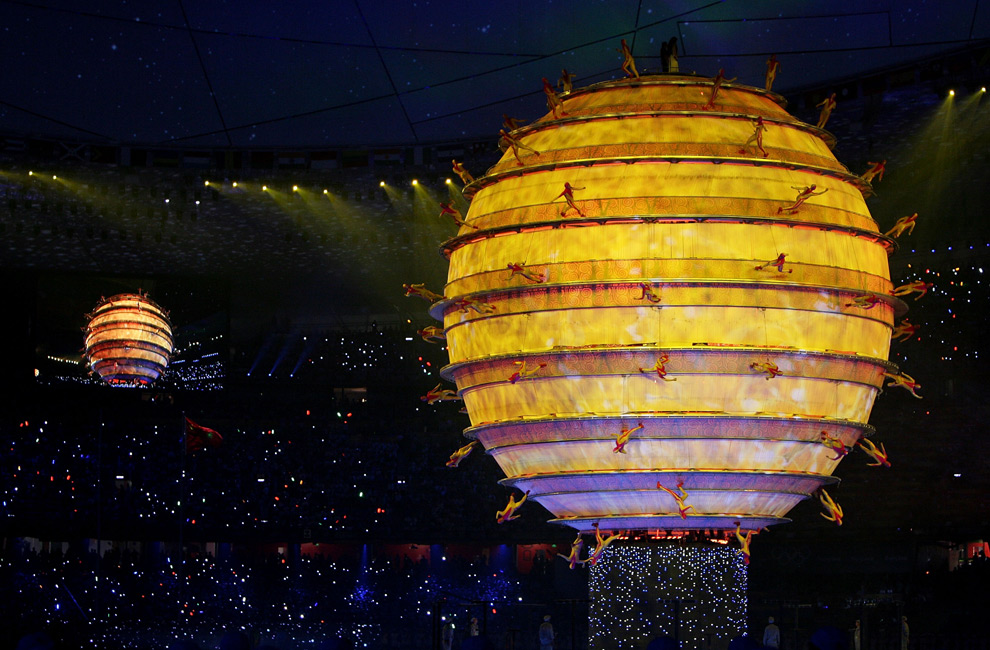
Wednesday, July 16, 2008
 From the comments:
Disagree with you on the New Yorker cover.Now, I agree with Shankar on a wide range of issues, but I still think this anxiety is simply overheated. First, the image's meaning is unmistakable, because frankly it deconstructs itself; it's impossible for anyone with either a modicum of political intelligence or cultural savvy to take this image at face value. Obama doesn't dress like that; Michelle Obama doesn't look like that; presidential candidates don't burn flags or stand in front of pictures of Osama bin Laden. That's not to say that there aren't still people who won't get the joke, despite all its obvious tells—sadly, there probably are—but I just don't think there are especially large numbers of people in that category, nor to the extent that there are do I see much compelling reason to dumb down the culture in an effort to cater to them.
I'm even not sure who these mythical people are supposed to be who are with it enough to have heard of the New Yorker in the first place yet still clueless enough to take the cover at face value.
People who walk by magazine stands? People who have it emailed to them? People who see it posted on a bulletin board or as the new desktop background of someone who just had it emailed to them?
We have a politics of image and symbolism. You can't throw this kind of stuff out there into the public sphere and not expect it to be misused and abused.
I think the "oh, everyone gets the joke" thing comes from a fairly parochial point of view.
Art and literature are misunderstood all the time. That's their nature. They're nonetheless good things to have in the public sphere, even when they're misused and abused at the margins.
I'm also not clear on what the actual objection to the cover is supposed to be. Most of the concern on the left seems to be that the cover isn't "useful," which may or may not be true, but it's neither here nor there with regard to its cultural value. (And I'd add that for what it's worth the image may actually prove itself pretty useful to Obama—the best response to this sort of under-the-radar bullshit is mockery and marginalization, which is what we all agree this is.)
Then there are the claims that the image is tasteless or offensive. Now, I write from a very privileged subject position, white heterosexual upper-middle-class American male, and it's certainly possible that this cartoon trips sensitivities I just don't have. I'm open to that. But I haven't seen any compelling explanation of just what about this extremely pro-Obama cartoon is actually supposed to be offensive; instead, its offensiveness and tasteless are simply taken for granted, as if everyone in the world but me and Jon Stewart's writers had forgotten what irony is.
Irony: it's a good thing, and a powerful weapon. Didn't we learn from Orwell that without irony language is just Newspeak?
'The Eleventh Edition is the definitive edition,' he said. 'We're getting the language into its final shape -- the shape it's going to have when nobody speaks anything else. When we've finished with it, people like you will have to learn it all over again. You think, I dare say, that our chief job is inventing new words. But not a bit of it! We're destroying words -- scores of them, hundreds of them, every day. We're cutting the language down to the bone. The Eleventh Edition won't contain a single word that will become obsolete before the year 2050.'
He bit hungrily into his bread and swallowed a couple of mouthfuls, then continued speaking, with a sort of pedant's passion. His thin dark face had become animated, his eyes had lost their mocking expression and grown almost dreamy.
'It's a beautiful thing, the destruction of words. Of course the great wastage is in the verbs and adjectives, but there are hundreds of nouns that can be got rid of as well. It isn't only the synonyms; there are also the antonyms. After all, what justification is there for a word which is simply the opposite of some other word? A word contains its opposite in itself. Take "good", for instance. If you have a word like "good", what need is there for a word like "bad"? "Ungood" will do just as well -- better, because it's an exact opposite, which the other is not. Or again, if you want a stronger version of "good", what sense is there in having a whole string of vague useless words like "excellent" and "splendid" and all the rest of them? "Plusgood" covers the meaning, or " doubleplusgood" if you want something stronger still. Of course we use those forms already. but in the final version of Newspeak there'll be nothing else. In the end the whole notion of goodness and badness will be covered by only six words -- in reality, only one word. Don't you see the beauty of that, Winston? It was B.B.'s idea originally, of course,' he added as an afterthought.
A sort of vapid eagerness flitted across Winston's face at the mention of Big Brother. Nevertheless Syme immediately detected a certain lack of enthusiasm.
'You haven't a real appreciation of Newspeak, Winston,' he said almost sadly. 'Even when you write it you're still thinking in Oldspeak. I've read some of those pieces that you write in The Times occasionally. They're good enough, but they're translations. In your heart you'd prefer to stick to Oldspeak, with all its vagueness and its useless shades of meaning. You don't grasp the beauty of the destruction of words. Do you know that Newspeak is the only language in the world whose vocabulary gets smaller every year?'
Winston did know that, of course. He smiled, sympathetically he hoped, not trusting himself to speak. Syme bit off another fragment of the dark-coloured bread, chewed it briefly, and went on:
'Don't you see that the whole aim of Newspeak is to narrow the range of thought? In the end we shall make thoughtcrime literally impossible, because there will be no words in which to express it. Every concept that can ever be needed, will be expressed by exactly one word, with its meaning rigidly defined and all its subsidiary meanings rubbed out and forgotten. Already, in the Eleventh Edition, we're not far from that point. But the process will still be continuing long after you and I are dead. Every year fewer and fewer words, and the range of consciousness always a little smaller. Even now, of course, there's no reason or excuse for committing thoughtcrime. It's merely a question of self-discipline, reality-control. But in the end there won't be any need even for that. The Revolution will be complete when the language is perfect. Newspeak is Ingsoc and Ingsoc is Newspeak,' he added with a sort of mystical satisfaction. 'Has it ever occurred to you, Winston, that by the year 2050, at the very latest, not a single human being will be alive who could understand such a conversation as we are having now?'
'Except-' began Winston doubtfully, and he stopped.
It had been on the tip of his tongue to say 'Except the proles,' but he checked himself, not feeling fully certain that this remark was not in some way unorthodox. Syme, however, had divined what he was about to say.
'The proles are not human beings,' he said carelessly. ' By 2050 earlier, probably -- all real knowledge of Oldspeak will have disappeared. The whole literature of the past will have been destroyed. Chaucer, Shakespeare, Milton, Byron -- they'll exist only in Newspeak versions, not merely changed into something different, but actually changed into something contradictory of what they used to be. Even the literature of the Party will change. Even the slogans will change. How could you have a slogan like "freedom is slavery" when the concept of freedom has been abolished? The whole climate of thought will be different. In fact there will be no thought, as we understand it now. Orthodoxy means not thinking -- not needing to think. Orthodoxy is unconsciousness.'
Tuesday, July 08, 2008
The allegory of the cave in science fiction, from Orwell to Wall-E.
Tuesday, September 11, 2007
* Oscar buzz for Darjeeling? And does that suggest it will be good or bad?
* George Lucas on track to ruin another classic movie franchise: Indiana Jones and the Kingdom of the Crystal Skull is very nearly the worst possible title for Indy IV, with almost any variant (...and the Crystal Skull, ...and the Kingdom of Crystal, ... and the Kingdom of the Skull) being superior. I'm quite suspicious about the alien connection, too—it's got to be a Chariot of the Gods situation, because Close Encounters just isn't going to work. MetaFilter has a little bit more.
* Only the best need apply. $21k for full time June 25 - Aug 20 employment.
* Analyzing the logos of terrorist organizations.
* Bitter Laughter duckspeak thoughtcrime doubleplusungood 9/11.
Two years ago when I taught 1984, I realized that not a single person in my class knew what Osama bin Laden really wanted--what his grievances were, what his ideology looks like, etc. All they knew was that he was inimical to "us," and that he was the enemy. "Enmity" is mightily empty category, and a dangerous one at that, if you refuse to allow it to have content.* Michael Tomasky on Citizen Gore.
And that's exactly what bin Laden is for Americans, an enemy without content. The fact of the matter is that Osama bin Laden is not isomorphic with himself. That is, "Osama bin Laden," as that name is understood in this country, is a simulacrum of the actual man. We do not need to listen to what he has to say because we know what he is -- after all, he is our creation. He represents for us something to fight against, the implement against which we sharpen our knives and define ourselves. His words are not relevant since they communicate a version of himself that does not square with our understanding of him. Why would we both listen or give credence to his video musings?
* George Saunders on the teevee.


 Posts
Posts


