Armed with millions of e-mail addresses and a political operation that harnessed the Internet like no campaign before it, Barack Obama will enter the White House with the opportunity to create the first truly "wired" presidency.
...
"He's going to be the first president to be connected in this way, directly, with millions of Americans," Trippi said.
Showing posts with label democracy. Show all posts
Showing posts with label democracy. Show all posts
Monday, November 10, 2008

Sunday, November 09, 2008
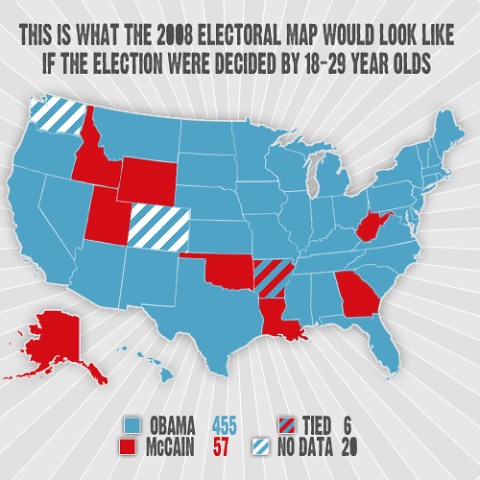 MyDD crunches some numbers on the youth vote.
CIRCLE now estimates that:It's my last year in this particular demographic, so I'm very glad to see what we pulled off. Republican strategists can't be happy with the way that map looks.* 23 million young voters cast a ballot on Tuesday, an increase of 3.4 million over 2004.The big story still remains Obama's staggering 66 - 32% margin among youth...
* Youth turnout will likely top off at 52 - 53%. That would rival the 1992 turnout, and fall just short of the all time record of 55.4% set in 1972.
* Young voters accounted for 60% of the overall turnout increase. That for the whole electorate.
* CIRCLE still estimates that young voters made up 18% of the total electorate.
Wednesday, November 05, 2008
Voter turnout is the highest since the enfranchisement of women, with the youth vote at the highest level since 1972.
Wednesday, October 29, 2008
A judge in Pennsylvania has the common sense to rule that backup paper ballots must be provided in the event of extensive voting machine failure.
A federal judge has sided with Pennsylvania voter groups and ordered election officials to provide paper ballots if half the machines break down Tuesday. The state had provided paper ballots only if all machines at a polling place broke down.Why, oh why, are we using these things at all? The voting machines don't work.
Thursday, October 23, 2008
"We have a very good chance of beating the 64 percent turnout in the 1960 election," McDonald said. "We really could be looking at a historic election in modern American history."
Wednesday, October 15, 2008
The debate begins in just a few minutes, but there's time to appreciate some good early voting news: 'Obama Dominating Among Early Voters in Five Swing States.'
There's also time to worry a bit about some bad early voting news: Republicans in Ohio have won a court case requiring Secretary of State Jennifer Brunner to create computer programs to cross check all new voter registrations so that county boards of elections can doublecheck new registrants. Voter suppression there just got a whole lot easier.
It may not matter: no matter what McCain says or does, it looks like people are voting for Obama anyway.
54 year-old white male, voted Kerry '04, Bush '00, Dole '96, hunter, NASCAR fan...hard for Obama said: "I'm gonna hate him the minute I vote for him. He's gonna be a bad president. But I won't ever vote for another god-damn Republican. I want the government to take over all of Wall Street and bankers and the car companies and Wal-Mart run this county like we used to when Reagan was President."
The next was a woman, late 50s, Democrat but strongly pro-life. Loved B. and H. Clinton, loved Bush in 2000. "Well, I don't know much about this terrorist group Barack used to be in with that Weather guy but I'm sick of paying for health insurance at work and that's why I'm supporting Barack."
Saturday, October 04, 2008
Are you registered to vote? A Google Maps tool will help you check your registration and tell you where to go if you're not.
Registration deadlines are starting to close, so don't slack...
Tuesday, September 23, 2008
I get results: facing something like an outright revolt from the press, McCain cracks at forty days in the desert and gives an eleven-minute press conference.
Thursday, September 11, 2008
Actually existing voter fraud: following up on the Michigan outrage from earlier today, a MetaFilter thread collects vote-suppression stories from across the nation:
Wisconsin
Mississippi
Virginia
Greg Palast has more. More and more I think we need a Voting Rights Act for the 21st Century—attacking the right to vote, increasingly the national policy of the Republican party, is the deepest, darkest betrayal possible in a democracy. The games have to stop. Elections must be fair.
And good for Ohio Secretary of State Jennifer Brunner for taking a stand on it.
In Michigan, Republicans think if your house is foreclosed, you should lose your right to vote.
The chairman of the Republican Party in Macomb County Michigan, a key swing county in a key swing state, is planning to use a list of foreclosed homes to block people from voting in the upcoming election as part of the state GOP’s effort to challenge some voters on Election Day.We saw these tactics before in 2000 and 2004, and I imagine we'll keep saying them in 2012, 2016, 2020, and on and on, until somebody starts prosecuting officials who screw with elections.
“We will have a list of foreclosed homes and will make sure people aren’t voting from those addresses,” party chairman James Carabelli told Michigan Messenger in a telephone interview earlier this week. He said the local party wanted to make sure that proper electoral procedures were followed.
...
“You can’t challenge people without a factual basis for doing so,” said J. Gerald Hebert, a former voting rights litigator for the U.S. Justice Department who now runs the Campaign Legal Center, a Washington D.C.-based public-interest law firm. “I don’t think a foreclosure notice is sufficient basis for a challenge, because people often remain in their homes after foreclosure begins and sometimes are able to negotiate and refinance.”
As for the practice of challenging the right to vote of foreclosed property owners, Hebert called it, “mean-spirited.”
Undercutting the foundation of our democracy is not part of the campaign game.
Tuesday, September 09, 2008
From small things, Mama, big things one day come: Ron Paul is on the Montana ballot. In the last poll, taken over a month ago, McCain and Obama were tied in the state.
Saturday, September 06, 2008
On the politics front, the new GOP line (apparently) is that Sarah Palin isn't ready to be president after all—yet.
I'm certain that over the next couple of weeks the press will be pounding her and the campaign wanting to know where the access is. There'll be a lot of process stories about why isn't she talking to reporters. There'll be a lot of noise that voters, frankly, don't really care about—and as frustrated as the press is gonna be it's a smart move by the campaign because, like I said, voters don't really care about these process stories, but if she goes out and makes a mistake, that is something that [voters will] care about, and that's something that will haunt [McCain] for awhile, so I think this is a smart move.
GOP strategist Todd Harris goes on to say that she'll be getting prepped for as long as two weeks before she talks to anyone in the media. The Jed Report says it best:
This has got to be one of the craziest messaging decisions ever: Harris is conceding that Palin’s not even ready to be a vice presidential candidate, let alone be president.Kevin Drum, too:
The McCain campaign is scared to death. They knew nothing about Palin before they announced her, they relied on a cursory vetting process that has turned out to be shot full of holes, they realize now that she has no settled views on any issue of national importance and could blurt out anything at any time, and they're terrified about what might crop up next. So they're keeping her in the deep freeze.Has it really come to this? The absolute lack of confidence McCain has in his own pick to be vice president is mind-boggling; the absurdity of this past week truly marks a singular event in the history of our Republic, and if things go wrong it'll be probably be used (alongside Florida 2000) to mark the start of its final decline.
This is monarchism, not democracy. A candidate for office needs to be accountable to the voters, not to a vague mish-mash of identitarian buzzwords. If we as a nation passively accept the Palin candidacy, if we demand nothing more than this from the Republicans or from ourselves, then American democracy is simply dead.
(Of course, a candidate should also be trusted to talk about something other than their own love of self, but we're sitting by and letting John McCain fail that test, too.)
In more positive news, at least Joe Biden continues to win my respect. Give 'em hell, Joe.
Saturday, August 23, 2008
Eight years after the Recount, the voting machines still don't work. Via MeFi.
Tuesday, August 05, 2008
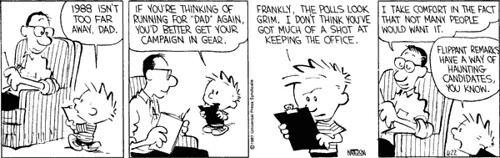
Today's Calvin & Hobbes (originally run June 22, 1987) brings back to mind one of the strip's better running gags: Calvin's perennial polling of his father's performance as "Dad." For some reason people who should know better keep breathlessly reporting the daily oscillations of months-out national polls as if they actually mean something—and given that we still have (at least) 91 more days of this silliness, I think we can all use the reminder.
Thanks to this extremely exhaustive Calvin & Hobbes archive and search engine for the images.
December 2, 1985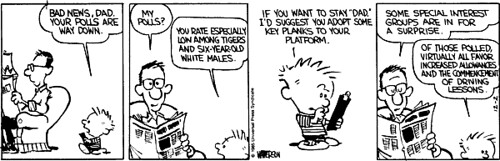
January 28, 1986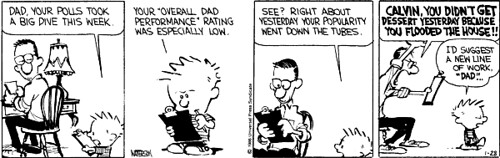
March 18, 1986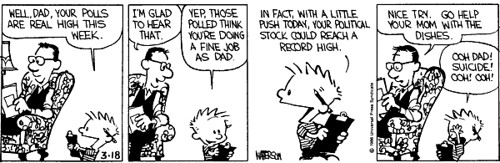
August 30, 1986
(this one's my favorite)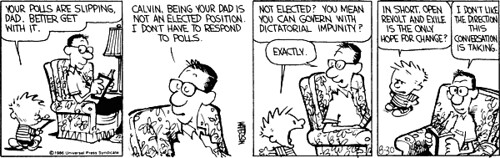
July 24, 1987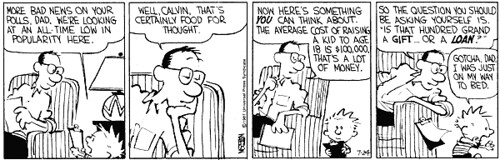
April 11, 1988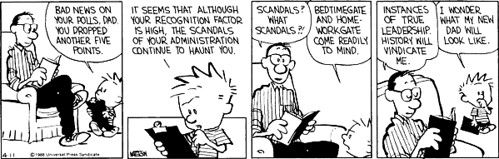
April 12, 1988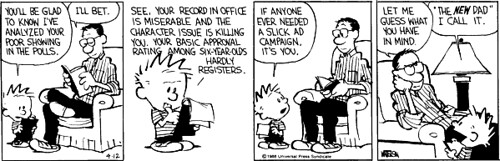
November 7, 1988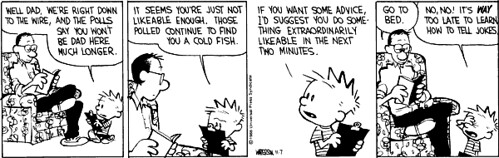
January 3, 1992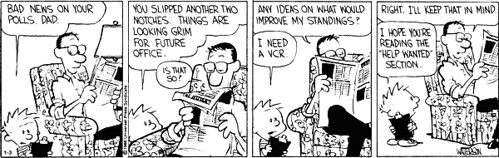
April 30, 1992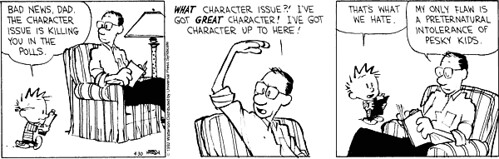
September 20, 1993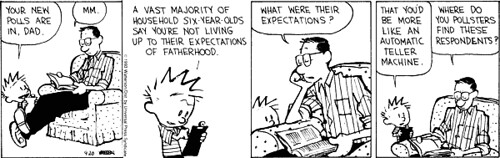
July 26, 1994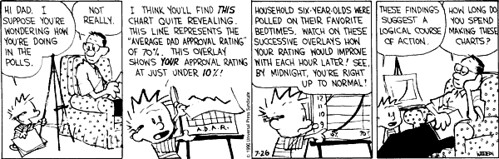
And probably the most important comment on the state of democracy in a mass-media culture in the entire run of Calvin & Hobbes, March 1, 1994: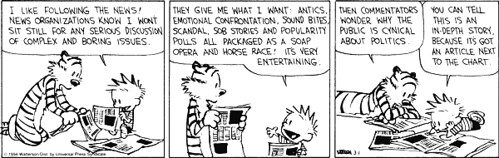
UPDATE: Okay, two more, also highly appropriate for the moment.
September 2, 1988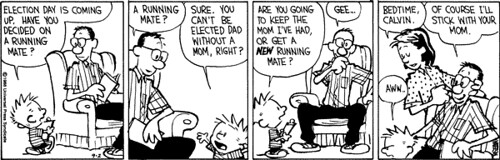
August 31, 1992
Thursday, June 12, 2008
Both mvy in my comments and Matt Yglesias at his blog have posts talking up the National Popular Vote movement. It's absolutely clear that the Electoral College needs to be abolished, and I think the NPV compact is a genuinely clever way of getting around the impossibility of ever amending the Constitution for this purpose—but I do have serious concerns about the compact's constitutionality, and whether or not it would actually be held up by the courts if challenged and/or reneged upon during a close vote.
It may still be the best fix available to us, but it's certainly not perfect, and carries with it serious potential for total electoral chaos.
Monday, June 02, 2008
Now that the primary season has nearly run its course, a different pattern can be seen. Followed day by day, the race for the Democratic nomination has been the most exciting election in living memory. But viewed in retrospect, it is clear that it has been quite predictable. All the twists and turns have been a function of the somewhat random sequencing of different state primaries, which taken individually have invariably conformed to type, with Obama winning where he was always likely to win (caucus states, among college-educated and black voters, in the cities), and Clinton winning where she was likely to win (big states with secret ballots, among less well-educated whites and Hispanics, in rural areas). Even the initial drama of that week in early January – when Obama’s victory in Iowa had seemed to give him a chance of finishing Clinton off, only to be confounded by her victory in New Hampshire, which defied the expectation of the pundits and had them all speculating about what had swung it (was it her welling up in a diner? was it hastily rekindled memories of Bill? was it hints of hubris from Obama?) – turns out to have been an illusion. Iowa was Obama country (younger, smaller, caucus meetings) and New Hampshire wasn’t (older, bigger, voting machines). The salient fact about this campaign is that demography trumps everything: people have been voting in fixed patterns set by age, race, gender, income and educational level, and the winner in the different contests has been determined by the way these different groups are divided up within and between state boundaries. Anyone who knows how to read the census data (and that includes some of the smart, tech-savvy types around Obama) has had a good idea of how this was going to play from the outset. All the rest is noise.Also in LRB: Clinton supporter David Runciman explains how for all the sound, fury, and breathless reporting surrounding the 2008 Democratic primary, if anything we should be surprised by just how few surprising things happened. Demographics, in the end, was destiny—geography, not momentum, played the determinative role.
As insightful, I think, is this from Joseph Schumpeter in 1942:
It turns out that the best guide to what’s been going on during the ceaseless clamour of this election season comes from one of John Dewey’s contemporaries, the émigré Austrian economist and philosopher Joseph Schumpeter, who also died during Truman’s second term, in 1950. In Capitalism, Socialism and Democracy, written in 1942, Schumpeter pointed out that most people do not think much about politics at all: they simply respond to triggers in ways that require the minimum of mental effort. ‘The typical citizen,’ Schumpeter wrote, ‘drops down to a lower level of mental performance as soon as he enters the political field. He argues and analyses in a way which he would readily recognise as infantile within the sphere of his real interests. He becomes a primitive again. His thinking becomes associative and affective.’ The demographic determinism of this election campaign is evidence of the ease with which the main candidates have been able to exploit the instinctive reflexes of various segments of the population, and the difficulty that their opponents have had in overcoming these reflexes with competing arguments.
Monday, May 19, 2008
Bill Moyers: 'Democracy in America Is a Series of Narrow Escapes, and We May Be Running Out of Luck.' Via Daily Kos.
Democracy in America is a series of narrow escapes, and we may be running out of luck. The reigning presumption about the American experience, as the historian Lawrence Goodwyn has written, is grounded in the idea of progress, the conviction that the present is "better" than the past and the future will bring even more improvement. For all of its shortcomings, we keep telling ourselves, "The system works."
Now all bets are off. We have fallen under the spell of money, faction, and fear, and the great American experience in creating a different future together has been subjugated to individual cunning in the pursuit of wealth and power -and to the claims of empire, with its ravenous demands and stuporous distractions. A sense of political impotence pervades the country -- a mass resignation defined by Goodwyn as "believing the dogma of 'democracy' on a superficial public level but not believing it privately." We hold elections, knowing they are unlikely to bring the corporate state under popular control. There is considerable vigor at local levels, but it has not been translated into new vistas of social possibility or the political will to address our most intractable challenges. Hope no longer seems the operative dynamic of America, and without hope we lose the talent and drive to cooperate in the shaping of our destiny.
The earth we share as our common gift, to be passed on in good condition to our children's children, is being despoiled. Private wealth is growing as public needs increase apace. Our Constitution is perilously close to being consigned to the valley of the shadow of death, betrayed by a powerful cabal of secrecy-obsessed authoritarians. Terms like "liberty" and "individual freedom" invoked by generations of Americans who battled to widen the 1787 promise to "promote the general welfare" have been perverted to create a government primarily dedicated to the welfare of the state and the political class that runs it. Yes, Virginia, there is a class war and ordinary people are losing it.
Tuesday, May 13, 2008
I like what Ezra Klein has to say about the recent wrong-track and Bush-disapproval numbers so much I'll just quote it:
It's something of a crisis for our political system that the president has now spent over three years hated and mistrusted by the majority of the country, and yet has never felt the need to take steps to restore his legitimacy. Something is wrong.It's worse than that, of course, when you consider the cloud of corruption under which the man was both elected and re-elected. Something, indeed, has gone drastically and dramatically wrong with our democracy; it's almost as if the opinion of the governed doesn't actually matter at all.
That said, I must admit I'm pretty fond of the photo he chose to illustrate this somber reflection.
Saturday, April 12, 2008
Science fiction based on the fall of the Roman Empire. What may be more important here, I think, is the way most of our ideas of democracy (and what happens to it) seem to be based upon the fall of the Roman Republic. More and more it seems to me that on some level U.S. democracy is ideologically infused with a sense of futurity that pulls it towards a collapse into empire—as if for many people it's not worth fighting against the encroachments of the state, the expansion of the executive branch, or the evacuation of actually existing representation in government because, well, it's bound to happen eventually anyway.
Tuesday, February 26, 2008
A new study from Harvard's Ben Olken argues that political assassinations tend to lead to democratization in autocracies but have "found no substantial 'effect following assassinations—or assassination attempts—on democratic leaders.'"
The researchers also found that assassinations have no effect on the inauguration of wars, a result that “suggests that World War I might have begun regardless of whether or not the attempt on the life of Archduke Franz Ferdinand in 1914 had succeeded or failed.” Olken’s research on assassination suggests that World War I might have begun regardless of the murder of Archduke Ferdinand.This and other results in a profile of Olken this month's The American.
In “Do Leaders Matter? National Leadership and Growth since World War II,” Olken and Jones explored whether “individual political leaders make a difference in economic growth.” This is tricky business for the researcher because, as Olken explains, a country’s economic situation can affect the election of a leader: when the economic outlook is good, for instance, presidents are more likely to be reelected. So Olken and Jones looked at 57 leaders who died in office from accidents or natural causes and “found big changes in growth when autocratic leaders die in office—both positive and negative,” but no substantial change when democratic leaders died in office. “The results suggest,” they write, “that individual leaders can play crucial roles in shaping the growth of nations,” provided they are ruling with minimal or nonexistent checks and balances to their power (think Augusto Pinochet or Robert Mugabe).


 Posts


