The richest nation in the history of the world: 'Half of US kids will get food stamps, study says.'
Showing posts with label class struggle. Show all posts
Showing posts with label class struggle. Show all posts
Monday, November 02, 2009

Wednesday, September 30, 2009
More links.
* New trailers for Fantastic Mr. Fox and The Road.
* The EPA has announced new guidelines to regulate greenhouse gases.
* The oldest living things in the world. (via)
* Richard Kahlenberg argues at Washington Monthly towards class-based affirmative action.
* Common Roman Polanski Defenses, Refuted.
Wednesday, July 22, 2009
The difference is that in Raleigh, in 1976, the Wake County Public School system was created to zone the suburbs and inner city together to ensure a continued healthy mix of social classes.Why there are no bad schools in Raleigh. Via Donkeylicious.
Sunday, June 14, 2009
Juan Cole: So to believe that the 20% hard line support of 2001 has become 63% in 2009, we would have to posit that Iran is less urban, less literate and less interested in cultural issues today than 8 years ago. We would have to posit that the reformist camp once again boycotted the election and stayed home in droves.
..
So observers who want to lay a guilt trip on us about falling for Mousavi's smooth upper middle class schtick are simply ignoring the last 12 years of Iranian history. It was about culture wars, not class.
Friday, May 29, 2009
As a white dude from the suburbs my objective application of universal human reason is, of course, beyond reproach, and it admits to some abstract discomfort with affirmative action. It is, on the one hand, significantly under-responsive to class privilege, which seems in my experience to be more wide-ranging and pernicious than either race or gender privilege. Second, affirmative action is, I think, under-responsive to the passage of time, especially with regard to the timeline of its eventual elimination. Finally, I regret that policies that promote justice in the main across the population sometimes require arbitrary and unfair discrimination at the level of the individual, even, in boundary cases, rising themselves to the level of injustice.
Affirmative action, in other words, is not something you'd enact if you were designing a polity from scratch—but of course America was not designed from scratch. Less than fifty years from Jim Crow, we need it, at least for now, and probably for as long as any of us will be alive. But it is not uncomplicated or easy, and a subject about which reasonable people can certainly disagree.
All this is just prelude to a particular sort of outraged right-wing response to the Sonia Sotomayor appointment, the claim that she (in Michael Goldfarb's words) "has been the recipient of preferential treatment for most of her life" or that she has (in Fred Barnes's words) "benefited from affirmative action over the years tremendously." There is, it must be said, no evidence that either of these prejudiced, kneejerk assumptions is remotely accurate; it is the mere fact that Sotomayor is Latina that not only suggests the preferential treatment she must have received but, in fact, puts it beyond all possible dispute. As these pundits now cast about aimlessly looking for proof of what they assumed went without saying, it's worth wondering what else a valedictorian of her high school class who went on to graduate from Princeton summa cum laude, winning the prestigious Pyne Prize in the process, before heading off to Yale where she served as editor of the Law Review, before pursuing a distinguished career in law including high appointments from both Democratic and Republican presidents could possibly achieve before her accomplishments were allowed to speak for themselves.
Saturday, May 23, 2009
At last, a world without classes.
Tuesday, March 31, 2009
 Tuesday Night Linkdump #2: College Edition.
* Via my friend Eric via The Believer, Donald Barthelme’s reading list. Joseph Campbell, Donald? Really?
* Facing fallen endowments and needier students, many colleges are looking more favorably on wealthier applicants as they make their admissions decisions this year. Meritocracy!
* A master's degree is social media is actually not as stupid as everybody is pretending, Twitter-twittering aside.
* Four college majors that will still get you a job, even in today’s economy. Science fiction studies snubbed again.
* Nobody panic: MLA citation style has changed.
Friday, March 20, 2009
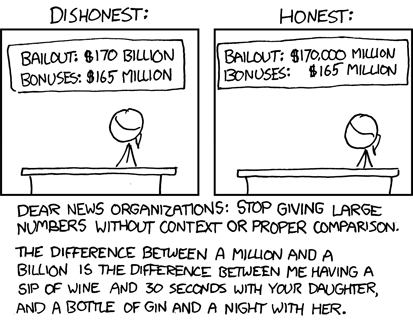
Let's start off with xkcd's lesson in how numbers lie.
As I've been saying both up top and in the comments the significance of this AIG bonus outrage is being badly overblown. The bonuses are a nice red-meat issue for the media circus but they're basically a rounding error with regard to the scale of the bailout as a whole. Nate Silver is basically right here precisely because, as the cliche goes, "hard facts make bad law"—though his comparison to the Terry Schaivo case flounders at the fact that this silly thing the Congress is doing has wide popular support. (Nate and Josh Marshall both have more on the possible unintended consequences of this poorly thought-out new tax.)
As I've been trying to argue, the only relevant consideration regarding the bonuses is whether they were legal contracts, negotiated in the proper way and not predicated on fraudulent accounting or other illegal activity. Andrew Cuomo and Eric Holder should be investigating the bonuses, in other words, not Barney Frank. If they were legal, and their terms were met, pay them out; if they were fraudulent or predicated on fraud, arrest people.
What angers me about this situation is the widespread assumption that of course the bonuses are legal (just ill-advised), just like of course everything AIG did was legal but ill-advised. See, for instance, Ezra Klein on Madoff:
Madoff knew his investment scheme was a fraud. Wall Street should have known their investment schemes were a fraud.Give me a break. Plenty of people on Wall Street knew their investment schemes were fraudulent. Those people are crooks, not dupes, and criminal prosecutions are the way we find out who they are.
(EDITED TO ADD: You can draw a distinction between AIG and Madoff, but it's the distinction between two separate categories of crime, not between the guilty and the innocent.)
Repeating what I wrote in answer to Shankar's question "Criminal Prosecution for what?" last night:
Well, that's the job of state and federal prosecutors to determine. But there's plenty of reason to think that (say) underwritingbillionstrillions of dollars in insurance obligations you know you have no capacity to pay out on is an abrogation of your fiduciary obligations -- just for starters. Fraud and dishonest account methods were rampant in the banking industry, which has strict rules about this sort of thing that plainly weren't followed. It's not *just* stupid -- in many cases it was stupid and illegal. Or so it seems to me.
...To add the obvious disclaimer, I'm not a lawyer, much less a prosecutor. But the treatment of the issue in the media tends to frustrate me on this point. Generally speaking the operative assumption seems to be "Oops, and they all got away with it" -- that what they did was obviously legal, just slimy, and so we're all just going to have to swallow our anger and move on. I don't know that it *was* legal in all cases, and if CEOs and CFOs broke the law in chasing these bogus returns then DOJ and state AGs absolutely need to get involved. It's a much higher priority for me than retributive taxation of contracts that are obscene (but probably legal) in an industry where the payment of obscene salaries is already (and still) an unchallenged norm. The bonuses are peanuts compared to the amount of money that's already vanished.
Wednesday, January 21, 2009
A few midday links. * There's a new viral site for Watchmen with links to background ephemera created for the film. I'm getting excited for this one despite myself. Via Candleblog.
* Bookninja considers Elizabeth Alexander's inaugural poem, with links to other negative reviews at the Guardian, L.A. Times, the Times of London, and Seattle's Post-Intelligencer. I thought it was okay, if not quite up to its moment, and in any event there were parts of it I quite liked to hear said:
Sing the names of the dead who brought us here,I'm sure it reminded more than one Springsteenphile of his song "American Land."
who laid the train tracks, raised the bridges,
picked the cotton and the lettuce, built
brick by brick the glittering edifices
they would then keep clean and work inside of.
The McNicholas, the Posalski's, the Smiths, Zerillis, too* It turns out Dirk Benedict is sort of totally crazy.
The Blacks, the Irish, Italians, the Germans and the Jews
Come across the water a thousand miles from home
With nothin in their bellies but the fire down below
They died building the railroads worked to bones and skin
They died in the fields and factories names scattered in the wind
They died to get here a hundred years ago they're still dyin now
The hands that built the country were always trying to keep down
There was a time, I know I was there, when men were men, women were women and sometimes a cigar was just a good smoke. But 40 years of feminism have taken their toll. The war against masculinity has been won. Everything has turned into its opposite, so that what was once flirting and smoking is now sexual harassment and criminal. And everyone is more lonely and miserable as a result.Uh..... huh.
* China censors parts Of Obama's speech. What's more, they did it in a weirdly self-conscious, self-aware way:
At one point, Obama said earlier generations "faced down communism and fascism not just with missiles and tanks, but with sturdy alliances and enduring convictions." He later addressed "those who cling to power through corruption and deceit and the silencing of dissent—know that you are on the wrong side of history."A little too on the nose.
The Chinese translation of the speech, credited to the Web site of the official China Daily newspaper, was missing the word "communism" in the first sentence. The paragraph with the sentence on dissent had been removed entirely.
* And the first press release from the Obama administration has been released.
At 8:35 AM, the President arrived in the Oval Office and spent 10 minutes alone in the office. He read the note left to him by President Bush that was in an envelope marked “To: #44, From: #43”. At 8:45 AM, White House Chief of Staff Rahm Emanuel came in to discuss the schedule of today’s events. The First Lady came into the Oval Office at 9:10 AM. We will release a picture shortly.Oh, to get one's hands on that note.
Tuesday, September 23, 2008
More politics.
* Obama gave a press conference today, too, coming down hard on the Paulson version of the bailout. An anti-bailout consensus seems to have gelled among both elites (more, more) and the general population, with even GOP foot soldiers refusing to fall in line. (Maybe platforms do mean something after all.) Which is not to say the bailout won't happen—I think it will, if only because the Democrats never met an issue they couldn't sell out on. But it won't be the Paulson version of the bailout, at least and it won't happen at all unless John McCain agrees to sign on and not use Obama's willingness to put country first against him. * More bailout: Kevin Drum has the single best chart I've seen, while Pandagon points out what I'd suspected all along: poor people and minorities did this to us.
* Schumer, like a lot of people, wants to know what's the rush.
* Kossacks want to know how long this has been in the works.
* Colorado wants to vote for Obama by a huge margin, with strong evidence that the Palin pick backfired there.
* McCain's being forced to defend Indiana.
* Alex Greenberg has your conspiracy theory fodder for the day.
Army Unit to Deploy in October for Domestic Operations* The latest smoking gun on Troopergate is actually fairly damning.
Beginning in October, the Army plans to station an active unit inside the United States for the first time to serve as an on-call federal response in times of emergency. The 3rd Infantry Division’s 1st Brigade Combat Team has spent thirty-five of the last sixty months in Iraq, but now the unit is training for domestic operations. The unit will soon be under the day-to-day control of US Army North, the Army service component of Northern Command. The Army Times reports this new mission marks the first time an active unit has been given a dedicated assignment to Northern Command. The paper says the Army unit may be called upon to help with civil unrest and crowd control. The soldiers are learning to use so-called nonlethal weapons designed to subdue unruly or dangerous individuals and crowds.
Here's why this is all so damaging to the governor. It's one thing to try to get a trooper fired because you believe he is a danger to the public. But using your considerable power as governor to block the benefits of a former family member you have a long-running dispute with moves this scandal into a new realm.* And my former candidate for president Howard Dean gave a press conference today, too.
Sunday, September 21, 2008
Sunday morning politics linkdump. Sorry for all these linkdumps, by the way—it was a busy week. Next week should see a return to a little bit more sustained commentary (including the exciting return of debate liveblogging!).
* There have been some interesting debates about poll biases lately. Ron Fournier (grumble) at the AP covers a study that argues Obama would be further ahead were it not for racial animus, by as many as six points. FiveThirtyEight throws cold water on this, as well as looking closely at the possibility of a "cellphone effect" in the polls. If Obama does 2.8% better in polls that include cellphones, that suggests a shifting map like the one below, turning Virginia light-blue and strengthening small Dem leads in Ohio and Colorado.
* A study from political scientist Alan Abramowitz argues that Obama will win, when all is said and done, with 54% of the popular vote. That he's naively comparing historical models with this year's unprecedentedly diverse tickets in both camps shows how seriously we should take this analysis.
* A new PPP poll shows North Carolina tied. Other recent polls show South Carolina within six, West Virginia within four, and MontanVoteRonPaula within two.
* There's evidence of a "Palin effect" in Florida driving undecided voters to Obama.
* The Spine tries to get a handle on Obama's early-voting advantage, beginning as early as this Friday in Virginia. The second link has some stats of interest for Dukies and Durham residents:
In addition, more early-voting centers are being located at colleges and universities, a change that significantly affects student turnout. Students at the University of North Carolina and N.C. State were able to vote on campus throughout the two weeks leading up to North Carolina's primary contest in April. At Duke University, however, students had to make their way to voting sites in the city of Durham. While turnout for Durham County was 52% in the Democratic primary, only 11% of eligible Duke students voted. This fall, however, Duke will have its own early-voting center, open for business starting Oct. 16.* The McCain camp has successfully demanded the VP debate rules be changed to protect Sarah Palin.
*Judge orders Cheney not to destroy his VP records.
* SNL mocked McCain this week. He also preemptively mocked himself with an article in Contingencies arguing (for reals) that "Opening up the health insurance market to more vigorous nationwide competition, as we have done over the last decade in banking, would provide more choices of innovative products less burdened by the worst excesses of state-based regulation." Straight out of the Dept. of Bad Timing. Obama's already taken aim at this.
* Will Obama raise my taxes? A helpful widget.
* And American Stranger has a long post on ideology that seems to take as one starting point my post on Slavoj Žižek, Obama Supporter. Essentially Ryan takes aim at the various binds the Left finds itself in with regard to political action, and I largely agree with what he says—though I certainly hope I wasn't in mind as his example of sell-out "liberal 'pragmatism' a la The New Republic." My point, both in the earlier post and now in this one, is simply that the U.S. President has a tremendous ability to make life better or worse for real people with real lives, all over the world, many of whom (believe it or not!) do not have cushy long-term contracts with elite universities. Naderite "Oh, they're all the same!" negativity only makes sense to people who are inoculated by class and privilege from the consequences of that power.
The mere recognition that the perfect not be the enemy of the good doesn't quite throw my lot in with TNR, I don't think, and certainly not so long as we also keep in mind that the good not be the enemy of the better. Our discomfort with pragmatic compromises—and we should be discomforted by them, every time and in every case—isn't by itself a reason not to be pragmatic.
Sunday, September 07, 2008
I am wholly pessimistic about American society. I believe The Wire is a show about the end of the American Empire. We are all, or our kids, are going to live that event. How we end up at the end of it and where we end up and whether or not we can survive and on what terms is going to be the only question from now on.MetaFilter has great links on David Simon and the pessimistic politics of the The Wire.
First, this from the Guardian: "The escalating breakdown of urban society across the US."
I live in Baltimore, in a neighbourhood that is none of these things. I am vested in the city and its future and I can drive you to places in this city that would transform even the most devout Wire fan into a fat, happy tourist. Baltimore's charms are no less plentiful than most American cities.And second, clips of a recent lecture from Loyola College:
And yet there are places in Baltimore where The Wire is not at all hyperbole, where all of the depicted tragedy and waste and dysfunction are fixed, certain and constant. And that place is, I might add, about 20 blocks from where I live.
That is the context of The Wire and that is the only context in which Baltimore - and by reasonable extension, urban America - can be fairly regarded. There are two Americas - separate, unequal, and no longer even acknowledging each other except on the barest cultural terms. In the one nation, new millionaires are minted every day. In the other, human beings no longer necessary to our economy, to our society, are being devalued and destroyed. Both things are true, and one gets a sense, reading the distant reaction to The Wire, that Europeans are far more ready to be convinced by one vision than the other.
Wednesday, August 13, 2008
The question is not, as Ryan Avent asks while guest-blogging for Ezra Klein, whether high-energy prices will destroy the suburbs. It seems clear that they will, at least to some extent, and more importantly it seems clear that these energy realities exist in a context with other, perhaps more immediate trends that point in the same general direction: America's cities are on the mend, and it's the suburbs that now face decline.
The important question, then, is not whether all this will happen but how suburban America will react to the fact of re-urbanification, which will have dire financial consequences for those who have concentrated the bulk of their wealth in the prices of their suburban homes. To the extent that middle- and upper-class people, especially young people, increasingly choose to live in cities, prices will rise there and fall in the suburbs, which over time will essentially wipe out those people whose suburban residence is also their primary or sole investment.
These people will have every financial incentive to fight to keep the suburban lifestyle intact, no matter what the cost in money, energy, or sprawl. And they'll vote, demanding pro-suburban incentives and policy counter to every consideration of sustainability or good sense.
This will be not only a geographic fight but a class and intergenerational one as well, and if you'll allow me to make a Big Prediction for a moment I fully expect this to be one of the more highly contested divides in American politics as we face the end of cheap energy and the accordant, dramatic weakening of our automobile-centric culture.
UPDATE: There's more of this sort of speculation at Freakonomics, Political Animal, and Matt Yglesias.
Wednesday, June 11, 2008
The United States has been an affluent nation since its founding. But the country was, by and large, not corrupted by wealth. For centuries, it remained industrious, ambitious and frugal.I don't usually agree with David Brooks, and like Kevin Drum I think it's pretty likely that he and I wouldn't agree at all on the solutions—but I have to say I think he's mostly right about identifying a huge problem in the culture of debt in post-Fordist America. Still more, and charts!, from Ezra Klein.
Over the past 30 years, much of that has been shredded. The social norms and institutions that encouraged frugality and spending what you earn have been undermined. The institutions that encourage debt and living for the moment have been strengthened. The country’s moral guardians are forever looking for decadence out of Hollywood and reality TV. But the most rampant decadence today is financial decadence, the trampling of decent norms about how to use and harness money.
Monday, May 19, 2008
Bill Moyers: 'Democracy in America Is a Series of Narrow Escapes, and We May Be Running Out of Luck.' Via Daily Kos.
Democracy in America is a series of narrow escapes, and we may be running out of luck. The reigning presumption about the American experience, as the historian Lawrence Goodwyn has written, is grounded in the idea of progress, the conviction that the present is "better" than the past and the future will bring even more improvement. For all of its shortcomings, we keep telling ourselves, "The system works."
Now all bets are off. We have fallen under the spell of money, faction, and fear, and the great American experience in creating a different future together has been subjugated to individual cunning in the pursuit of wealth and power -and to the claims of empire, with its ravenous demands and stuporous distractions. A sense of political impotence pervades the country -- a mass resignation defined by Goodwyn as "believing the dogma of 'democracy' on a superficial public level but not believing it privately." We hold elections, knowing they are unlikely to bring the corporate state under popular control. There is considerable vigor at local levels, but it has not been translated into new vistas of social possibility or the political will to address our most intractable challenges. Hope no longer seems the operative dynamic of America, and without hope we lose the talent and drive to cooperate in the shaping of our destiny.
The earth we share as our common gift, to be passed on in good condition to our children's children, is being despoiled. Private wealth is growing as public needs increase apace. Our Constitution is perilously close to being consigned to the valley of the shadow of death, betrayed by a powerful cabal of secrecy-obsessed authoritarians. Terms like "liberty" and "individual freedom" invoked by generations of Americans who battled to widen the 1787 promise to "promote the general welfare" have been perverted to create a government primarily dedicated to the welfare of the state and the political class that runs it. Yes, Virginia, there is a class war and ordinary people are losing it.
Wednesday, April 16, 2008
Why won't the government cut taxes for people making between $30,650 and $45,000 a year? Political Calculations poses the question and then answers it.


 Posts
Posts


