Lots of pictures of Ozymandian Detroit around this weekend, from Time to Flickr. Lots of images to choose from, but the one I went with is a R. Crumb poster linked in the MeFi thread. 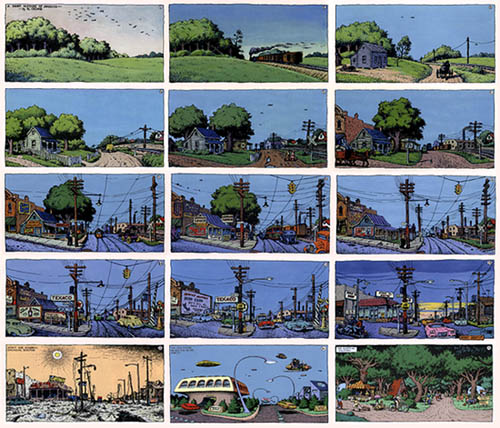
Sadly the picture's not big enough for the lettering to be read, so here's a closeup of the fourth to last panel.
Originally that's where the comic ended, but Crumb later went in and drew three possible answers: ecological collapse, technofuturism, and ecotopia. Right now we're still hovering over "What's next?"
My former students may appreciate the similarities between this static image and the Soylent Green opening titles...
Showing posts with label technopositivity. Show all posts
Showing posts with label technopositivity. Show all posts
Saturday, March 14, 2009

Saturday, February 14, 2009
All the material and intellectual forces which could be put to work for the realization of a free society are at hand. That they are not used for that purpose is to be attributed to the total mobilization of existing society against its own potential for liberation.Every so often, when I can, I like to share snippets of what I'm reading for my exams. Yesterday it was Herbert Marcuse's "The End of Utopia," in which he argues that a functionally limitless technological horizon which finally eliminates the realm of necessity demands in turn an aesthetic-erotic revolution in values. This one's short and good. Check it out.
Even on the left the notion of socialism has been taken too much within the framework of the development of productive forces, of increasing the productivity of labor, something which was not only justified but necessary at the level of productivity at which the idea of scientific socialism was developed but which today is at least subject to discussion. Today we must try to discuss and define--without any inhibitions, even when it may seem ridiculous--the qualitative difference between socialist society as a free society and the existing society. And it is precisely here that, if we are looking for a concept that can perhaps indicate the qualitative difference in socialist society, the aesthetic-erotic dimension comes to mind almost spontaneously, at least to me. Here the notion "aesthetic" is taken in its original sense, namely as the form of sensitivity of the senses and as the form of the concrete world of human life. Taken in this way, the notion projects the convergence of technology and art and the convergence of work and play. It is no accident that the work of Fourier is becoming topical again among the avant-garde left-wing intelligentsia. As Marx and Engels themselves acknowledged, Fourier was the only one to have made clear this qualitative difference between free and unfree society. And he did not shrink back in fear, as Marx still did, from speaking of a possible society in which work becomes play, a society in which even socially necessary labor can be organized in harmony with the liberated, genuine needs of men.
Friday, November 28, 2008
Whatever happened to the hydrogen economy?
Other industry observers are far more equivocal. "The jury is out on battery versus fuel cell," says Richard Wenham of car industry consultancy Ricardo. "That's why everybody is researching everything."
But for all the research into hydrogen, fuel cells remain dependent on platinum, and hydrogen generation is still punitively inefficient. Meanwhile battery technologies are developing rapidly and continue to attract huge investment. The jury may not be out for very much longer. According to Kendall: "Hydrogen has always been the fuel of the future, and it looks like it always will be."
Sunday, October 26, 2008
We're saved, part 2? Researchers at Massachusetts Institute of Technology (MIT) have discovered a new way of storing energy from sunlight that could lead to ‘unlimited’ solar power.
(Here, I suppose, was part 1.)
Friday, June 06, 2008
 Two from Ryan: 'Nukes not so clean or green' and Wired Magazine's hippies-suck special on ecology. The latter actually dovetails fairly nicely with the ecology post I put up on culturemonkey last night, both as a striking example of the sorts of myopic conclusions you're driven towards when you only think inside capitalist markets and as a nice lead-in to the (forthcoming) second half of the series, which will deal with ecology as a program for the conservation of nature vs. ecology as a program for the regulation of nature.
But mostly the Wired issue stands as a noteworthy testament to what happens when you allow an unholy trinity of technopositivity, kneejerk know-it-all contrarianism, and fierce resentment of hippies to drive your coverage: even your good insights get drowned in smarm.
Given the above priorities, Wired is forced down a peculiar chain of reasoning:
1. There are multiple environmental crises in progress.This probably makes a lot of sense if you're marketing a magazine to nerds who like being right and who hate any criticism of technocapitalism, especially when it comes from dirty hippies—but it doesn't make any sense as a basis for environmental policy.
2. Climate change is the most immediate of these.
3. Therefore in all matters we should ignore any and all considerations but the most short-term carbon calculus, no matter what the consequences will be with regard to the other crises.
* Priuses are stupid because used cars still exist!Color me unimpressed.
* Nuclear power has no relevant drawbacks whatsoever!
* Same with Frankenfoods!
* If you define the scope of the environmental crisis incredibly specifically you can conclude old-growth forests harm the environment!
* Same with organic agriculture!
* We're screwed no matter what we do, and anyway, don't people like it a little hotter?
This from the last link will probably serve as the intro for the zizecology 2 post:
In his 1992 best seller, Earth in the Balance, Al Gore derided adaptation as "a kind of laziness, an arrogant faith in our ability to react in time to save our own skin." Better to take Stewart Brand's advice from the opening page of the original Whole Earth Catalog: "We are as gods and might as well get good at it." We're in charge here. Let's get to work.


 Posts
Posts


