My blog has moved!

You should be automatically redirected to the new home page in 60 seconds. If not, please visit
http://gerrycanavan.com
and be sure to update your bookmarks. Sorry about the inconvenience.

Showing posts with label optimism. Show all posts

Saturday, November 07, 2009

Happy Saturday. You've earned it.

* On the Yankee payroll. Via Barking Up the Wrong Tree.

In 2002, the Yankees spent $17 million more in payroll than any other team.

In 2003, the Yankees spent $35 million more in payroll than any other team.

In 2004, the Yankees spent $57 million more in payroll than any other team. I mean, it’s ridiculous from the start but this is pure absurdity. Basically, this is like the Yankees saying: “OK, let’s spend exactly as much as the second-highest payroll in baseball. OK, we’re spending exactly as much. And now … let’s add the Oakland A’s. No, I mean let’s add their whole team, the whole payroll, add it on top and let’s play some ball!”

In 2005, the Yankees spent $85 million more than any other team. Not a misprint. Eight five.

In 2006, the Yankees spent $74 million more than any other team.

In 2007, the Yankees spent $40 million more than any other team — cutbacks, you know.

In 2008, the Yankees spent $72 million more than any other team.

In 2009, the Yankees spent $52 million more than any other team.
Congrats again on that World Series.

* Ryan recommends Paul Fry's literary theory course from Yale Open Courses. I've downloaded all the lectures and they'll be joining me on my run tomorrow.

* First, Let’s Kill All the Credit Default Swaps. Related: an NPR interview on The Greatest Trade Ever, which tells the story of how a middle-of-the-road hedge fund manager made billions during the financial collapse.

* Al Gore, revolutionary.
When making his Oscar-winning 2006 documentary, An Inconvenient Truth, Gore arguably had it easy: it's fairly straightforward to grip an audience when you're portraying scenes of apocalyptic destruction. The new book pulls off a considerably more impressive feat. It focuses on solving the crisis, yet manages to be absorbing on a topic that is all too often – can we just come clean about this, please? – crushingly boring. Importantly, it seeks to enlist readers as political advocates for the cause, rather than just urging them to turn down the heating. "It's important to change lightbulbs," he says, in a well-burnished soundbite, "but more important to change policies and laws." Or perhaps to break laws instead: peaceful occupations of the kind witnessed recently in the UK, he predicts, are only going to become more widespread. "Civil disobedience has an honourable history, and when the urgency and moral clarity cross a certain threshold, then I think that civil disobedience is quite understandable, and it has a role to play. And I expect that it will increase, no question about it." People sometimes express incredulity that Gore, who was groomed for the presidency almost since birth, seems so resolved that he'll never return to electoral politics. But here's a vivid example of the benefits of life on the outside: how many serving politicians would feel able to come so close to urging people to commit trespass?
A friend reminds me that Al Gore was elected President of the United States 9 years ago today.

* And Barbara Ehrenreich's new book argues that positive thinking is destroying America.

Thursday, October 22, 2009

News keeps rolling out about the public option today; ABC is reporting that a public option is likely to be in the final Senate bill (about which Max Baucus is said to be "apoplectic"), and Open Left's informal whip count has 58 votes for cloture. (Most Important People in the Country by this count: Mary Landrieu and Evan Bayh.)

Open Left also discusses reports that suggest Pelosi's "robust" version will pass the House. Genuine health care reform seems very close today.

UPDATE: Steve Benen has some thoughts on Mary Landrieu and her stated opposition to the public option. Of course the real question is not whether she'll vote for the bill but whether she'll vote for cloture—and call me a pie-in-the-sky optimist but I find it hard to imagine, when push comes to shove, that any member of the Democratic caucus would cast the lone vote to destroy health care reform by denying it a floor vote. (Landrieu or Bayh would basically have to switch parties if they did, and no one jumps onto a sinking ship.) Because he's a proud member of the notoriously independent Connecticut for Lieberman caucus, I've been much more worried about Lieberman's loyalty than anybody else's—so I'm glad to see he's already confirmed he'll vote for cloture.

UPDATE 2: Apparently Landrieu announced today that she won't support a Republican filibuster. If Open Left's count is right, that just leaves President Bayh.

Wednesday, December 10, 2008

Afternoonery.

* Support for renewable energy technology to fight global warming is weakening in the face of worldwide economic problems and the true scale of the carbon reductions required, a survey published today has suggested.

Figures presented at the UN climate talks in Poznan, Poland, show that climate experts have less faith in alternative energy than they did 12 months ago.


* Grist reviews 2008's most essential book on shit.

* DFW's last book will be published next year, based off the Kenyon College commence speech he gave in 2005. Devotees may recall that this speech was the basis for my MetaFilter obit post.

* Everyone's in love with this evolved Mona Lisa. More evolution fun at Pharyngula and MetaFilter.

* Everyone's in love with Macs.

* Don't miss Metallica's latest music video, a prophecy of zombie disaster originating with the Tungska Event.

Sunday, October 26, 2008

We're saved, part 2? Researchers at Massachusetts Institute of Technology (MIT) have discovered a new way of storing energy from sunlight that could lead to ‘unlimited’ solar power.

(Here, I suppose, was part 1.)

Wednesday, August 13, 2008

Job market optimism? It's a little hard to fathom, but my fellow Dukeling Alex Greenberg links to stats and predictions that my unhappy, rag-tag generation of would-be tenured academics will all be making fat professor money very soon.

But do a search for the word "tenure" and I'm afraid the news won't strike you as really all that good:

The number of tenure-track positions is declining as institutions seek flexibility in dealing with financial matters and changing student interests. Institutions rely more heavily on limited term contracts and part-time, or adjunct, faculty, thus shrinking the total pool of tenured faculty. Limited-term contracts—typically 2- to 5 years, may be terminated or extended when they expire but generally do not lead to the granting of tenure. In addition, some institutions have limited the percentage of faculty who can be tenured.
Note too that this optimism is largely predicated on the expectation that there are "large numbers of postsecondary teachers who are likely to retire over the next decade," a long-prophecied, perpetually unrealized mass exodus that is more or less the grad student equivalent of the Second Coming...

Thursday, February 14, 2008

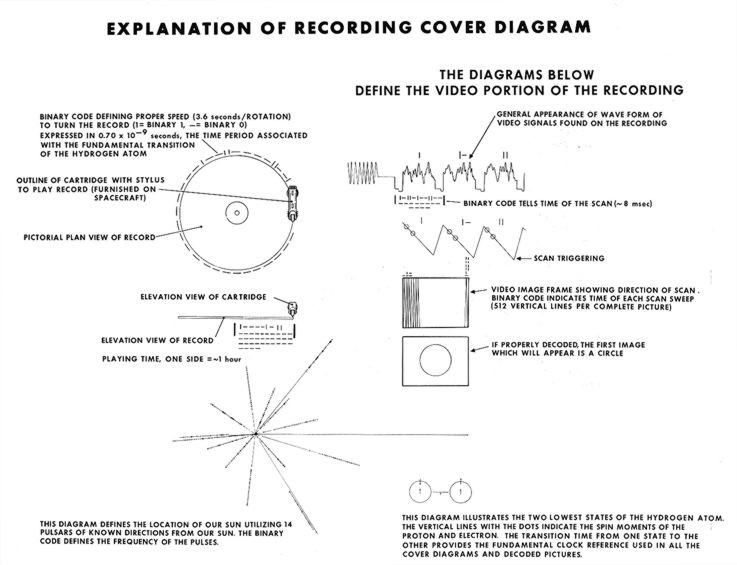
This Voyager spacecraft was constructed by the United States of America. We are a community of 240 million human beings among the more than 4 billion who inhabit the planet Earth. We human beings are still divided into nation states, but these states are rapidly becoming a single global civilization.

We cast this message into the cosmos. It is likely to survive a billion years into our future, when our civilization is profoundly altered and the surface of the Earth may be vastly changed. Of the 200 billion stars in the Milky Way galaxy, some--perhaps many--may have inhabited planets and spacefaring civilizations. If one such civilization intercepts Voyager and can understand these recorded contents, here is our message:

This is a present from a small distant world, a token of our sounds, our science, our images, our music, our thoughts, and our feelings. We are attempting to survive our time so we may live into yours. We hope someday, having solved the problems we face, to join a community of galactic civilizations. This record represents our hope and our determination, and our good will in a vast and awesome universe.

—President Carter's statement, placed on the Voyager spacecraft, June 16, 1977

I've always been fascinated by the Golden Record, the carefully crafted, would-be universal greeting to any unlikely extraterrestrial discoverer of the Voyager spacecraft. Just look at the statement from Carter—can you imagine anything so unabashedly Utopian and unrepentantly sci-fi getting the official stamp of approval today? There's something magical about it.

Tuesday, January 29, 2008

In all the hoopla surrounding South Carolina and the Kennedy endorsement, it's tough to remember that Obama is still heading into Super Duper Tuesday at a significant disadvantage, especially in big states like California, New York, and New Jersey. (Note: as of 2 PM on 1/29 the charts on polllster.com haven't taken South Carolina and the possible Kennedy bump into consideration yet.) But there's reason to be hopeful—the latest Survey USA poll has him down 11 points, 49 to 38, up from 15 points down two weeks ago and 30 points down in December. Nor have the polls been especially reliable this time around; the likely voter models haven't really been reliable in any state, most recently and most notably in South Carolina, where a twelve-point projected victory turned into twenty-eight points.

The always reliable Douchebag of Liberty Bob Novak writes in the Washington Post today that Clinton's lead in California may be significantly softer than it looks:

Clinton's double-digit lead in California polls over Sen. Barack Obama is misleading. Subtract a Latino voting bloc whose dependability to show up on Election Day always has been shaky, and Clinton is no better than even here, with Obama gaining.

...

The poll's demographics are more important. Clinton has dramatically lost support among blacks, now trailing Obama 58 percent to 24 percent. It is a virtual dead heat among white non-Hispanics, 32 percent to 30 percent. The 12-point overall lead derives from a 59 percent to 19 percent Clinton edge among Latinos.

In California, the Latino vote is notoriously undependable in actual voting, especially when compared with African American turnout.
Novak also notes that independents (who can only vote in the Democratic primary in California) and young voters (who are notoriously unpredictable) are two additional wild cards that may work in Obama's favor.

In the New York Times, David Brooks echoes the thoughts of a lot of people when he writes that "something fundamental has shifted in the Democratic party":
Then, in the speech’s most striking passage, he set Bill Clinton afloat on the receding tide of memory. “There was another time,” Kennedy said, “when another young candidate was running for president and challenging America to cross a New Frontier.” But, he continued, another former Democratic president, Harry Truman, said he should have patience. He said he lacked experience. John Kennedy replied: “The world is changing. The old ways will not do!”

The audience at American University roared. It was mostly young people, and to them, the Clintons are as old as the Trumans were in 1960. And in the students’ rapture for Kennedy’s message, you began to see the folding over of generations, the service generation of John and Robert Kennedy united with the service generation of the One Campaign. The grandparents and children united against the parents.
Matt Yglesias and his commentators even offer some slim hope for a close finish in New York City and State, albeit with a possible assist from the Good Lord himself:
A big icestorm upstate and a light rainstorm in the city on Feb 5 could be very good for Obama. Remember there is no early voting in NYS. To vote absentee you have to specify a reason why you can't make it to the polls.
All I'm trying to say is this: Keep hope alive, bald people.

Saturday, January 05, 2008

I'm going to try and watch the Democratic candidate debate tonight—I've avoided these things so far, because they're almost always unwatchable, but there comes a time when you can no longer run—so if anything interesting happens I'll be around to blog about it. In the meantime, though I have a few more primary links for those of you who aren't totally sick of this topic yet:

* The new ARG poll, previously favorable to Clinton, now shows Obama clobbering her 38% to 26%.

* Inevitable "Worst Person in the World" Bill O'Reilly got accosted by the Secret Service today after making a scene at an Obama rally. If the party alignment were switched he probably would have been arrested, but for now I'm content just to see the guy continuing to make a complete ass out of himself.

* Pictures from an Obama rally this morning show the huge numbers of people who are turning out to see him speak. I believe this particular rally had over 2,500 people attend—they packed two gyms. Marc Ambinder, though apparently a Clinton supporter, has a nice post that recognizes the sheer magnitude of what is going on here, and what it means for the Clinton campaign going forward.

* This cartoon comparing the greatness of two Illinois politicians with limited "national experience" is very cute, but even it returns us inevitably to the current paroxysm of fear gripping many in both the African-American community and the progressive left, before and after Iowa, my endlessly pessimistic self included: What if the worst happens, again? I don't fear violence after either an Obama victory or loss, as some on the right already claim to; all I fear is that at some point in the days and months and (hopefully) years ahead the country will once again be made to suffer its best and brightest hope being snatched away. I've felt this fear intensely since immediately following the news of Obama's Iowa victory, and I suspect I'll keep feeling it on some level or another until Jan. 20, 2017. I admire the hell out of the man just for risking that alone; talk about the audacity of hope.

Friday, September 28, 2007

Tim Burke has an article in the latest minnesota review about academic freedom and in particular the way that tenure can work to stifle the very open debate it exists to protect.

In particular, the system of tenure, allegedly the cornerstone of academic freedom, often acts perversely in the opposite direction. The tenure system sometimes suppresses rather than enhances autonomy and freedom among graduate students and junior faculty during their most crucial period of professionalization. Moving outside of established consensus views of topics and methodologies as a junior scholar creates a very serious risk to an academic career. Junior scholars are encouraged to be original but often only within very narrow paradigmatic definitions of originality. While both academics and non-academics have heard tenure "horror stories" in which clearly qualified candidates have been punished for perceived non-conformity or unorthodoxy, the real problem is subtler. Senior scholars who break cover and exhibit open brutality towards junior faculty are at least slightly unusual. More important by far are the small, pervasive, and sometimes unconscious ways that tenured scholars are able to direct or channel the intellectual labor of untenured scholars.
He may be right, but he'll get my imaginary tenure out of my cold, dead hands.

Via The Valve, where elsewhere Smurov presents the "Little Nell" school of criticism in all its glory:
1. Convene the PTA on the docks.
2. Call up to the clipper’s captain: “Does Little Nell yet live?"
3. If “yes,” deem the book acceptable. If “no,” start the bonfire.

Saturday, June 02, 2007

Sometimes there's good news: New Hampshire has approved civil unions.

Wednesday, May 16, 2007

Bill Simmon at Candleblog has a pair of posts responding to yesterday's Salon piece on futurism, arguing that the "the future really is here and it's mostly better than the past." This is, certainly, true in many important ways—but the question of the sustainable grounding for all this technomagic is more than just a footnote to our prosperity, it's the elephant in the room. If we've really hit worldwide peak oil, or will in the next few years, the elixir than drives the digital paradise is going to start becoming scarce, and we haven't found a suitable replacement.

The other, related issue with Utopia-is-now technocratic optimism, of course, is who it leaves behind. Class divisions are being increasingly exacerbated within this country and even more dramatically worldwide—that the present might seem like a paradise to us is largely a function of our incredible wealth, vis-à-vis everybody else. (Likewise, the progress made in racial and sexual freedoms is largely tied to these same class differences.) Cribbing again from Jared Diamond, there's good reason why he called agriculture the worst mistake in the history of the human race.

I'd like to agree with Bill here, but Utopia can't be a ticking clock or Fritz Lang's Metropolis—it's got to be for everyone and it's got to be able to last. The older I get, the more the techno-optimism of my youth evaporates into a growing sense that neither will happen.