My blog has moved!

You should be automatically redirected to the new home page in 60 seconds. If not, please visit
http://gerrycanavan.com
and be sure to update your bookmarks. Sorry about the inconvenience.

Showing posts with label childhood. Show all posts

Tuesday, September 15, 2009

Tuesday night!

* The buzzword at the heart of my dissertation got a bump today.

* 'Good Night and Tough Luck': a short web comic about the misery of insomnia.

* Good news/bad news: the total implosion of the global economy has caused CO2 emissions to plummet 6%, to 8.5% of 2005 levels.

* Corzine takes his first polling lead over Chris Christie in the New Jersey governor's race.

* Osama bin Laden blurbs a few of his favorite books, including Jimmy Carter's Palestine: Peace Not Apartheid and (apparently) Confessions of an Economic Hit Man. (via)

* American debt, the Chinese economy, and mutually assured financial destruction.

* The House passed a resolution of disapproval against Congressman Joe Wilson along strict party lines? You lie!

* When will the MSM break its silence on Obama's secret rat love?

* 'Wealthcare': A brief history of Ayn Rand. Some talk at MeFi.

(The anti-government activist Grover Norquist has told a similar story from childhood, in which his father would steal bites of his ice cream cone, labelling each bite "sales tax" or "income tax." The psychological link between a certain form of childhood deprivation and extreme libertarianism awaits serious study.)
* Conservative bloggers have truly outdone themselves in their efforts to hype the 9/12 rally; Steve Benen and Media Matters have the details on "the largest event held in Washington, D.C., ever." It's the greatest propaganda FAIL since they tried to pass off a picture of the Promise Keepers rally as being from last weekend.

* And this interview from one of Bush's last speechwriters has been linked by nearly every mainstream political blog I read: Ezra Klein, Matt Yglesias, Steve Benen, Kevin Drum, Atrios, Ben Smith, Think Progress, MetaFilter, and Crooks and Liars, each with their own favorite moment from the piece. The Palin line is sort of inescapable:
“I’m trying to remember if I’ve met her before. I’m sure I must have.” His eyes twinkled, then he asked, “What is she, the governor of Guam?”

Everyone in the room seemed to look at him in horror, their mouths agape. When Ed told him that conservatives were greeting the choice enthusiastically, he replied, “Look, I’m a team player, I’m on board.” He thought about it for a minute. “She’s interesting,” he said again. “You know, just wait a few days until the bloom is off the rose.” Then he made a very smart assessment.

“This woman is being put into a position she is not even remotely prepared for,” he said. “She hasn’t spent one day on the national level. Neither has her family. Let’s wait and see how she looks five days out.”

Monday, July 13, 2009

Rather short Infinite Summer post from me this time around as I put together all the things that need to be put together for my late-summer stint as an instructor at the Duke University Institute for Gifted Youngsters. Like last year, posting will be somewhat slow the next three weeks; I'll mostly be posting only in the very early morning, at night, and on weekends, with occasional daytime posts here and there whenever I'm able to commit a little time theft.

With IGY on my mind, I was really struck by footnote 76, which provides as good a summary as you'll find of the inner life of anyone stamped "gifted" when they are young, not just Hal Incandenza but also my IGY students and me and most of the people who have become my close friends over the years and maybe you as well:

Hal Incandenza had been thought for a while as a toddler to have some sort of Attention Deficit Disorder—partly because he read so fast and spent so little time on each level of various pre-CD-ROM video games, partly because just about any upscale kid even slightly to port or starboard of the bell curve's acme was thought at that time to have A.D.D.—and for a while there'd been a certain amount of specialist-shuttling, and many of the specialists were veterans of Mario and were preconditioned to see Hal as also damaged, but thanks to the diagnostic savvy of Brandeis's Child Development Center the damage assessments were not only retracted but reversed way out to the other side of the Damaged-to-Gifted spectrum, and for much of the glabrous part of his childhood Hal'd been classified as somewhere between "Borderline Gifted" and "Gifted"—though part of this high cerebral rank was because B.C.D.C.'s diagnostic tests weren't quite so keen when it came to distinguishing between raw neural gifts and the young Hal's monomaniacally obsessive interest and effort, as if Hal were trying as if his very life were in the balance to please some person or persons, even though no one had ever even hinted that his life depended on seeming gifted or precocious or even exceptionally pleasing—and when he'd committed to memory entire dictionaries and vocab-check software and syntax manuals and then had gotten some chance to recite some small part of what he'd pounded into his RAM for a proudly nonchalant mother or even a by-this-time-as-far-as-he-was-concerned-pretty-much-out-there father, at these times of public performance and pleasure—the Weston M.A. school district in the early B.S. 1990s had had interschool range-of-reading-and-recall spelling-beeish competitions called "Battle of the Books," which these were for Hal pretty much of a public turkey-shoot and approval-fest—when he'd extracted what was desired from memory and faultlessly pronounced it before certain persons, he'd felt almost that same pale sweet aura that an LSD afterglow conferred, some milky corona, like almost a halo of approved grace, made all the milkier by the faultless nonchalance of a Moms who made it clear that his value was not contingent on winning first or even second prize, ever.
The incredibly slippery slope from this sort of childhood precociousness to adult dysfunction is something we've talked about here once or twice before in connection with the films of Wes Anderson, whose thematically similar The Royal Tenenbaums pops up around the fringes of IJ discussion quite a bit. And we can see now what a hard-luck case I really am: thirty years old and I'm still a student, still chasing the same damn high.

Most of the rest of what I'd have to say about today's spoiler line was already covered in my post last week on DFW, addiction, and suicide, for which Joelle is something of an exemplary case. This weekend's pages were pretty much all Joelle, all the time, not that I'm complaining. She's an interesting character and somehow able to bring us closer to the mind of Himself than anyone else we've met thus far.

Monday, July 06, 2009

Monday procrastination sensations.

* The Burnt-out Adjunct has some advice at Inside Higher Ed about the difference between adjuncts, add-junks, and instructors.

* 3 Quarks Daily has some thoughts from Timothy Fongon on building a viable American left:

Only about 25 percent of US citizens hold a passport. (See 2007 population data here and number of Americans with passports here.) A majority of Americans have never travelled overseas. Thus, any movement which makes appeals primarily on the basis of universalist/internationalist rhetoric is likely to have an audience significantly smaller than the majority of the US population.
The whole essay strongly echoes a proclamation from the C.L.R. James I was reading just last night: "To Bolshevize America it is necessary to Americanize Bolshevism."

* A Feministe guestblogger describes the difficulties in filling out forms when one is transgender. The thread also introduces me to a term I've missed up to now, cisgender, denoting someone whose gender identity is aligned with their biological sex—which means I can now describe the forms Queen Emily discusses as cisnormative (which they are—no need for little boxes with prescribed answers when you could just have a blank line).

* Nate Silver gets a little more pragmatic with a close look at how a climate bill can get 60 votes in the Senate. He's also got a post on Sarah Palin's appeal that, for my money, misses what's so terrifying about Palin: (1) the clear sense that the right is building itself a second George W. Bush out of identitarian resestment, sloganeering, faux folksy charm, and hero worship, and (2) that it already worked once.

* Steve Benen has your bogus Obama scandal roundup.
Walpin was all the rage in conservative circles, right up until the "controversy" appeared baseless, and White House detractors were forced to move on.

But notice how this has happened quite a bit in the very young Obama administration. Remember when conservatives were convinced that the White House was closing car dealerships based on owners' political contributions? Or how about the not-so-scandalous Department of Homeland Security report about potentially violent extremists, which prompted some conservatives to call for Napolitano's resignation? Or about the EPA economist whose bizarre memo on global cooling was "suppressed"?

All of these caused widespread apoplexy among rabid anti-Obama activists. And all of these quickly fell apart after minimal scrutiny.
* Transformers II and racism. More from Ezra Klein.

* And Michael Chabon has a nice essay in The New York Review of Books about the wilderness of childhood set against both adult nostalgia for the freedom of youth and contemporary overparenting and child endangerment hysteria. But the headline ("Manhood for Amateurs") is wrong under the article's own terms:
This is a mistaken notion, in my view. People read stories of adventure—and write them—because they have themselves been adventurers. Childhood is, or has been, or ought to be, the great original adventure, a tale of privation, courage, constant vigilance, danger, and sometimes calamity. For the most part the young adventurer sets forth equipped only with the fragmentary map—marked here there be tygers and mean kid with air rifle—that he or she has been able to construct out of a patchwork of personal misfortune, bedtime reading, and the accumulated local lore of the neighborhood children.
Sloppy work from the editor there.

Tuesday, February 03, 2009

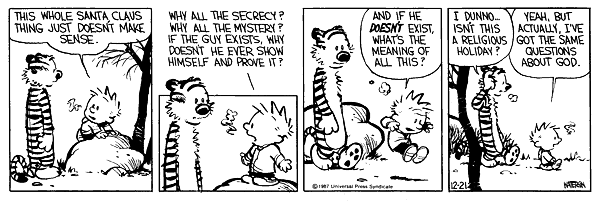
Whether by pure chance or divine plan, a couple of stories about childhood atheism and/or conversion to atheism ran across my screen yesterday.

* Ricky Gervais
* Calvin & Hobbes
* Julia Sweeney

In varying ways the story of my own "conversion" has affinities with each of these three; I think I've told it somewhere on the Internets before. There's really two stories. The first is the night when I was five or so and figured out that Santa Claus, the Tooth Fairy, the Easter Bunny, and all the rest didn't exist, in a row, one after another. The second is a few years later, eleven or twelve years old and obscenely terrified of death because I didn't really believe in God anymore. My parents, eventually fed up with my panic, took me to see our local priest, who gave me a couple of metaphors to chew on and told me I should pray for guidance.

So I did, and when I was done, I realized I'd been talking to myself.

Sunday, November 09, 2008

Some articles for this lazy Sunday.

* "A Boy's Life": Biology, politics, and transgender children in America.

Brandon raced by, arm in arm with his new friend, giggling. Tina and Bill didn’t know this yet, but Brandon had already started telling the other kids that his name was Bridget, after the pet mouse he’d recently buried (“My beloved Bridget. Rest With the Lord,” the memorial in his room read). The comment of an older transsexual from Brooklyn who’d sat behind Tina in a session earlier that day echoed in my head. He’d had his sex-change operation when he was in his 50s, and in his wild, wispy wig, he looked like a biblical prophet, with breasts. “You think you have troubles now,” he’d yelled out to Tina. “Wait until next week. Once you let the genie out of the bottle, she’s not going back in!”
* "Rock, Paper, Scissors": A history of the polls.
Voting in America, it’s fair to say, used to be different. “Are you not a man in the full vigor of manhood and strength?” a member of the House Committee on Elections asked another Harrison supporter who, like Kyle, went to the polls but turned back without voting (and who happened to stand six feet and weigh more than two hundred pounds). The hearings established a precedent. “To vacate an election,” an election-law textbook subsequently advised, “it must clearly appear that there was such a display of force as ought to have intimidated men of ordinary firmness.”
* "Red Sex, Blue Sex."
During the campaign, the media has largely respected calls to treat Bristol Palin’s pregnancy as a private matter. But the reactions to it have exposed a cultural rift that mirrors America’s dominant political divide. Social liberals in the country’s “blue states” tend to support sex education and are not particularly troubled by the idea that many teen-agers have sex before marriage, but would regard a teen-age daughter’s pregnancy as devastating news. And the social conservatives in “red states” generally advocate abstinence-only education and denounce sex before marriage, but are relatively unruffled if a teen-ager becomes pregnant, as long as she doesn’t choose to have an abortion.
* "The Things He Carried": Jeffrey Goldberg exposes the joke that is airport security.
During one secondary inspection, at O’Hare International Airport in Chicago, I was wearing under my shirt a spectacular, only-in-America device called a “Beerbelly,” a neoprene sling that holds a polyurethane bladder and drinking tube. The Beerbelly, designed originally to sneak alcohol—up to 80 ounces—into football games, can quite obviously be used to sneak up to 80 ounces of liquid through airport security. (The company that manufactures the Beerbelly also makes something called a “Winerack,” a bra that holds up to 25 ounces of booze and is recommended, according to the company’s Web site, for PTA meetings.) My Beerbelly, which fit comfortably over my beer belly, contained two cans’ worth of Bud Light at the time of the inspection. It went undetected. The eight-ounce bottle of water in my carry-on bag, however, was seized by the federal government.
* "Verbage": The Republican war on words.
Doesn’t this reflect a deep suspicion of language itself? It’s as if Republican practitioners saw words the way Captain Ahab saw “all visible objects”—as “pasteboard masks,” concealing acts and deeds and things—and, like Ahab, were bent on striking through those masks. The Melvillean atmosphere may not be accidental, since, beyond the familiar American anti-intellectualism—to work with words is not to work at all—there’s a residual Puritanism. The letter killeth, as St. Paul has it, but the spirit giveth life. (In that first debate, McCain twice charged his opponent with the misdeed of “parsing words.”) In this vision, there is something Pharisaical about words. They confuse, they corrupt; they get in the way of Jesus.
* "Thumbspeak": A brief history of texting.
Texting is international. It may have come late to the United States because personal computers became a routine part of life much earlier here than in other countries, and so people could e-mail and Instant Message (which shares a lot of texting lingo). Crystal provides lists of text abbreviations in eleven languages besides English. And it is clear from the lists that different cultures have had to solve the problem of squeezing commonly delivered messages onto the cell-phone screen according to their own particular national needs. In the Czech Republic, for example, “hosipa” is used for “Hovno si pamatuju”: “I can’t remember anything.” One can imagine a wide range of contexts in which Czech texters might have recourse to that sentiment. French texters have devised “ght2v1,” which means “J’ai acheté du vin.” In Germany, “nok” is an efficient solution to the problem of how to explain “Nicht ohne Kondom”—“not without condom.” If you receive a text reading “aun” from the fine Finnish lady you met in the airport lounge, she is telling you “Älä unta nää”—in English, “Dream on.”