This one's local interest, but anyone in the Triangle who is interested in an "Ecology and the Humanities" working group sponsored by Duke's Franklin Humanities Institute and administered by the Polygraph 22 editors should shoot me an email for details about our first meeting on Nov. 12. We're reading Radkau and Dana Philips the first week.
Showing posts with label humanities. Show all posts
Showing posts with label humanities. Show all posts
Wednesday, October 21, 2009

Wednesday, September 16, 2009
This month's "Theory killed English" article is stranger than most, as it begins with a recognition that drops in English departments are commensurate with drops in foreign languages, history, and "philosophy and religious studies" (which I had no idea was a single discipline). It therefore concludes that these disciplines must all be part of something called "the literary humanities," whose decline can still be pinned (of course) on politicized disputes within English itself. Now, it's true that I have long thought History was ripe for academic colonization, but I think my friends in that department might resist the idea that their discipline is a mere appendix to mine.
English: from 7.6 percent of the majors to 3.9 percentIt takes real work to look at numbers showing a roughly 50% decline across the board in the humanities since 1970/1971 and conclude that intra-English shifts must be the primary culprit. I look at these same numbers, note the nearly identical drops in History and elsewhere, and conclude the decline must have been caused by external pressures, having nothing to do with theory or the canon at all.
Foreign languages and literatures: from 2.5 percent to 1.3 percent
Philosophy and religious studies: from 0.9 percent to 0.7 percent
History: from 18.5 percent to 10.7 percent
Business: from 13.7 percent to 21.9 percent
Monday, August 31, 2009
Paging David Horowitz: "[O]ur results suggest that postmodernism, rather than science, is the bête noir—the strongest antagonist—of religiosity." Via @traxus4420.
Wednesday, June 24, 2009
Wednesday 3. * First Read considers the curse of the 2012 GOP candidate, noting that only Mitt Romney has avoided total credibility implosion. But stay tuned: it's a long way to Iowa, and I believe in the Mittpocalypse.
Of course, it's also worth noting that Obama's political opponents tend to be cursed in this way: consider that his main opponents for Illinois State Senate were pulled from the ballot for insufficient signatures, that his original run for Senate was facilitated by the scandal surrounding the divorce of Jack and Jeri "Seven of Nine" Ryan, and that his opponent for the presidency actually thought Sarah Palin was a credible vice presidential candidate.
* More on Kay Hagan and health care from Triangulator. Contact information for Hagan's Senate office is here.
* The MTA is trying to sell name rights for subway stations. Can't we get a court to bar this kind of silliness? "Atlantic Avenue" is a useful and informative name for a subway station; the name of a bank in London is not remotely. UPDATE: I'm 99% less outraged upon realizing that Barclay's is building a basketball stadium near that subway station.
* Michael Bérubé on the futility on the humanities. Said futility is not a bad thing.
* Žižek on Iran (at least allegedly).
And, last but not least, what this means is that there is a genuine liberating potential in Islam – to find a “good” Islam, one doesn’t have to go back to the 10th century, we have it right here, in front of our eyes.* Soccer in South Africa, at the Big Picture.
The future is uncertain – in all probability, those in power will contain the popular explosion, and the cat will not fall into the precipice, but regain ground. However, it will no longer be the same regime, but just one corrupted authoritarian rule among others. Whatever the outcome, it is vitally important to keep in mind that we are witnessing a great emancipatory event which doesn’t fit the frame of the struggle between pro-Western liberals and anti-Western fundamentalists. If our cynical pragmatism will make us lose the capacity to recognize this emancipatory dimension, then we in the West are effectively entering a post-democratic era, getting ready for our own Ahmadinejads. Italians already know his name: Berlusconi. Others are waiting in line.

Saturday, May 16, 2009
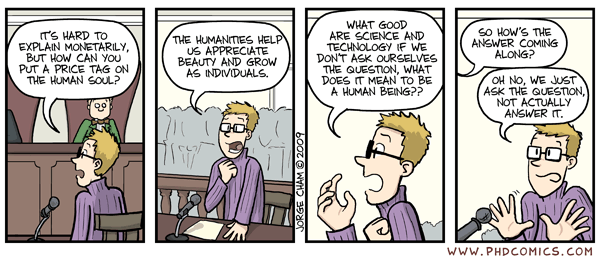
Kind of got our number there.
Saturday, March 07, 2009
Saturday night's all right for blogging. After the first few links we even get to some stuff that's not about Watchmen.
* Walter Chaw's Watchmen review goes to many of the same places as my own, albeit in a more thoroughgoing way:
Freeze any frame of the film and find in it the panel that inspired it. With each section separated by grabs from the covers of the comic book's initial run, fanboys should have no quarrel with the fidelity of the piece--but the reaction to the picture will likely continue to be fairly muted, as devotees of the graphic novel didn't exactly appreciate it for its slickness and sexiness. I'd hazard that what attracted people to the book is that Moore's vision is one of absolute respect for the power of the image in molding human history. Snyder does seem to understand this in restaging the Kennedy assassination with one of his masked heroes as the culprit, drawing a line pure and true from Zapruder's inauguration of film as history to the comic-book medium's inextricable hold on the collective imagination-in-formation. The power of Moore's work is that it takes the divine and, like Milton's mission, explains the ways of these gods to men in terms that men can understand: they're corrupted by their power and governed by their avarice and the essential baseness of being human. This sentiment is all but jettisoned, alas, by the time Snyder recasts the pathetic victories of sexually-reawakened schlub Night Owl (Patrick Wilson) and paramour Silk Spectre (a severely overmatched Malin Akerman) as triumphant victories. Watchmen--filthy with its director's now-trademark ramping technique--sees itself as a superhero adaptation of a human book. The failures of these characters are just weaknesses our übermenchen must overcome, not the foibles and hubris that lead to their downfall--and ours.Vu and kate both get at this deep in the comments to my original post as well.
* Meanwhile, Spencer Ackerman says Watchmen is a "great film" and then spends the rest of the post explaining why it isn't.
* The headline reads, "Watchmen's first day disappoints." You're telling me!
* John Scalzi argues for a statute of limitations on spoilers.
Television: One week (because it’s generally episodic, and that’s how long you have until the next episode)To my mind the whole "spoiler" hysteria needs to end; suspense is an overrated aesthetic in all but the rarest cultural productions.
Movies: One year (time enough for everyone to see it in the theaters, on DVD and on cable)
Books: Five years (because books don’t reach nearly as many people at one time)
* Husband, Wife Unaware They Are A Comedy Team.
* I suffered from this for years without knowing there was a name for it besides "being a college student."
* Another picture of a grown-up Calvin and Hobbes for your collection.
* The economy and literature: Will this crisis produce a Gatsby? More at MeFi.
* Does the financial crisis signal the end of neo-liberalism? David Harvey on the credit crunch and class.
* Abandoned places: a LiveJournal community. (Thanks, Eli!)
* And attention would-be humanities grad students: there are no jobs. None.
Sunday, March 01, 2009
 Sunday, Sunday.
* The New Yorker has fiction from the late great David Foster Wallace as well as discussion of his unfinished final novel. (There's also a profile of Rahmbo.) Discussion at MeFi.
* Even more six-word science fiction. More at MetaFilter.
* The twenty-first century: an FAQ from Charlie Stross.
* Hypothesis: Sufficiently usable read/write platforms will attract porn and activists. If there's no porn, the tool doesn't work. If there's no activists, it doesn't work well. (via)
* Maybe Dollhouse shouldn't have been as series: io9 clues into the central problem facing American television production, open-ended perpetual serialization. Discussion at Whedonesque.
* Sebelius to HHS.
* The formula that killed Wall Street. Some talk at MetaFilter. * Anime Peanuts. More along these lines at MeFi.
* Reverse-plot movies. Reverse-plot games.
* Aside from their nihilism and incompetence, the biggest problem facing Republicans is that their mythology has become too difficult for the average person to follow. It’s like a comic book “universe” where the writers have been straining to maintain continuity for decades — all the ever-more-fine-grained details are really satisfying for the hardcore fans, but intimidating for potential new readers, who are left asking, “Trickle-what? Chappaquid-who? What’s that about Obama’s birth certificate? Obama’s European now? I thought he was a Muslim! Darn it, I’ll never catch up!”
I suggest, therefore, that the Republicans use their current time of wandering in the wilderness to do their own version of Crisis on Infinite Earths. They wouldn’t have to ditch their favorite heroes, of course — we could also be treated to limited series like Rush Limbaugh: Year One, Newt Gingrich: Year One, etc. They can reboot all the plotlines, free the beloved characters of the chains of continuity, and then do it again, and yet again — until finally they find success in some genre other than politics, much as comic book superheroes have moved on to the movies. GOP: Year One. * See also: the GOP's voice and intellectual force, Rush Limbaugh.
* Forget Switzerland: Is Ireland the next Iceland? Don't forget your recession tourism.
* Slowly but surely, here comes marijuana decriminalization/legalization. Don't forget your revenue stream.
* Imprisoned fifteen-year-old beaten by police officer. On tape.
* And put aside that old question of "justifying" the humanities: the real problem is that for much of the past decade, the culture isn't listening to what the humanities have to teach.
Wednesday, February 25, 2009
The headline reads, "In Tough Times, the Humanities Must Justify Their Worth." And it seems like only yesterday we had to justify our worth in the booming information economy...
Tuesday, July 08, 2008
Via The Valve, Wilfred McClay responds to Stanley Fish's slacker "defense" of the humanities in Wilson Quarterly.
The humanities, rightly pursued and rightly ordered, can do things, and teach things, and preserve things, and illuminate things, which can be accomplished in no other way. It is the humanities that instruct us in the range and depth of human possibility, including our immense capacity for both goodness and depravity. It is the humanities that nourish and sustain our shared memories, and connect us with our civilization’s past and with those who have come before us. It is the humanities that teach us how to ask what the good life is for us humans, and guide us in the search for civic ideals and institutions that will make the good life possible.So far so good—but it wouldn't be an article about the humanities or literature if literary theorists didn't get smacked in the face along the way.
The humanities are imprecise by their very nature. But that does not mean they are a form of intellectual finger-painting. The knowledge they convey is not a rough, preliminary substitute for what psychology, chemistry, molecular biology, and physics will eventually resolve with greater finality. They are an accurate reflection of the subject they treat, the most accurate possible. In the long run, we cannot do without them.
But they are not indestructible, and will not be sustainable without active attention from us. The recovery and repair of the humanities—and the restoration of the kind of insight they provide—is an enormous task. Its urgency is only increasing as we move closer to the technologies of a posthuman future, a strange, half-lit frontier in which bioengineering and pharmacology may combine to make all the fearsome transgressions of the past into the iron cages of the future, and leave the human image permanently altered.
The mere fact that there are so many people whose livelihood depends on the humanities, and that the humanities have a certain lingering cultural capital associated with them, and a resultant snob appeal, does not mean that they are necessarily capable of exercising any real cultural authority. This is where the second sense of burden comes in—the humanities as reclamation task. The humanities cannot be saved by massive increases in funding. But they can be saved by men and women who believe in them.
It utterly violates the spirit of literature, and robs it of its value, to reduce it to something else. Too often, there seems to be a presumption among scholars that the only interest in Dickens or Proust or Conrad derives from the extent to which they can be read to confirm the abstract propositions of Marx, Freud, Fanon, and the like—or Smith and Hayek and Rand, for that matter—and promote the right preordained political attitudes, or lend support to the identity politics du jour. Strange, that an era so pleased with its superficially freewheeling and antinomian qualities is actually so distrustful of the literary imagination, so intent upon making its productions conform to predetermined criteria.Isn't it time somebody wrote one of these articles about the dangers of reducing literary theory to "something else" through the same, endlessly recurring, prefabricated critique playing paean to the fantasy of an ahistorical and absolutely autonomous aesthetic realm? I think I might like to see an article do that.
Tuesday, January 08, 2008
Here are a few links for this lovely Tuesday morning, the last before I return to the theory-mines for another six months. This list pushes the link to the first of our "American futurity" culturemonkey posts way down the page, so please check that out if you missed it last night.
* Stanley Fish asks: Should we look to the humanities save us from ourselves?Thrill to this picture of filial piety in the Aeneid and you will yourself become devoted to your father. Admire the selfless act with which Sidney Carton ends his life in “A Tale of Two Cities” and you will be moved to prefer the happiness of others to your own. Watch with horror what happens to Faust and you will be less likely to sell your soul. Understand Kant’s categorical imperative and you will not impose restrictions on others that you would resist if they were imposed on you.* Living with a heart transplant isn't necessarily as fun as you might think. Via MeFi.
It’s a pretty idea, but there is no evidence to support it and a lot of evidence against it. If it were true, the most generous, patient, good-hearted and honest people on earth would be the members of literature and philosophy departments, who spend every waking hour with great books and great thoughts, and as someone who’s been there (for 45 years) I can tell you it just isn’t so. Teachers and students of literature and philosophy don’t learn how to be good and wise; they learn how to analyze literary effects and to distinguish between different accounts of the foundations of knowledge. The texts Kronman recommends are, as he says, concerned with the meaning of life; those who study them, however, come away not with a life made newly meaningful, but with a disciplinary knowledge newly enlarged.
* Cynical-C has a link to the ugly biology behind high heels. Just a snippet from the whole chart:
* And Paleo-Future asks the question that's on all our minds: Will war drive civilization underground?


 Posts
Posts


