My blog has moved!

You should be automatically redirected to the new home page in 60 seconds. If not, please visit
http://gerrycanavan.com
and be sure to update your bookmarks. Sorry about the inconvenience.

Showing posts with label time. Show all posts

Monday, July 06, 2009

Page 140 marks a major shift in the narrative presentation of Infinite Jest. The all-caps chapter headings, which up to now have constrained themselves to either the name of the year in Subsidized Time or (much more rarely) a short one- or two-line description of the event to be described, suddenly explode into totally excessive information overload to a degree the chapter-heading pattern to which we've grown accustomed cannot hope to contain:

HAL INCANDENZA'S FIRST EXTANT WRITTEN COMMENT ON ANYTHING EVEN REMOTELY FILMIC, SUBMITTED IN MR. OGILVIE'S SEVENTH-GRADE 'INTRODUCTION TO ENTERTAINMENT STUDIES' (2 TERMS, REQUIRED), ENFIELD TENNIS ACADEMY, 21 FEBRUARY IN THE YEAR OF THE PERDUE WONDERCHICKEN, @ FOUR YEARS AFTER THE DEMISE OF BROADCAST TELEVISION, ONE YEAR AFTER DR. JAMES O. INCANDENZA PASSED FROM THIS LIFE, A SUBMISSION RECEIVING JUST A B/B+, DESPITE OVERALL POSITIVE FEEDBACK, MOSTLY BECAUSE ITS CONCLUDING ¶ WAS NEITHER SET UP BY THE ESSAY'S BODY NOR SUPPORTED, OGILVE POINTED OUT, BY ANYTHING MORE THAN SUBJECTIVE INTUITION AND RHETORICAL FLOURISH
The next two major chapter headings are likewise unrestrained and rambling, with the third chapter heading introducing ellipses, em-dashes, and question marks to the first's regime of parenthesis and cascading dependent clauses. The multiple perspectives characteristic of Infinite Jest have now, suddenly, infected the text itself; the chapter headings that had previously presented themselves as objective and reliable third-person-omniscient narration are now uncovered as subjective and perspectival, opinionated, excitable, and frankly a little confused.

The question Well, so whose perspective is this? immediately presents itself, only to be apparently foreclosed by the content of Hal's essay on postmodern heroism, which (with surprising sophistication for an 8th grader) argues that postmodern culture denies individual subjectivity in favor of herd subjectivity and interconnectedness, and denies traditional narrative hero in favor of bureaucratic flux. So maybe "perspective" is an outmoded category to look for in Infinite Jest; maybe this sort of decentered narrative chaos is the best we can hope for.

That postmodernism now emerges as a named problem in Infinite Jest—and maybe the problem—is further highlighted at this moment by a related complication of the way the chapter headings have heretofore been presented. The @ symbol in the quoted text above draws our attention to what I think is the second major textual innovation of the chapter heading on page 140: the reintroduction of history against the Jamesonian "perpetual present" of Subsidized Time, which in assigning totally arbitrary names to succeeding years both blurs all temporal distinctions and obliterates memory. Unsubsidized time—numerical time—implicitly foregrounds the importance of history in the steady increase of its digits; whether this is ideologically coded as "progress" or just "one damn thing after another," it is at least a map. Time, if we can say nothing else about it, passes; 1977 is thirty years after 1947 and thirty years before 2007. Subsidized Time is in this way the ultimate triumph of the postmodern over history; it delinks each year from any other, deterritorializing history itself. But history is tricky, and reemerges unexpectedly in a kind of return of the repressed: suddenly we learn that The Year of the Purdue Wonderchicken is four years after one event—the end of broadcast television—and one year after another—James Incandenza's death by suicide—at a time when Hal was in 8th grade, which marks this moment as occurring approximately five years before what is natural to think of as the "present" of the novel, the timeframe of the remarkable first section, the Year of Glad. Suddenly (and, perhaps for readers who are struggling with the time leaps, blessedly) we have history; we have context. How appropriate, then, that at the end of the "spoiler line" for today we are thrown back further than we have ever been, further, I think, than we might have thought we could go, so deep into IJ's history that it might as well be prehistoric: WINTER, B.S. 1960—TUCSON AZ.

* * *

On a completely unrelated note, let me add that the videophony section (144-151) is one of my absolute favorite pieces of this novel. Hilarious, brilliant, amazing, and totally 100% true. A+.

Friday, March 06, 2009

Friday morning links.

* Is Dollhouse already canceled? Fox is advertising that Prison Break returns to Fridays on 4/17.

* Mike Krzyzewski gets a tough evaluation on ratemyprofessor.com.


* Alternate-universe Watchmens. Only the Woody Allen hypothesis really sings.


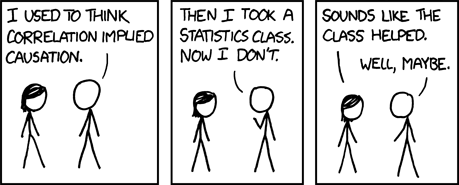
* And this xkcd is quieter than the ones that usually get ricocheted across the Internet, but damn if it didn't make me laugh.

Correlation

* And is time really the fire in which we burn? Consider the thermal time hypothesis. More at MetaFilter.

According to Connes and Rovelli, the same applies to the universe at large. There are many more constituents to keep track of: not only do we have particles of matter to deal with, we also have space itself and therefore gravity. When we average over this vast microscopic arrangement, the macroscopic feature that emerges is not temperature, but time. "It is not reality that has a time flow, it is our very approximate knowledge of reality that has a time flow," says Rovelli. "Time is the effect of our ignorance."
I think Rovelli just wrote Alan Moore's next three graphic novels. Grant Morrison's, too.

Wednesday, December 10, 2008

Get ready for this year's leap second.

Tuesday, December 02, 2008

Random linkfest.

* Coup in Canada! Somehow the Liberals and New Democrats finally managed to pull their heads out of their asses and kick Harper out.

* You had me at Planet of the Apes. Just don't screw it up this time. More at CHUD.

* Matt Yglesias: If you’re not following Shaq’s Twitter feed you’re not really living in the contemporary world. He’s moved us all the way to Web 4.0.

* Flight of the Conchords Season 2 is coming.

* Jon Stewart speaks truth to power MSNBC.

* Life with perfect memory.

Monday, November 17, 2008

Don Draper is 84 years old. Relatedly: Is Mad Men good nostalgia or bad nostalgia?

Sunday, November 16, 2008

Apropos of my birthday, this post from Kottke on "timeline twins."

When I was a kid, "oldies" music and movies seemed ancient. Even though I'm now in my 30s, the entertainment that I watched and listened to in my youth still feels pretty recent to me. Raiders of the Lost Ark wasn't all that long ago, right? But comparing my distorted recall of childhood favorites to the oldies of the time jogs my memory in unpleasant ways. For example:

Listening to Michael Jackson's Thriller today is equivalent to listening to Elvis Presley's first album (1956) at the time of Thriller's release in 1982. Elvis singles in 1956 included Blue Suede Shoes, Hound Dog, and Love Me Tender.
Lots more examples in the post and in Kottke's comments. Surely every generation experiences this to some extent or another—but it seems to me there really is good reason to think there's more cultural distance between Hound Dog and Thriller than between Thriller and now. (Though I must admit that to my comfortable perch on this side of thirty Thriller doesn't seem especially fresh.)

First, the political, cultural, and technological revolutions of the '60s and '70s really were far more radical than anything that has been experienced since. Not every set of 36 years is identically tumultuous.

But the way we consume media has also changed in a way that has tended to ensure continuity, in two senses—first, technologies like the explosion of niche cable networks, DVDs, MP3s, YouTube, etc. allow media-cultural events to have cultural vitality for far longer, and second, repeated quotation and citation as both self-referentiality and nostalgia (famously characteristic of postmodernism) has in general helped keep these things alive.

Against future shock, call it future drag: things no longer seem to change, time no longer seems to pass, the past is always at our fingertips.

I also like the analogy improbable makes to oil painting:
Lots of other fields have the same property of developing rapidly once the technology is there. We've had oil paints for how many centuries? The first few decades saw rapid innovation, and the grand masters are from not long after that.
So music back then really was newer, fresher, and better. That's why we're still listening: it's still the best there is.

Sunday, October 19, 2008

At the Valve, Joseph Kugelmass is thinking about time.

Eternity is a comfort. It is relaxing to think of narratives repeating themselves across time, to imagine, as Levi-Strauss hungered to do, the structural webs that could make sense of contraries and bring them to peace. But the old homologies, the sparkle of humanistic erudition that unites Derrida with Plato or Shakespeare with Agamben is now a pose, a front for a deeper anxiety that something terrible is coming and that it will take us unawares. Think of all those scenes in the movies where somebody tries to unscramble a coded message, or copy a computer file, or do other kinds of information work while their friend struggles to barricade the door against monsters: that is the real terror underneath these continual re-discoveries of the beautiful fact that time is simultaneous, eternal, unmoving, its truths waiting to be collected, like laundry hanging on the line.

Friday, July 11, 2008

A late convert to the greatness of the early Charles Schulz, I must admit to being oddly moved by this years-old requiem for Peanuts written on the occasion of Charles Schulz's death. Via Progressive Ruin, which had a nice future-of-Peanuts thing going earlier in the week.

Friday, May 23, 2008

They say time is the fire in which we burn: Scientific American looks at time, entropy, and the immortal question: Does time run backwards in other universes?

Monday, April 14, 2008

A new study shows that once our brains make a decision it takes ten seconds for our conscious minds to become aware of it.

Wednesday, February 06, 2008

But let's get back to the important stuff: the subject of my 1000th post, the question of how many days Bill Murray spent trapped in a temporal loop in early-1990s soft-s.f. classic Groundhog Day. The screenwriter, Danny Rubin, has weighed in at his blog, and says the following:

My original intent was that the length of time needn’t be specific, just terribly long, and in my mind, more than one lifetime. That was in fact the whole point of the original experiment, the one I hoped to play out via comedic dramatization: if a person could live long enough would that person fundamentally change? The clarity of the experiment would come from the huge exaggeration of time. He would have to live longer than a person is supposed to live, more than one lifetime. The repetition part was how I got to the immortality.

I know that I have been quoted as having originally intended for Phil to have lived “ten thousand years”, a time-frame with Buddhist overtones. I find that so incredibly cool that I put no effort into disputing it. But it’s not true. For me, any lifetime for Phil longer than one would have sufficed, and even so, that statistic never had to leave my head. As long as the audience understood it to be a very, very long time, it never had to become specific.

In my original draft I had created a device to help audiences feel the massiveness of time on Phil’s shoulders. It was my version of five-bundled hatch marks on a prison wall, which of course would not work for Phil as each morning the marks would be gone. My solution was a wall-length bookcase in the Bed and Breakfast. Every day Phil would read a single page from a single book. Every now and then we would see him finish the first chapter, then the whole book, then the last book in the row. On one sad day we see him finish the last page of the last book in the bookcase – only to then have to walk back to the very first book and begin again.

The studio had a note: He’s there too long. He can’t repeat the day so many times. Peoples’ heads would explode. The studio solution: Two weeks.

Monday, January 07, 2008

I've put up the first of our promised "American futurity" posts over at culturemonkey, this one beginning with some thoughts on space and time in the imagination of Utopia and ultimately coming to rest on the possible structural origins for the claim of "American exceptionalism" that so thoroughly dominates American politics today. I must warn you that the post starts out a little bit "in the weeds," as they say, but I hope it gets better as it goes on—and there's a few easter egg links inside for those with the wisdom patience to read through the whole thing.

Wednesday, December 26, 2007

A few more links to soothe (or cause) the post-Christmas blues:

* More depressing news from the credit sector: the current credit and liquidity crisis could make 1929 look like 'walk in the park.'

* Via Srinivas, an apropos-of-nothing Jared Diamond profile in the New York Times tries to get at the heart of our complicated understanding of collapse and reemergence.

* Also in the Times, this review of Best American Comics 2007 preempts any review I might have written about the ways in which the book failed to quite live up to its promise this year, due in large part to Chris Ware's strange over-reliance on autobiographical comics (though, as the review notes, there are still as always some really good bits).

* Shankar points to this Daily Kos diary that nicely satirizes the recent, incomprehensible spate of anti-Obama rhetoric in the blogosphere, originating just in the moment that he started to gain traction against Hillary, proving once and for all that the Left wouldn't allow itself to be happy even if they did have a good candidate for once.

* And, in the Telegraph, we learn that the universe may be running down, presaging yet another possible end for everything: total stasis.

Sunday, December 09, 2007

At age 28:

The Danish physicist Niels Bohr published his revolutionary theory of the atom.

French novelist George Sand published her first novel, Indiana.

Dr. Ludwig Zamenhof of Warsaw invented the artificial language Esperanto.

British physician Thomas Wakley began publishing The Lancet.

Jamaican reggae composer/performer Bob Marley recorded "I Shot the Sheriff"...
Things other people accomplished when they were your age.

Monday, December 03, 2007

Random links before I get back to work:

* How America Lost the War on Drugs. In Rolling Stone.

* An astoundingly complete timeline of the Planets of the Apes universe. Via Cynical-C.

* A man who walked into a police station five years after he was presumed dead in a canoeing accident has told officers he has no memory of what happened to him. Either this guy is a zombie, Jesus, a clone, or he was kidnapped by aliens. There are no other possibilities. Via MeFi.

* Rudy Giuliani: The Security Candidate.

Wednesday, November 28, 2007

Jaimee and I don't host parties often, but we once had an after-reading party in Greensboro back in 2003 or 2004. The food was good, the conversation was good, a lot of good people came, and I daresay a good time was had by all. Maybe the best time was had by a friend of ours named Detlef, who spent much of the night scribbling cryptic notes on Post-its and stashing them around the house. I found a few the next morning, one in the freezer, another in the shower.

"I hid them everywhere. You'll be finding these things for the rest of your life," he told me.

We found a few more over the coming months, about ten or so, and after that things were pretty quiet. Every so often I'd be surprised: one inside the toilet tank, another at the bottom of a drawer or inside rarely used tupperware. When we moved, I found a few final stragglers in the furniture, including one inside the couch and another underneath a bookshelf.

None in the year and a half since, until today, when I randomly had occasion to pull my copy of A Brief History of Time off the bookshelf for the first time in years. The book flipped open to a random page.


That was flashback enough. Then I saw the inscription on the inside front cover. I'd totally forgotten where I'd gotten the book in the first place: ten years ago, on my 18th birthday, from a girl with whom (let's be charitable) Things Did Not Work Out. In her note she'd written a number of bold predictions about the importance and permanence of our friendship, predictions which not only pretty spectacularly failed to come to pass but which (given my memory of November 1998) may actually have been proven wrong within the next ten minutes.

So it's been a funny kind of morning.

Thursday, November 15, 2007

Another 1960s experimental film from Jim Henson, "Time Piece." Via Ze.

If you missed it back in May, don't forget to check out "The Cube" from 1969.