My blog has moved!

You should be automatically redirected to the new home page in 60 seconds. If not, please visit
http://gerrycanavan.com
and be sure to update your bookmarks. Sorry about the inconvenience.

Showing posts with label entropy. Show all posts

Tuesday, October 27, 2009

Tuesday links.

* I do feel a bit like my characters from one movie could walk into another one of my movies and it would make sense, whereas people from other peoples’ movies would probably feel a bit uncomfortable there. Wes Anderson interviewed in Interview. There's also a profile in this week's New Yorker, apparently, though it's not online. (via Rushmore Academy)

* Case Studies of Comic Book Medicine. More here.

* Graduating during a recession can have a lifelong impact on your earnings.

* Also from Yglesias: Cable monopolies are killing your internet access.

* Infinite Thought has Engels on entropy.

Millions of years may elapse, hundreds of thousands of generations be born and die, but inexorably the time will come when the declining warmth of the sun will no longer suffice to melt the ice thrusting itself forward from the poles; when the human race, crowding more and more about the equator, will finally no longer find even there enough heat for life; when gradually even the last trace of organic life will vanish; and the earth, an extinct frozen globe like the moon, will circle in deepest darkness and in an ever narrower orbit about the equally extinct sun, and at last fall into it. Other planets will have preceded it, others will follow it; instead of the bright, warm solar system with its harmonious arrangement of members, only a cold, dead sphere will still pursue its lonely path through universal space. And what will happen to our solar system will happen sooner or later to all the other systems of our island universe; it will happen to all the other innumerable island universes, even to those the light of which will never reach the earth while there is a living human eye to receive it.
The quote is from 1833's The Dialectics of Nature, and goes on to suggest a kind of eternal return:
It is an eternal cycle in which matter moves, a cycle that certainly only completes its orbit in periods of time for which our terrestrial year is no adequate measure, a cycle in which the time of highest development, the time of organic life and still more that of the life of beings conscious of nature and of themselves, is just as narrowly restricted as the space in which life and self-consciousness come into operation; a cycle in which every finite mode of existence of matter, whether it be sun or nebular vapour, single animal or genus of animals, chemical combination or dissociation, is equally transient, and wherein nothing is eternal but eternally changing, eternally moving matter and the laws according to which it moves and changes. But however often, and however relentlessly, this cycle is completed in time and space, however many millions of suns and earths may arise and pass away, however long it may last before the conditions for organic life develop, however innumerable the organic beings that have to arise and to pass away before animals with a brain capable of thought are developed from their midst, and for a short span of time find conditions suitable for life, only to be exterminated later without mercy, we have the certainty that matter remains eternally the same in all its transformations, that none of its attributes can ever be lost, and therefore, also, that with the same iron necessity that it will exterminate on the earth its highest creation, the thinking mind, it must somewhere else and at another time again produce it.
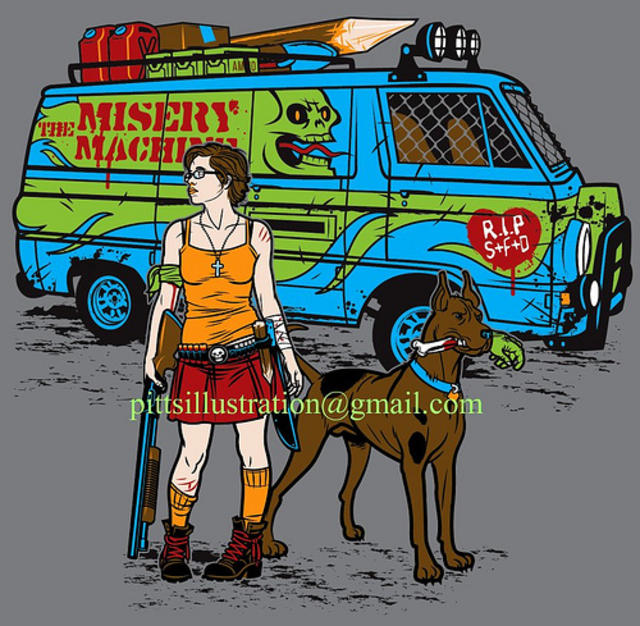
* And Boing Boing has your Scooby Doo/zombie apocalypse mashup of the day.
Sunday, October 11, 2009

We're off to sample Detroit today. While we're waiting for showers to finish here are a few links I never got around to yesterday.

* Dollhouse 2.3, which I haven't seen yet, ticked upwards in the ratings, managing this week to beat reruns on ABC. Related: Ten TV Spin-offs That Were Better Than the Original Shows includes Angel—I agree in the main—Daria, Xena, DS9, and, The Simpsons. Also related: Flashforward is falling fast, endorsing Bill's thesis that the show is blowing it. Related and ridiculous: "Is science fiction becoming feminized?" Mary Shelley will be heartbroken.

* Josh Marshall on the Nobel: [T]he unmistakable message of the award is one of the consequences of a period in which the most powerful country in the world, the 'hyper-power' as the French have it, became the focus of destabilization and in real if limited ways lawlessness. A harsh judgment, yes. But a dark period. And Obama has begun, if fitfully and very imperfectly to many of his supporters, to steer the ship of state in a different direction. If that seems like a meager accomplishment to many of the usual Washington types it's a profound reflection of their own enablement of the Bush era and how compromised they are by it, how much they perpetuated the belief that it was 'normal history' rather than dark aberration. More from Steve Benen.

* Something, something, something, Detroit.

* The big Moon bombing appears not to have gone so well. Did the aliens step in?

* Iceland, an epicenter of the last financial crisis, looks to recover with data centers that offer free air-side cooling.

* The L.A. Times discusses the Fantastic Mr. Fox directing controversy. (via)

* Some bad news: Universe To End Sooner Than Thought.

* And more bad news: time has not ceased its unrelenting march.

Friday, October 02, 2009

Friday night roundup.

* Why would they send Obama to Copenhagen if there was any chance it might not work? Really poor showing from the White House on this one.

* Best thing on the Internet today: Liu Bolin's extreme camouflage photography. Warning: May blow your mind.

* The Sesame Street Mad Men parody. Warning: probably will not.

* Scenes from the A-Team movie.

* Bill Simmon is rapidly losing patience with Flashforward. I agree—but as I wrote in the comments over at his place, we have to remember that Lost's first great episode was episode four, and that the show was by and large pretty terrible until at least the second half of season three. So there's still hope. It's doing well enough in the ratings that the producers should have time and leeway to develop the story however they want.

* Related: What caused the flashforwards?

* Jaimee has a review in the Indy this week.

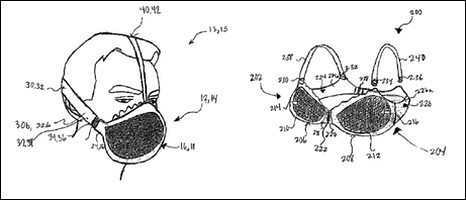
* Presenting the gas mask bra.


* And some bad news: Supermassive Black Holes Bringing Universe Closer to Death.

Sunday, March 01, 2009

Found on the Internet: grown-up Calvins and Hobbeses. I've seen a couple links to this one and it made me want to poke around.


That's Susie Derkins, of course.

This one, I think, is my favorite:


A few others. I found these via a Google image search, so I confess I don't know where they came from.


(original context)

This last one is less a grown-up Calvin than an updated one, but there's a similar poignance to it all the same. And I know from the file name it comes from Jim Rugg, who I published way back in Backwards City #1:


It's quite reminiscent of this better-known "end of Calvin," which I've linked before.


If you're not done yet, there's always Fight Club.

(a couple via NeilAlien and this Marvel Peanuts MeFi thread, but mostly just via Google)

Monday, February 16, 2009

Calvino in the New Yorker.

What happens on the earth when a moon dies is not easy to describe; I’ll try to do it by referring to the last instance I can remember. Following a lengthy period of evolution, the earth had more or less reached the point where we are now; in other words, it had entered the phase when cars wear out more quickly than the soles of shoes. Beings that were barely human manufactured and bought and sold things, and cities covered the continents with luminous color. These cities grew in approximately the same places as our cities do now, however different the shape of the continents was. There was even a New York that in some way resembled the New York familiar to all of you, but was much newer, or, rather, more awash with new products, new toothbrushes, a New York with its own Manhattan that stretched out dense with skyscrapers gleaming like the nylon bristles of a brand-new toothbrush.

In this world where every object was thrown away at the slightest sign of breakage or aging, at the first dent or stain, and replaced with a new and perfect substitute, there was just one false note, one shadow: the moon. It wandered through the sky naked, corroded, and gray, more and more alien to the world down here, a hangover from a way of being that was now outdated.

Ancient expressions like “full moon,” “half-moon,” “last-quarter-moon” continued to be used but were really only figures of speech: how could we call “full” a shape that was all cracks and holes and that always seemed on the point of crashing down on our heads in a shower of rubble? Not to mention when it was a waning moon! It was reduced to a kind of nibbled cheese rind, and it always disappeared before we expected it to. At each new moon, we wondered whether it would ever appear again (were we hoping that it would simply disappear?), and when it did reappear, looking more and more like a comb that had lost its teeth, we averted our eyes with a shudder.

It was a depressing sight. We went out in the crowds, our arms laden with parcels, coming and going from the big department stores that were open day and night, and while we were scanning the neon signs that climbed higher and higher up the skyscrapers and notified us constantly of new products that had been launched, we’d suddenly see it advancing, pale amid those dazzling lights, slow and sick, and we could not get it out of our heads that every new thing, each product that we had just bought, could similarly wear out, deteriorate, fade away, and we would lose our enthusiasm for running around buying things and working like crazy—a loss that was not without consequences for industry and commerce.

That was how we began to consider the problem of what to do with it, this counterproductive satellite. It did not serve any purpose; it was a useless wreck. As it lost weight, it started to incline its orbit toward the earth: it was dangerous, above and beyond anything else. And the nearer it got the more it slowed its course; we could no longer calculate its phases. Even the calendar, the rhythm of the months, had become a mere convention; the moon went forward in fits and starts, as though it were about to collapse...

Friday, May 23, 2008

They say time is the fire in which we burn: Scientific American looks at time, entropy, and the immortal question: Does time run backwards in other universes?

Sunday, May 04, 2008

The Long Now Foundation: thinking responsibly about the next 10,000 years.