We're off to sample Detroit today. While we're waiting for showers to finish here are a few links I never got around to yesterday.
* Dollhouse 2.3, which I haven't seen yet, ticked upwards in the ratings, managing this week to beat reruns on ABC. Related: Ten TV Spin-offs That Were Better Than the Original Shows includes Angel—I agree in the main—Daria, Xena, DS9, and, The Simpsons. Also related: Flashforward is falling fast, endorsing Bill's thesis that the show is blowing it. Related and ridiculous: "Is science fiction becoming feminized?" Mary Shelley will be heartbroken.
* Josh Marshall on the Nobel: [T]he unmistakable message of the award is one of the consequences of a period in which the most powerful country in the world, the 'hyper-power' as the French have it, became the focus of destabilization and in real if limited ways lawlessness. A harsh judgment, yes. But a dark period. And Obama has begun, if fitfully and very imperfectly to many of his supporters, to steer the ship of state in a different direction. If that seems like a meager accomplishment to many of the usual Washington types it's a profound reflection of their own enablement of the Bush era and how compromised they are by it, how much they perpetuated the belief that it was 'normal history' rather than dark aberration. More from Steve Benen.
* Something, something, something, Detroit.
* The big Moon bombing appears not to have gone so well. Did the aliens step in?
* Iceland, an epicenter of the last financial crisis, looks to recover with data centers that offer free air-side cooling.
* The L.A. Times discusses the Fantastic Mr. Fox directing controversy. (via)
* Some bad news: Universe To End Sooner Than Thought.
* And more bad news: time has not ceased its unrelenting march.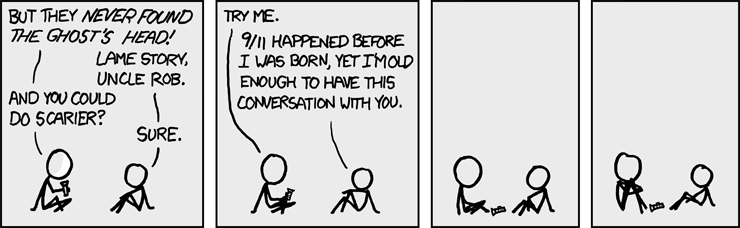
Sunday, October 11, 2009

Friday, October 09, 2009
In a move that seems a bit premature, even to me, Barack Obama has been awarded the 2009 Nobel Peace Prize.
Thursday, October 08, 2009
Friday, February 20, 2009
Please do allow me to deliver one very personal message. It is something that I always keep in mind while I am writing fiction. I have never gone so far as to write it on a piece of paper and paste it to the wall: rather, it is carved into the wall of my mind, and it goes something like this:Haruki Murakami accepts the Jerusalem Prize in Israel. Seconding Black Garterbelt: Give this man a Nobel already.
"Between a high, solid wall and an egg that breaks against it, I will always stand on the side of the egg."
Yes, no matter how right the wall may be and how wrong the egg, I will stand with the egg. Someone else will have to decide what is right and what is wrong; perhaps time or history will decide. If there were a novelist who, for whatever reason, wrote works standing with the wall, of what value would such works be?
I have only one thing I hope to convey to you today. We are all human beings, individuals transcending nationality and race and religion, fragile eggs faced with a solid wall called the System. To all appearances, we have no hope of winning. The wall is too high, too strong -- and too cold. If we have any hope of victory at all, it will have to come from our believing in the utter uniqueness and irreplaceability of our own and others' souls and from the warmth we gain by joining souls together.
Take a moment to think about this. Each of us possesses a tangible, living soul. The System has no such thing. We must not allow the System to exploit us. We must not allow the System to take on a life of its own. The System did not make us: We made the System. That is all I have to say to you.
Sunday, December 07, 2008
Nobel economics prize winner Paul Krugman said Sunday that the beleaguered U.S. auto industry will likely disappear. Now, I'm no Nobel Prize winner, but this seems very unlikely to me, about as unlikely as it does to Paul Rosenberg.
Monday, October 13, 2008
Paul Krugman is the world's first Nobel Laureate blogger.
But it's not a *real* Nobel...
Thursday, October 09, 2008
Here's more on Nobel winner Jean-Marie Gustave Le Clézio, whose work I confess I'm not at all familiar with.
* Guardian write-up
* N.Y. Times write-up
* BBC write-up
*'Will Le Clézio's Nobel prize cut America down to size? Have the judges of the Nobel prize for literature struck a blow against Coca-colonisation?'
* 'Nobel judges like their books experimental - to the cost of the classic American novelists'
* 'Nobel award restores French literary pride'
* NPR
France's Jean-Marie Gustave Le Clézio has won the Nobel Prize for Literature.
Wednesday, October 01, 2008
Nobel Prize committee to U.S. authors: "Drop dead."
Permanent secretary of the Swedish Academy Horace Engdahl told the Associated Press that US writers were "too sensitive to trends in their own mass culture", which he said dragged down the quality of their work. "The US is too isolated, too insular. They don't translate enough and don't really participate in the big dialogue of literature," Engdahl said. "That ignorance is restraining."
Friday, September 26, 2008

Waiting for the liveblogging to begin, a few links.
* Sixty-one Nobel laureates have jointly endorsed Obama. * So have donuts and bacon.
* Slate predicts McCain's next ten Hail Marys, while the L.A. Times takes on the potential downside of his "Great Man" strategy:
But as many Great Men come to learn, there is a colossal downside built into running a campaign on outsized personal virtue. The line between stoic, honorable service and showy moral vanity is oftentimes difficult to maintain.*Spencer Ackerman has the world's best wrap-up of the Great Campaign Suspension Stunt of '08.
And when a candidate confuses his own political ambitions with the fortunes of his country, that's when Great Men turn into self- parodies.
Let's recap. McCain kinda-but-doesn't-really suspend his campaign to make himself the indispensable man in the bailout agreement. He gets to Washington as an object of ridicule and the deal falls apart -- something that at least some people, admittedly Democrats, attribute to McCain's transparent stunt. Then, despite Harry Reid saying he's going to keep the Senate in session until there's a deal, McCain abruptly announces he's... going back to campaigning (not that he stopped!) and will attend the debates.
 * Entertainment Weekly interviews Stewart and Colbert.
* Far-right-wing columnist Kathleen Parker argues that Palin needs to step down in, of all places, the National Review (!).
McCain can’t repudiate his choice for running mate. He not only risks the wrath of the GOP’s unforgiving base, but he invites others to second-guess his executive decision-making ability. Barack Obama faces the same problem with Biden.This backs up new claims that the McCain campaign is deeply panicked over her utter lack of ability.
Only Palin can save McCain, her party, and the country she loves. She can bow out for personal reasons, perhaps because she wants to spend more time with her newborn. No one would criticize a mother who puts her family first.
Do it for your country.
* And Kevin Drum and Brad DeLong are doing their best to walk the blogosphere back from the brink on the bailout.
To get get a $500B macroeconomic gain in production and employment, Paulson wants to take on a position with an expected value of -$100B. But the true value of that position could be anywhere between +$200B and -$400B. Looks like a good bet to me.
Friday, May 16, 2008
Polygraph 22—Call for Papers
http://www.duke.edu/web/polygraph/cfp22.html
Special Issue: Ecology and Ideology
The contemporary moment abounds with speculation concerning our ecological future. Specialists in a variety of fields forecast immanent catastrophe, stemming from a combination of climate change, fossil-fuel depletion, and consumer waste. The recent bestowal of the Nobel Peace Prize on a group of scientists studying climate change indicates the degree to which "peace" has come to signify ecological balance; even the declaration by the Vatican of a new set of "7 Deadly Sins for the modern age" includes pollution in an attempt to grapple with the potential of individuals to inflict ecological damage on a global scale.
In the name of an impending crisis felt to be collectively shared, new political, cultural, and intellectual alignments are being forged, just as seismic shifts in the flow of global capital once again threaten to "redistribute" the world's resources and people. Ecological crisis has become a 24/7 media event, canvassing the planet in the imagery and rhetoric of disaster. From the halls of research and policy to activist documentary and apocalyptic fantasy, at the news desk, podium, pulpit, classroom, and computer monitor alike, all channels are united by a single underlying conviction: the present ecological catastrophe has humanity as its cause.
Precisely because the answer seems so obvious, we want to know: why now? Where are the points of antagonism in the midst of such apparent consensus, and what is at stake in their difference?
The Polygraph Editorial Collective invites papers concerning any aspect of ecology's relationship to ideology, both interrogating ecology as a location for critique of global capitalism and analyzing the ways in which ecology functions as an ideology in its own right.
Potential areas of interest include:
Political Ecology
Globalization and ecology
Marxism and ecology
"Environmental accounting" as a challenge to the free market
Ecology and capital / consumerism
Ecology as growth market
Eco-Disaster
Peak oil and climate change
Biofuels and the food crisis
Overpopulation and Neo-Malthusianism
Ecology as a rhetoric of control
Figurations of eco-disaster in popular culture
Religion and Ecology
Green apocalypticism and green evangelism
Ecology and world religion
Ecology and gender
Recent articulations of eco-feminism
Eco- & transnational feminisms
Women's work and the global chain of production
Agricultural work and reproduction
Ecologies against ecologies
"Light" vs. "dark green" environmentalism (i.e. deep ecology)
Primitivism and technofuturism
The status of international Green movements
Polygraph welcomes work from a variety of different disciplines, including critical geography, cultural anthropology, political economy, political theology, science studies, and systems theory. We also encourage the submission of a variety of formats and genres: i.e. field reports, surveys, interviews, photography, essays, etc.
SUBMISSION DEADLINE
December 31, 2008
ISSUE EDITORS
Gerry Canavan
Lisa Klarr
Ryan Vu
CONTACT
polygraph22cfp@gmail.com
Friday, December 07, 2007
Doris Lessing's Nobel Prize acceptance speech, at the Guardian.
The storyteller is deep inside everyone of us. The story-maker is always with us. Let us suppose our world is attacked by war, by the horrors that we all of us easily imagine. Let us suppose floods wash through our cities, the seas rise . . . but the storyteller will be there, for it is our imaginations which shape us, keep us, create us - for good and for ill. It is our stories that will recreate us, when we are torn, hurt, even destroyed. It is the storyteller, the dream-maker, the myth-maker, that is our phoenix, that represents us at our best, and at our most creative.
That poor girl trudging through the dust, dreaming of an education for her children, do we think that we are better than she is - we, stuffed full of food, our cupboards full of clothes, stifling in our superfluities?
I think it is that girl and the women who were talking about books and an education when they had not eaten for three days, that may yet define us.
Monday, October 22, 2007
 This week's image and tag is intended as a little bit of a provocation, as I've just reread One Hundred Years of Solitude for the first time this decade and I'm hard-pressed to disagree with William Kennedy's infamous pronouncement that the book is "the first piece of literature since the Book of Genesis that should be required reading for the entire human race" (except, of course, insofar as I don't believe that's even true of Genesis). I'm honestly hard-pressed to think of books with matching claims on the vaunted title of "greatest work of literature ever" (which is funny, because it's been so long since I'd last read it that I accidentally and shamefully left it off my list of the definitive books of the 20th century back in June).
So, who are the serious challengers? Ulysses? Don Quixote? Karamazov? Homer? The Bhagavad Gita? Arabian Nights? The Book of Psalms? I think García Márquez takes all comers.
Here's the Nobel Prize lecture from which the tag is taken, an optimistic reworking of the novel's wonderfully apocalyptic final sentence. If there's one thing I'm learning from studying all these Nobel Prize winners this semester, it's that you've got to turn your optimism all the way up to 11 in Stockholm, no matter how depressing your novels actually are.
Tuesday, October 16, 2007
We regret the omission: Why Gandhi never received a Nobel Prize. Via Mefi.
Friday, October 12, 2007
Josh Marshall on Gore's Nobel:
There are several layers of irony and poetic justice wrapped into this honor. The first is that the greatest step for world peace would simply have been for Gore not to have had the presidency stolen from him in November 2000. By every just measure, Gore won the presidency in 2000 only to have George W. Bush steal it from him with the critical assistance of the US Supreme Court. It's worth taking a few moments today to consider where the country and world would be without that original sin of this corrupt presidency.I have one idea where we might go.
And yet this is a fitting bookend, with Gore receiving this accolade while the sitting president grows daily an object of greater disapproval, disapprobation and collective shame. And let's not discount another benefit: watching the rump of the American right detail the liberal bias of the Nobel Committee and at this point I guess the entire world. Fox News vs. the world.
And not to forget what this award is about even more than Gore. If half of what we think we know about global warming is true, people will look back fifty years from now on the claims that "War on Terror" was the defining challenge of this century and see it as a very sick, sad joke -- which rather sums up the Bush presidency.
But more than thinking only of what might have been, where can we go from here?
Told ya. As widely predicted, Al Gore has won the Nobel Peace Prize. This is very good news, but even better news will be his decision to enter the presidential race...now.
...Now.
Now.
Damnit.
Thursday, October 11, 2007
Neil's yearly taunt whenever the Nobel Prize in Literature is about to handed out is "This is your year!" We can now look forward to 2008, as Doris Lessing has taken this year's Nobel Prize.
Monday, October 08, 2007
The London Times says Al Gore's going to win the Nobel Peace Prize, which I've been saying since February at least. Nearly every winner since 2002 has been first and foremost an anti-Bush, and there's no better anti-Bush than Gore; even if Al didn't deserve it, as he most assuredly does, the committee wouldn't be able to help itself.
And I don't care what Kevin Drum says, I hope it does prompt him to run. Someone needs to save the left from Hillary Clinton and it doesn't look like it will be Obama. Run, Al, run.
Wednesday, September 05, 2007
 Wednesday afternoon apocalypse: William Faulkner's Nobel Prize speech from 1950.
Our tragedy today is a general and universal physical fear so long sustained by now that we can even bear it. There are no longer problems of the spirit. There is only the question: When will I be blown up? Because of this, the young man or woman writing today has forgotten the problems of the human heart in conflict with itself which alone can make good writing because only that is worth writing about, worth the agony and the sweat.Gabriel García Márquez riffs briefly on Faulkner's address in his own Nobel lecture, in 1982:
He must learn them again. He must teach himself that the basest of all things is to be afraid; and, teaching himself that, forget it forever, leaving no room in his workshop for anything but the old verities and truths of the heart, the old universal truths lacking which any story is ephemeral and doomed - love and honor and pity and pride and compassion and sacrifice. Until he does so, he labors under a curse. He writes not of love but of lust, of defeats in which nobody loses anything of value, of victories without hope and, worst of all, without pity or compassion. His griefs grieve on no universal bones, leaving no scars. He writes not of the heart but of the glands.
Until he relearns these things, he will write as though he stood among and watched the end of man. I decline to accept the end of man. It is easy enough to say that man is immortal simply because he will endure: that when the last dingdong of doom has clanged and faded from the last worthless rock hanging tideless in the last red and dying evening, that even then there will still be one more sound: that of his puny inexhaustible voice, still talking. I refuse to accept this. I believe that man will not merely endure: he will prevail. He is immortal, not because he alone among creatures has an inexhaustible voice, but because he has a soul, a spirit capable of compassion and sacrifice and endurance. The poet's, the writer's, duty is to write about these things. It is his privilege to help man endure by lifting his heart, by reminding him of the courage and honor and hope and pride and compassion and pity and sacrifice which have been the glory of his past. The poet's voice need not merely be the record of man, it can be one of the props, the pillars to help him endure and prevail.
On a day like today, my master William Faulkner said, "I decline to accept the end of man". I would fall unworthy of standing in this place that was his, if I were not fully aware that the colossal tragedy he refused to recognize thirty-two years ago is now, for the first time since the beginning of humanity, nothing more than a simple scientific possibility. Faced with this awesome reality that must have seemed a mere utopia through all of human time, we, the inventors of tales, who will believe anything, feel entitled to believe that it is not yet too late to engage in the creation of the opposite utopia. A new and sweeping utopia of life, where no one will be able to decide for others how they die, where love will prove true and happiness be possible, and where the races condemned to one hundred years of solitude will have, at last and forever, a second opportunity on earth.(via my course on the South and the Global South)


 Posts
Posts


