 Infinite linkdump Thursday, just politics.
* The Mark Sanford story grows stranger by the day, with 19 South Carolina politicians now on the record calling for his resignation. (TPM reports that Senators DeMint and Graham have gone to Sanford to prevail on him to resign.) Today he backed off a pledge to release his travel records, which suggests more trouble may be brewing for him.
* Who could have imagined that Exxon-Mobil would lie about its continued support for climate-change "skepticism" advocacy groups?
* Highlights from the first day of the Al Franken Century.
* Democrats can now "hijack elections at their whim": just another responsible, measured, and most of all empirically provable claim from RNC chairman Michael Steele, truly our country's finest elder statesman.
* But it's not all craziness: Michele Bachmann is facing criticism from the GOP for her weird lies about the Census.
* What caused the financial crisis? Matt Taibbi in Rolling Stone (via MeFi) points to bubble economies nutured and created by giant investment firms, pointing the finger especially at Goldman Sachs. An Oklahoma lawmaker says it was "abortion, pornography, same sex marriage, sex trafficking, divorce, illegitimate births, child abuse, and many other forms of debauchery." I report, you decide.
* Malthusianism and world history: a chart from Conor Clarke.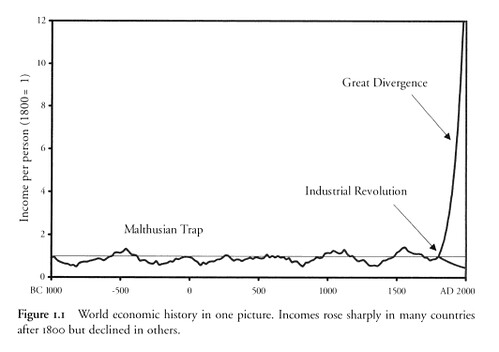
It's clear these growth trends can continue forever.

* Ezra Klein has a new Washington Post column on the politics of food.
Thursday, July 02, 2009

Friday, May 16, 2008
Polygraph 22—Call for Papers
http://www.duke.edu/web/polygraph/cfp22.html
Special Issue: Ecology and Ideology
The contemporary moment abounds with speculation concerning our ecological future. Specialists in a variety of fields forecast immanent catastrophe, stemming from a combination of climate change, fossil-fuel depletion, and consumer waste. The recent bestowal of the Nobel Peace Prize on a group of scientists studying climate change indicates the degree to which "peace" has come to signify ecological balance; even the declaration by the Vatican of a new set of "7 Deadly Sins for the modern age" includes pollution in an attempt to grapple with the potential of individuals to inflict ecological damage on a global scale.
In the name of an impending crisis felt to be collectively shared, new political, cultural, and intellectual alignments are being forged, just as seismic shifts in the flow of global capital once again threaten to "redistribute" the world's resources and people. Ecological crisis has become a 24/7 media event, canvassing the planet in the imagery and rhetoric of disaster. From the halls of research and policy to activist documentary and apocalyptic fantasy, at the news desk, podium, pulpit, classroom, and computer monitor alike, all channels are united by a single underlying conviction: the present ecological catastrophe has humanity as its cause.
Precisely because the answer seems so obvious, we want to know: why now? Where are the points of antagonism in the midst of such apparent consensus, and what is at stake in their difference?
The Polygraph Editorial Collective invites papers concerning any aspect of ecology's relationship to ideology, both interrogating ecology as a location for critique of global capitalism and analyzing the ways in which ecology functions as an ideology in its own right.
Potential areas of interest include:
Political Ecology
Globalization and ecology
Marxism and ecology
"Environmental accounting" as a challenge to the free market
Ecology and capital / consumerism
Ecology as growth market
Eco-Disaster
Peak oil and climate change
Biofuels and the food crisis
Overpopulation and Neo-Malthusianism
Ecology as a rhetoric of control
Figurations of eco-disaster in popular culture
Religion and Ecology
Green apocalypticism and green evangelism
Ecology and world religion
Ecology and gender
Recent articulations of eco-feminism
Eco- & transnational feminisms
Women's work and the global chain of production
Agricultural work and reproduction
Ecologies against ecologies
"Light" vs. "dark green" environmentalism (i.e. deep ecology)
Primitivism and technofuturism
The status of international Green movements
Polygraph welcomes work from a variety of different disciplines, including critical geography, cultural anthropology, political economy, political theology, science studies, and systems theory. We also encourage the submission of a variety of formats and genres: i.e. field reports, surveys, interviews, photography, essays, etc.
SUBMISSION DEADLINE
December 31, 2008
ISSUE EDITORS
Gerry Canavan
Lisa Klarr
Ryan Vu
CONTACT
polygraph22cfp@gmail.com


 Posts
Posts


