Even more Wednesday links.
* Not just talk: Reid and Schumer will introduce legislation to yank the health insurance industry's antitrust exemption.
* Conflicts of interest we can believe in: Hank Paulson. The original version of this post, which was up for about two minutes, confused Paulson with Timothy Geithner, who I also don't like, but who I guess is a step up.
* Among other things, this YouTube video of a Normandy Beach veteran speaking about marriage equality speaks to the (often underutilized) power of American exceptionalism in the service of progressive political causes. It's quite moving.
* 'Papers reveal Gabriel Garcia Marquez was under Mexican surveillance for years.'
* Duke Plans To Become ‘Climate Neutral’ By 2024.
* And Maureen Ryan at the Chicago Tribune says the next two weeks of Dollhouse will not disappoint. I've been pretty disappointed all season, so I hope she's right.
Wednesday, October 21, 2009

Saturday, July 25, 2009
Over the past generation — ever since the banking deregulation of the Reagan years — the U.S. economy has been “financialized.” The business of moving money around, of slicing, dicing and repackaging financial claims, has soared in importance compared with the actual production of useful stuff. The sector officially labeled “securities, commodity contracts and investments” has grown especially fast, from only 0.3 percent of G.D.P. in the late 1970s to 1.7 percent of G.D.P. in 2007.Read Paul Krugman.
Such growth would be fine if financialization really delivered on its promises — if financial firms made money by directing capital to its most productive uses, by developing innovative ways to spread and reduce risk. But can anyone, at this point, make those claims with a straight face? Financial firms, we now know, directed vast quantities of capital into the construction of unsellable houses and empty shopping malls. They increased risk rather than reducing it, and concentrated risk rather than spreading it. In effect, the industry was selling dangerous patent medicine to gullible consumers.
Thursday, July 02, 2009
 Infinite linkdump Thursday, just politics.
* The Mark Sanford story grows stranger by the day, with 19 South Carolina politicians now on the record calling for his resignation. (TPM reports that Senators DeMint and Graham have gone to Sanford to prevail on him to resign.) Today he backed off a pledge to release his travel records, which suggests more trouble may be brewing for him.
* Who could have imagined that Exxon-Mobil would lie about its continued support for climate-change "skepticism" advocacy groups?
* Highlights from the first day of the Al Franken Century.
* Democrats can now "hijack elections at their whim": just another responsible, measured, and most of all empirically provable claim from RNC chairman Michael Steele, truly our country's finest elder statesman.
* But it's not all craziness: Michele Bachmann is facing criticism from the GOP for her weird lies about the Census.
* What caused the financial crisis? Matt Taibbi in Rolling Stone (via MeFi) points to bubble economies nutured and created by giant investment firms, pointing the finger especially at Goldman Sachs. An Oklahoma lawmaker says it was "abortion, pornography, same sex marriage, sex trafficking, divorce, illegitimate births, child abuse, and many other forms of debauchery." I report, you decide.
* Malthusianism and world history: a chart from Conor Clarke.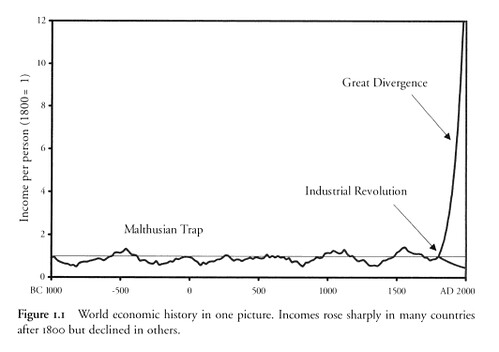
It's clear these growth trends can continue forever.

* Ezra Klein has a new Washington Post column on the politics of food.


 Posts
Posts


