My blog has moved!

You should be automatically redirected to the new home page in 60 seconds. If not, please visit
http://gerrycanavan.com
and be sure to update your bookmarks. Sorry about the inconvenience.

Showing posts with label Kim Stanley Robinson. Show all posts

Wednesday, November 11, 2009

Wednesday!

* In Galileo's time, science was clashing with religion; today, Robinson believes, we're living in a "Galilean moment" again, in which climate change means science has become politicised. This time, though, the clash is with capitalism. "There are cultural forces in our society which say, you can save the world or else you can make a profit, and they'll say sorry, we have to make a profit. So we have a strange religion now." As his global-warming-themed trilogy, which ends with 2007's Sixty Days and Counting, shows, a major theme for Robinson is ecological sustainability, and he stresses today his belief that "the climate crisis is an emergency." Another interview with Kim Stanley Robinson, this one focusing on his new time travel novel, Galileo's Dream.

* Fun graphic analysis of Choose Your Own Adventure novels, including Inside UFO 54-40, the only CYOA with an impossible-to-reach ending.


* The rhetoric of Google's suggested searches. Via Ezra Klein, who summarizes:

For instance: the most popular searches beginning with "how 2 ..." are "how 2 get pregnant" and "how 2 grow weed." Searches beginning with "how might one" tend to be about music or, weirdly, Andrew Jackson.

More titillatingly, people asking "is it wrong to" tend to have something sexually indecent in mind. The top results are "sleep with your cousin," "sleep with your stepdad after your mom has died," and "like your cousin." Searches beginning with "is it unethical to" tend to be about white-collar crime and animal rights.
One notes, at least in my geo-targeted region of the world, the top suggested result for "is it wrong to" is actually "is it wrong to sleep with your sister."

* Yesterday's Daily Show had a pair of fantastic clips: one on the Berlin Wall and another on Sean Hannity flagrantly lying (with video!) about the size Michelle Bachmann's health-care protest.

* Chart of the Day: Rock Music Quality vs. U.S. Oil Production.

Friday, November 06, 2009

There's nothing I love better than interviews with Kim Stanley Robinson.

TB: I understand that you live in a utopian community [called Village Homes, pictured above and below; images by Michael Corbett]. How does that work? Is it pre- or post-modern?

KSR: A little of both, I guess. The model is an English village really; about eighty acres, a lot of it owned in common, so there is a “commons” and no fences, except around little courtyards. There are a lot of vegetable gardens, and the landscaping is edible, meaning lots of fruits, grapes and nuts.

It’s really just a tweaking of suburban design, but a really good one. Energy mattered to the designers and we burn about 40 percent the energy of an ordinary suburban neighborhood of the same size. That’s still a lot, but it’s an improvement. Village Homes was built in 1980 or so; if every suburb since then had followed its lead, we would have much less craziness in America, because the standard suburb is bad for sanity. But that didn’t happen, so for the 1,000 people who live here it’s a kind of pocket utopia. Not the solution, but a nice place to live right now, and it could suggest aspects of a long-term solution. It’s been a real blessing to live here.

Saturday, September 19, 2009

Saturday links.

* Fox News caught stage-managing 9/12 protestors.

* Former Canadian Prime Minister Brian Mulroney, speaking to fellow members of his Conservative Party: "Fifty years from today, Americans will revere the name, 'Obama.' Because like his Canadian predecessors, he chose the tough responsibilities of national leadership over the meaningless nostrums of sterile partisanship that we see too much of in Canada and around the world."

* Also at TPM: new polling data suggests that resistance to health care reform peaked at the emergence of the town hall disruptions, suggesting this strategy may have backfired for the Republicans.

* Also backfiring on the Republicans: everything. More here and here.

* Game of the weekend: MagnetiZR.

* Cynical-C catches Kids in the Hall parodying Glenn Beck over a decade in advance.

* Collapse IV, "Concept Horror," is a free download.

* Between 2010 and 2050 each $7 spent on basic family planning can reduce emissions more than a ton; to achieve that same level of reduction using low-carbon tech would on average cost $32 per ton. Via Donkeylicious.

* Great find: Virginia Woolf's fan letter to Olaf Stapledon. Via Kim Stanley Robinson's New Scientist piece on British SF.

Wednesday, September 02, 2009

'We Are All Madoffs': David P. Barash writes in the Chronicle of Higher Education that the relationship of technological civilization to the natural world is that of a Ponzi scheme. Kim Stanley Robinson makes the same point in the interview we conducted with him for the upcoming Polygraph issue, which will eventually wind up on the website and likely also on this very blog:

KSR: ...I've been trying to use standard economic terms to describe the situation in ways capitalists might have to come to terms with, that might serve as entry-points to a larger discussion: that the implicit promise of capitalism was that a generation would work so hard in the working class that its children would be in the middle class, and that if extended this program would eventually lift everyone on Earth; but now, resource analysis makes it clear that for the three billion living on less than two dollars a day, this promise can never be fulfilled; so that capitalism is really nothing but a big Ponzi scheme, and would be illegal if run in a single state or community.

Then also, the pricing we put on things, carbon especially, does not include the environmental costs of making the thing, so that we are practicing systemic predatory dumping, and the competitors we are predating on are our own children and the generations to come. So we are predatory dumpers, out-competing non-existent people, which is easy enough; but they will suffer when they come into existence, and we are cheaters.
More on the Polygraph issue soon. (via)

Friday, August 07, 2009

Ongoing projects update.

* The Cultures of Recession graduate student conference (Nov. 20 & 21) is still accepting abstracts. We've just received word that the Duke Center for International Studies will be providing travel support for visiting grad students, which is very exciting.

* Polygraph 22: "Ecology & Ideology" is rapidly moving into the editorial phase. About half our articles are in and the other half will be in by the end of the Fall semester. Look for a great interview between Kim Stanley Robinson and the three editors in this space as the publication date draws closer...

* Fantasy soccer starts in two weeks. Don't miss out; email me or comment for the league codes.

Thursday, June 04, 2009

Presenting Kim Stanley Robinson's favorite Mars novels.

Thursday, April 09, 2009

Presenting a profile of the great Margaret Atwood.

Her sensibilities were shaped by the fact that she was raised largely in the Canadian woods by “two environmentally-aware biologists, back when that was a pretty moony thing to be.” The family often went without electricity. “It was almost like a 19th-century way of life,” she said.

She applies the same theory to nature as she does to financial debt: Humankind will doom itself by taking more than it gives back. “Our technology has become so clever that it can chew things up much faster than we can replace them,” she said.
I'm seeing this sort of realigning of public/private debt with ecological/futurological debt in a lot of places—just off the top of my head, it's something Kim Stanley Robinson talks a lot about as well—and it is, I think, is one of the most pressing theoretical concerns in our moment. There is more than one sense that capitalism is, in Kapp's phrase, an economy of unpaid costs.

Friday, April 03, 2009

Does the word postcapitalism look odd to you? It should, because you hardly ever see it. We have a blank spot in our vision of the future. Perhaps we think that history has somehow gone away. In fact, history is with us now more than ever, because we are at a crux in the human story. Choosing not to study a successor system to capitalism is an example of another kind of denial, an ostrich failure on the part of the field of economics and of business schools, I think, but it’s really all of us together, a social aporia or fear. We have persistently ignored and devalued the future—as if our actions are not creating that future for our children, as if things never change. But everything evolves. With a catastrophe bearing down on us, we need to evolve at nearly revolutionary speed. So some study of what could improve and replace our society’s current structure and systems is in order. If we don’t take such steps, the consequences will be intolerable. On the other hand, successfully dealing with this situation could lead to a sustainable civilization that would be truly exciting in its human potential.
What comes after capitalism? Kim Stanley Robinson has a report on the future, while David Harvey investigates what comes right before what comes after capitalism.

Tuesday, March 10, 2009

The first book in Kim Stanley Robinson's indispensable Mars Trilogy, which I've had occasion to talk about once or twice before, is now available for free download as a PDF. Via io9.

Thursday, February 26, 2009

Earlier today I gave my talk at the Southwest/Texas PCA/ACA conference, "Red Mars, Green Earth: Science Fiction and Ecological Futurity." Like the last paper I gave, these are ideas I'll be returning to in some form or another soon, but I can give you a short rundown of the argument now. (I think that these ideas may be somewhat unsurprising to anyone who has talked to me about this sort of thing before.)

1) Science fiction should be understood as an ecological literature. I recognize people might not recognize this claim immediately, as most people are familiar with SF through cultural productions like Star Wars. So I star with Star Wars, particularly a short clip of the Coruscant chase sequence from Attack of the Clones. I talk about the weightless, groundless quality of Lucas's idea of the city that has grown so large that it encompasses the entire planetary mass, and compare that to Asimov's Trantor.

Daily, fleets of ships in the tens of thousands brought the produce of twenty agricultural worlds to the dinner tables of Trantor. . . .

Its dependence upon the outer worlds for food and, indeed, for all necessities of life, made Trantor increasingly vulnerable to conquest by siege. In the last millennium of the Empire, the monotonously numerous revolts made Emperor after Emperor conscious of this, and Imperial policy became little more than the protection of Trantor’s delicate jugular vein. . . .
Trantor, unlike the green-screened Coruscant, is a material place, populated by living bodies with living needs. Trantor has an ecology; Coruscant does not. I go on about this for a little while.

2) I use the distinction between Coruscant and Trantor to draw a line between science fiction (SF) and science fantasy, using Darko Suvin's definition.
SF is, then, a literary genre whose necessary and sufficient conditions are the presence and interaction of estrangement and cognition, and whose main formal device is an imaginative framework alternative to the author’s empirical environment.
I try to establish that the boundary condition for SF is going to require precisely this sort of ecological thinking—to be SF rather than a (mere) fantasy you need to establish a plausible environmental network through which alternative modes of existence can be conceived. SF without ecology lapses into fairy tale and thereby (in Suvin’s words) “commits creative suicide.” (So watch out for that, George Lucas.)

3) I then try to argue that the how the current environmental crisis demands not just this sort of methodological ecology but a politically environmentalist consciousness, and trace the politics of this back to Frankenstein with a lot of attention paid to the early H.G. Wells.

4) To wrap up I do a little bit of taxonomy, comparing the apocalypse (Wall-E) to the dystopia of continuation (The Sheep Look Up) to the utopia (Kim Stanley Robinson). This last bit, not surprisingly, is where I get the title from...

Sunday, February 15, 2009

The "I Should Be Writing" podcast has an interview with Kim Stanley Robinson this week that's pretty good, though you have to be patient through some lengthy preliminary material. (Via Boing Boing.) It has to be said that KSR is extremely generous with his time; we're actually in the process of interviewing him ourselves for our "Ecology and Ideology" issue of Polygraph, due out sometime (we hope) early in 2010.

Monday, February 02, 2009

Last one for awhile.

* The UFO-themed art of Esther Pearl Wilson. Via io9.

* Bruce Sterling on geo-engineering: We are (lousy) climate engineers, so we might as well get good at it.

* Three years undercover with identity thieves.

* Critical Studies in Television: Essays on Dr. Horrible. Via Whedonesque.

* Neuroscience on how we read. Via Boing Boing.

* And the National Science Foundation is not quite as Utopian as Kim Stanley Robinson led me to believe.

Wednesday, January 07, 2009

Malcolm Gladwell gets a smackdown from The Morning News. Whedon says more Dr. Horrible on the way. What happens when a space elevator breaks. How exactly it was you came to fall in love with the majesty of colors. 3-D representations of 2-D video games. Scenes from Gaza. Bush White House precisely as dickish as originally thought.

Friday, December 19, 2008

Science fiction authors that lit geeks think it's cool to read. Surprisingly complete list from io9—off the top of my head it's hard to think of any omissions besides J.G. Ballard and perhaps Kim Stanley Robinson.

You could play the same game in the opposite direction, too: traditionally literary authors that sci-fi geeks think it's cool to read. Orwell, Huxley, Atwood, Kafka, DeLillo, Pynchon, DFW...

Monday, November 17, 2008

'Is science fiction dying?' So asks New Scientist's SF special. They direct the question to six writers of SF ranging from Margaret Atwood and Ursula K. Le Guin to William Gibson and Kim Stanley Robinson, the last of whom provocatively asserts that "Science fiction is now simply realism, the definition of our time." Via MeFi and Biology in Science Fiction.

Saturday, October 04, 2008

Hugely cool news for S.F. fans: AMC (having already proved its chops with Mad Men) is planning a series based on the Kim Stanley Robinson novel Red Mars. There are a few more details at io9 and the Hollywood Reporter.

I've talked a little bit about KSR's Mars novels before, but suffice it to say I think they're just fantastic, and they've changed my thinking about politics, Utopia, and ecology in some pretty important ways. Let's hope AMC can catch lightning in a bottle twice.

Tuesday, September 30, 2008

EcoTuesday!

* Kim Stanley Robinson, hero of the environment.

* People will have to be rationed to four modest portions of meat and one litre of milk a week if the world is to avoid run-away climate change, a major new report warns.

* We're double-saved! 'New Facility Uses Algae to Turn Coal Pollution Into Fuel.'

* Except we've already destroyed the oceans and the rainforests.

Thursday, August 07, 2008

We'll eventually be doing a full writeup for our Indy article on energy issues in the Triangle and North Carolina, but for now let me say that Earthaven Ecovillage near Asheville is easily one of the more interesting and inspiring places I've visited in six years in North Carolina. Nearly fifteen years old, and one of the largest communities of its kind in America, the project serves as a model for sustainable living and alternative, off-the-grid mode(s) of life.

I'm not going to lie to you: I was thinking about Mars the whole time we were there.

I've been up since six, so that's about all the coherent thought I can manage at the moment. For a lot more useful background on Earthaven, check Think or Thwim's report from a year or so ago. (There's always the Washington Post, too.)

Lots and lots of photos—over a hundred!—at my Flickr site. Just a few favorites below...


One of the many signs greeting you as you enter the community.


A painting inside the community's Council Hall.


A characteristically Ecotopian home.


Good advice.


Also good advice.


Delicious berries.


Delicious solar-powered golf cart.


Ducks.


Sometimes this happens. That's part of it, too.


The name of the main thoroughfare in the community and a succinct expression of their mission statement—there really is one. And in fact, as our tour guide was quick to remind us, emphasizing the diversity of the community and the many approaches to sustainability to be found inside Earthaven, there's not just another way, but other ways.

Friday, July 25, 2008

io9's playing with great opening sentences from science fiction. (More at MeFi.) Contrary to the aesthetics of io9's list, it seems to me that the best are those which refuse to immediately announce themselves as science fiction. Here are just a few from favorite s.f. novels that I haven't seen anywhere else (all links go to Amazon):

"We slept in what had once been the gymnasium."
—Margaret Atwood, The Handmaid's Tale

"Mars was empty before we came."
—Kim Stanley Robinson, Red Mars

"On those cloudy days, Robert Neville was never sure when sunset came, and sometimes they were in the streets before he could get back."
—Richard Matheson, I Am Legend

"What's it going to be then, eh?"
—Anthony Burgess, A Clockwork Orange
Though what can match the quiet elegance of Ursula K. Le Guin's The Dispossessed? "There was a wall."

Unless of course it's Octavia Butler in Dawn: "Alive!"

QUICK UPDATE: I realized too late that I'd omitted a book that should be on any list of this sort, Olaf Staledon's Star Maker:
One night when I had tasted bitterness I went out on to the hill.

Thursday, July 24, 2008

We spent most of the morning out in Pittsboro with Lyle Estill at Piedmont Biofuels, one of the largest renewable energy projects on the East Coast. Literally begun as a garage project in Estill's backyard, Piedmont Biofuels grew into a cooperative for approximately 600 local users before incorporating as an industrial site that sells biodiesel for blending with commercial petroleum.

Estill's a great guy and Piedmont's a fascinating and important project, which I'll have a lot more to say about in an longish Indy article we're working on about responses to Peak Oil in the Triangle. (One of the things that won't be in the article are some more Kim-Stanley-Robinson-inspired, science-fictiony thoughts on Utopia, particularly Robinson's critique of enclavism and his advocacy of distributed Utopian nodes, dispersed in a network and immanent to the system they oppose. That's the switch from the biodiesel cooperative to Piedmont Biofuels Industrial, LLC, and I think it's pretty interesting.)

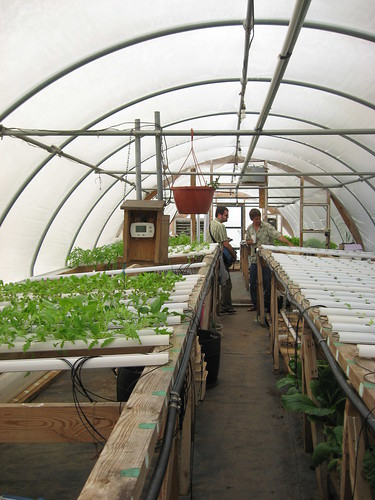
In the meantime, here's the FAQ, and here are the pictures Jaimee took while we were out there. What's impressive is not just how clean everything is, but the lengths to which the group has endeavored to make the project both sustainable and ecologically friendly—alongside the biodiesel plants are sustainable farms, hydroponic greenhouses, biodiversity gardens, waste-product reclamation, and a huge vermicomposting bin.

All in all, it's a pretty ecotopian place.