The Singularity is now: Are we on the brink of creating a computer with a human brain?
Showing posts with label the Singularity. Show all posts
Showing posts with label the Singularity. Show all posts
Wednesday, August 12, 2009

Tuesday, August 11, 2009
Paul Krugman, anti-Singularitarian?
UPDATE: The indispensable Bill Simmon has tracked down an MP3 and transcript. I hadn't realized Charlie Stross was Krugman's interlocutor; it was only last week that I was talking about how much I like Accelerando. Off to listen.
Wednesday, August 05, 2009
Just finished Accelerando for my exams and really enjoyed it. The book gets better as it goes, and in accordance with Stross's singularitarian themes it's free on the Internet. What I think I like best about the novel is Stross's unflinching take on the "rapture of the nerds," which is reframed at one point in the book as "the Vinge catastrophe"; what the Singularity is for Stross is not so much the moment A.I. achieves sentience but the moment corporations do.
Wednesday, July 08, 2009
If io9's Annalee Newitz is to be believed, the Singularity craze is finally over. Next up: Olduvaipunk.
Wednesday, June 24, 2009
 Wednesday night MetaFilterFilter.
* NASA climatologist James Hansen, recently arrested at an anti-mountaintop-mining demonstration in West Virginia, says we're almost too late to stop climate change. I wonder about that "almost."
* Nate Silver considers the legislative strategy at work in the upcoming Waxman-Markey vote.
* Mapping relationships in the X-Men Universe.
* An early Christmas present for my father? Corzine trails badly in New Jersey.
* Lots of talk lately about Robert Charles Wilson's anti-Singulatarian Julian Comstock: A Story of the 22nd Century. Here's an interview at io9 that takes up that angle, while Cory Doctorow highlights this blurb:
If Jules Verne had read Karl Marx, then sat down to write The Decline and Fall of the Roman Empire, he still wouldn't have matched the invention and exuberance of Robert Charles Wilson's Julian Comstock.* Dancing plagues and mass hysteria. Via MeFi.
* How complexity leads to social collapse: some intriguing historical exploration from Paul Kedrosky. Also via MeFi.
* Roger Ebert explains how Bill O'Reilly works.
O'Reilly represents a worrisome attention shift in the minds of Americans. More and more of us are not interested in substance. The nation has cut back on reading. Most eighth graders can't read a newspaper. A sizable percentage of the population doesn't watch television news at all. They want entertainment, or "news" that is entertainment. Many of us grew up in the world where most people read a daily paper and watched network and local newscasts. "All news" radio stations and TV channels were undreamed-of. News was a destination, not a generic commodity. Journalists, the good ones anyway, had ethical standards.Discussion (where else?) at MeFi.
In those days, if you quoted The New York Times, you were bringing an authority to the table. Now O'Reilly--O'Reilly!--advises viewers to cancel their subscriptions to a paper most of them may not have ever seen. In those days, if the wire services reported something, it probably happened. Today the wire services remain indispensable, but waste resources in producing celebrity info-nuggets that belong in trash magazines. Advertisers now seek readers they once thought of as shoplifters. If nuclear war breaks out, the average citizen of a Western democracy will be better informed about Brittny Spears than the causes of their death.
Tuesday, May 26, 2009
Tuesday night linkdump.
* Glenn Beck, jackass.
* It's not commonly known, but the Supreme Court actually deals with more than just abortion.
* Somedays I doubt James Inhofe's ability to rule fairly without undue influence from his own personal race, gender, or political preferences.
* Against empathy: The Terminator for the Supreme Court. It can't be bargained with. It can't be reasoned with. It doesn't feel pity, or remorse, or fear. And it absolutely will not stop, ever, until you are dead.
* Sonia Sotomayor, intellectual lightweight.
* The New York Times teases the coming superbrain.
* Red Bull is a hell of a drug.
Monday, April 27, 2009
Monday links.
* Vernor Vinge guarantees the Singularity by 2030. Take it to the bank. Via Boing Boing.
* They'll get the stone wall around East Campus when they pry it from my cold, dead hands.
* Today's most useful single-serving site: http://shouldibeworriedaboutswineflu.com/.
* The judgment against Eichmann speaks to Bybee: Far from absolving him of guilt, his remoteness from the actual torturers—his thoughtlessness—increases the degree of his responsibility. His is a special kind of evil—the evil of nonchalance where there should be outrage.
* Geoengineering and the New Climate Denialism.
* Meanwhile, Krugman seeks to tell the future by looking at programs Republicans have most recently tried to cut funding for.
Wednesday, March 25, 2009
Wednesday links.
* Scandal at UConn! The Plank says the story is peanuts; this sort of corruption is endemic to the NCAA.
* Cover Stories From the Most-Requested Back Issues of The American Prognosticator (1853–1987).
* Duke University professor and civil rights icon John Hope Franklin has died.
* Upright Citizens Brigade parodies Wes Anderson. Bastards!
* A 93-year-old Japanese man has become the first person certified as a survivor of both U.S. atomic bombings at the end of the Second World War.
* The first unambiguous case of electronic voting machine fraud in the U.S.?
* Solitary confinement as torture.
* Roman engineers chipped an aqueduct through more than 100 kilometers of stone to connect water to cities in the ancient province of Syria. The monumental effort took more than a century, says the German researcher who discovered it. How could the Romans think in terms of centuries but we can't think past a single business cycle?
* Lots of people are linking to this letter from an AIG bonus recipient. The merits of the contracts aside—I've said before they should be enforced unless fraudulent or predicated on fraud—but I don't think he helps his case much when he puts a number on it. His one-time after-tax "bonus" is more than I would have made in thirty years of adjuncting.
* David Brin wants to "uplift" animals, i.e., make them sentient. This is exactly why people don't take science fiction seriously; it's totally crazy, pointless, and cruel and it wouldn't even work...
Tuesday, February 10, 2009
Let's close some tabs.
* Stanley Fish says academic freedom is dangerous. I'm beginning to think Stanley Fish is dangerous.
* Forced arbitration is one of our most unrecogized societal injustices. And the courts are complicit.
After nearly three years of harassment, abuse and long hours for little or no pay, Dantz finally decided that she’d had enough. She filed suit against her employer—and the court kicked her to the curb. Even though Dantz refused to sign the binding arbitration agreement, the court said that merely by continuing to work for Applebees, she was bound by its terms. Debbie Dantz’ employer illegally abused her for almost three years, and Dantz was powerless to hold it accountable.What a horrifying story. Via MeFi.
* Scenes From An Alternate Universe Where Saved By The Bell, Rather Than Law And Order, Became The Dominant Television Franchise For A Generation.
* The Singularity is a myth. Pharyngula explains.
* Catholicism is a myth. Cynical-C explains.
* America loves Obama and hates the GOP.
* It looks like the stimulus package (tee hee) passes today. That's because we're all socialists now.
Monday, January 19, 2009
Okay, one more: "Yes, We Will," a comic about Barack Obama, 2012, and the Singularity.

Tuesday, November 18, 2008
Have I told you about how nerds destroy the world? From Pictures for Sad Children, via grinding.be.


Wednesday, July 30, 2008
 Quick links:
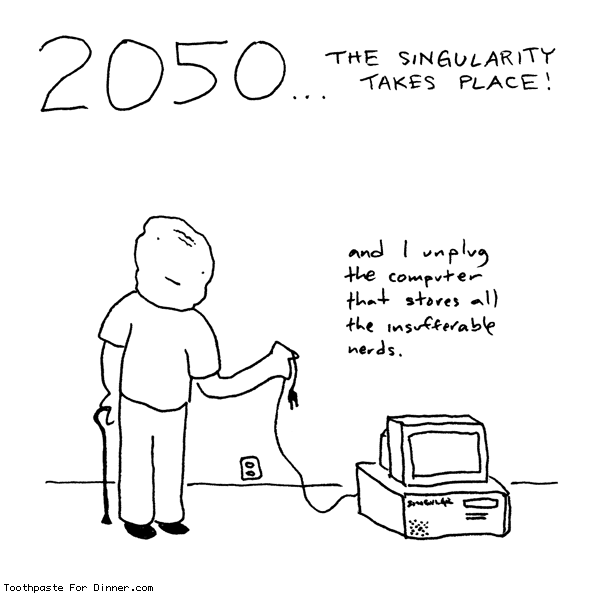
* Toothpaste for Dinner beholds the Singularity. (Thanks, kate w!)
* They're (finally) turning Isaac Asimov's Foundation series into a movie.
* Once again people are discovering Orson Scott Card's reprehensible politics. It happens about once every six months.
* 29 Literary Science Fiction Novels You Should Read. More than half of these are already on my exam lists; the rest probably will be by the time I take my exams in March...
Essentially, the contention is that our currently dominant power systems cannot long survive in space; beyond a certain technological level a degree of anarchy is arguably inevitable and anyway preferable.The Biology in Science Fiction blog introduces me to Iain M. Bank's ultra-Utopian enunciation of The Culture. Of course, as with any Utopia, labor turns out to be a pivotal concern:
Briefly, nothing and nobody in the Culture is exploited. It is essentially an automated civilisation in its manufacturing processes, with human labour restricted to something indistinguishable from play, or a hobby.Banks isn't coy; what he's talking about is a vision of interstellar socialism made possible by the concurrent elimination of both scarcity and hierarchy:
No machine is exploited, either; the idea here being that any job can be automated in such a way as to ensure that it can be done by a machine well below the level of potential consciousness; what to us would be a stunningly sophisticated computer running a factory (for example) would be looked on by the Culture's AIs as a glorified calculator, and no more exploited than an insect is exploited when it pollinates a fruit tree a human later eats a fruit from.
Where intelligent supervision of a manufacturing or maintenance operation is required, the intellectual challenge involved (and the relative lightness of the effort required) would make such supervision rewarding and enjoyable, whether for human or machine. The precise degree of supervision required can be adjusted to a level which satisfies the demand for it arising from the nature of the civilisation's members. People - and, I'd argue, the sort of conscious machines which would happily cooperate with them - hate to feel exploited, but they also hate to feel useless. One of the most important tasks in setting up and running a stable and internally content civilisation is finding an acceptable balance between the desire for freedom of choice in one's actions (and the freedom from mortal fear in one's life) and the need to feel that even in a society so self-correctingly Utopian one is still contributing something. Philosophy matters, here, and sound education.
Let me state here a personal conviction that appears, right now, to be profoundly unfashionable; which is that a planned economy can be more productive - and more morally desirable - than one left to market forces.Note too that it'll take both:
...
Of course, there is a place for serendipity and chance in any sensibly envisaged plan, and the degree to which this would affect the higher functions of a democratically designed economy would be one of the most important parameters to be set... but just as the information we have stored in our libraries and institutions has undeniably outgrown (if not outweighed) that resident in our genes, and just as we may, within a century of the invention of electronics, duplicate - through machine sentience - a process which evolution took billions of years to achieve, so we shall one day abandon the grossly targeted vagaries of the market for the precision creation of the planned economy.
The Culture, of course, has gone beyond even that, to an economy so much a part of society it is hardly worthy of a separate definition, and which is limited only by imagination, philosophy (and manners), and the idea of minimally wasteful elegance; a kind of galactic ecological awareness allied to a desire to create beauty and goodness.
The one thing that won't be enough is getting to a post-scarcity society; a statistically valid number of us have lived in something very like that for the past decade and a bit and we still collectively behaved like slavering morons, so it'll take more than just having more toys than we know what to do with to make us truly civilised.There's more at io9 and, of all places, CNN.
Thursday, June 12, 2008
Day -4 link rodeo.
* John Tierney writes up the Singularity in the New York Times: When do the post-humans show up? Via the Valve.
* The Index of Plagiarists.
* Shelby Knox, star of the Texas abstinence-education documentary The Education of Shelby Knox, has a blog.
* McCain up by only 2% in North Carolina. I've said it before: I really think Obama can win here.
* And, via Drawn!, Zombie Daily.
Wednesday, June 11, 2008
Climate change vs. the Singularity: one's going to win.
...let's assume that [the Singularity] mythology is true and, within about 25 years, computers will exceed human intelligence and rapidly bootstrap themselves to godlike status. At that point, they will aid us ... to transform the Earth into a paradise .Via Boing Boing.
Here's the problem: 25 years is too late. The newest business-as-usual climate scenarios look increasingly dire. If we haven't solved our problems within the next decade, even these theoretical godlike AIs aren't going to be able to help us. Thermodynamics is thermodynamics, and no amount of godlike thinking can reverse the irreversible.
Monday, June 09, 2008
The Guardian interviews science fiction writer Charlie Stross. Here he is on the Singularity, subject of his recent book Accelerado:
Perhaps the strangest future predicted by science fiction writers is the Singularity - an idea that is already "old hat" for Stross. This concept was more or less invented by scientist and author Vernor Vinge, and started with a simple insight: If an artificial intelligence can be created on computers, it can in turn design more powerful computers to create more powerful artificial intelligence and so on at an ever accelerating rate until we arrive at the Singularity - a point where technological change happens so quickly that it irrevocably alters human existence. A powerful idea, but as Stross is the first to point out, not one that science fiction has always treated with the scientific rigour it deserves.Like all good science-fiction writers, Stross has a blog.
"A whole bunch of extra cruft accreted rapidly around Vinge's idea, which was misappropriated and misunderstood by many writers," he explains. "Along with the idea of nanotechnology, the singularity became a substitute for magic pixie dust that could do anything, and a placeholder for what author Ken McLeod dubbed 'the rapture of the nerds'."
Tuesday, June 03, 2008
The new issue of IEEE Spectrum is all about the Singularity, with pieces from numerous Singularity skeptics, true believers, and the sci-fi writer who coined the term. Via MeFi.
Wednesday, May 14, 2008
In other sci-fi news, Candleblog ties together a couple of recent posts here as advice to would-be authors, including this reminder that the singularity is an asymptote, not an event.
Wednesday, April 16, 2008
Here come the quantum computers: Researchers have built a quantum logic gate in an optical fiber.
Wednesday, April 09, 2008
William Gibson: the Rolling Stone interview.
In the past ten years, we've seen incredible advances in nanotechnology and synthetic biology. Does any of it amaze you?
My assumption has always been that at some point we would lock on to a literally exponential increase in human knowledge. That was my best guess, somewhere back in the Seventies. There hasn't been anything that made me sit back and say, "Golly, I would never have imagined that." The aspects of recent history that have caused me to do that have been, in every case, manifestations of retrograde human stupidity.
How do you mean?
It's been an extraordinarily painful decade or so. I just never in my wildest dreams could have imagined that it could get as fucked up as this guy [George Bush]. It still amazes me how dumb so much of our species can manage to be. But that's kind of like being amazed at life.
Does any of it scare you? A new synthetic life form or nanobot running amok?
That could happen. It could all go to gray goo. But it just isn't in my nature to buy a lot of canned food and move to Alaska and try to escape the gray goo.


 Posts
Posts