The first book in Kim Stanley Robinson's indispensable Mars Trilogy, which I've had occasion to talk about once or twice before, is now available for free download as a PDF. Via io9.
Showing posts with label Mars trilogy. Show all posts
Showing posts with label Mars trilogy. Show all posts
Tuesday, March 10, 2009

Thursday, February 26, 2009
 Earlier today I gave my talk at the Southwest/Texas PCA/ACA conference, "Red Mars, Green Earth: Science Fiction and Ecological Futurity." Like the last paper I gave, these are ideas I'll be returning to in some form or another soon, but I can give you a short rundown of the argument now. (I think that these ideas may be somewhat unsurprising to anyone who has talked to me about this sort of thing before.)
1) Science fiction should be understood as an ecological literature. I recognize people might not recognize this claim immediately, as most people are familiar with SF through cultural productions like Star Wars. So I star with Star Wars, particularly a short clip of the Coruscant chase sequence from Attack of the Clones. I talk about the weightless, groundless quality of Lucas's idea of the city that has grown so large that it encompasses the entire planetary mass, and compare that to Asimov's Trantor.
Daily, fleets of ships in the tens of thousands brought the produce of twenty agricultural worlds to the dinner tables of Trantor. . . .Trantor, unlike the green-screened Coruscant, is a material place, populated by living bodies with living needs. Trantor has an ecology; Coruscant does not. I go on about this for a little while.
Its dependence upon the outer worlds for food and, indeed, for all necessities of life, made Trantor increasingly vulnerable to conquest by siege. In the last millennium of the Empire, the monotonously numerous revolts made Emperor after Emperor conscious of this, and Imperial policy became little more than the protection of Trantor’s delicate jugular vein. . . .
2) I use the distinction between Coruscant and Trantor to draw a line between science fiction (SF) and science fantasy, using Darko Suvin's definition.
SF is, then, a literary genre whose necessary and sufficient conditions are the presence and interaction of estrangement and cognition, and whose main formal device is an imaginative framework alternative to the author’s empirical environment.I try to establish that the boundary condition for SF is going to require precisely this sort of ecological thinking—to be SF rather than a (mere) fantasy you need to establish a plausible environmental network through which alternative modes of existence can be conceived. SF without ecology lapses into fairy tale and thereby (in Suvin’s words) “commits creative suicide.” (So watch out for that, George Lucas.)
3) I then try to argue that the how the current environmental crisis demands not just this sort of methodological ecology but a politically environmentalist consciousness, and trace the politics of this back to Frankenstein with a lot of attention paid to the early H.G. Wells.
4) To wrap up I do a little bit of taxonomy, comparing the apocalypse (Wall-E) to the dystopia of continuation (The Sheep Look Up) to the utopia (Kim Stanley Robinson). This last bit, not surprisingly, is where I get the title from...
Saturday, October 04, 2008
Hugely cool news for S.F. fans: AMC (having already proved its chops with Mad Men) is planning a series based on the Kim Stanley Robinson novel Red Mars. There are a few more details at io9 and the Hollywood Reporter.
I've talked a little bit about KSR's Mars novels before, but suffice it to say I think they're just fantastic, and they've changed my thinking about politics, Utopia, and ecology in some pretty important ways. Let's hope AMC can catch lightning in a bottle twice.
Thursday, August 07, 2008
We'll eventually be doing a full writeup for our Indy article on energy issues in the Triangle and North Carolina, but for now let me say that Earthaven Ecovillage near Asheville is easily one of the more interesting and inspiring places I've visited in six years in North Carolina. Nearly fifteen years old, and one of the largest communities of its kind in America, the project serves as a model for sustainable living and alternative, off-the-grid mode(s) of life.
I'm not going to lie to you: I was thinking about Mars the whole time we were there.
I've been up since six, so that's about all the coherent thought I can manage at the moment. For a lot more useful background on Earthaven, check Think or Thwim's report from a year or so ago. (There's always the Washington Post, too.)
Lots and lots of photos—over a hundred!—at my Flickr site. Just a few favorites below...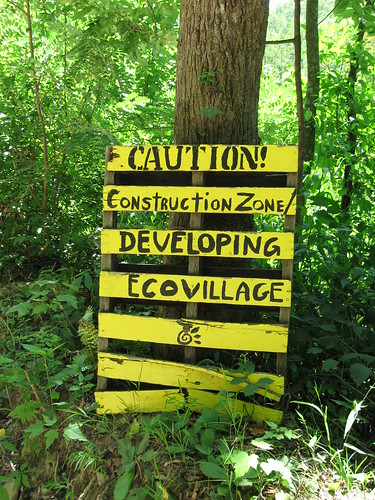
One of the many signs greeting you as you enter the community.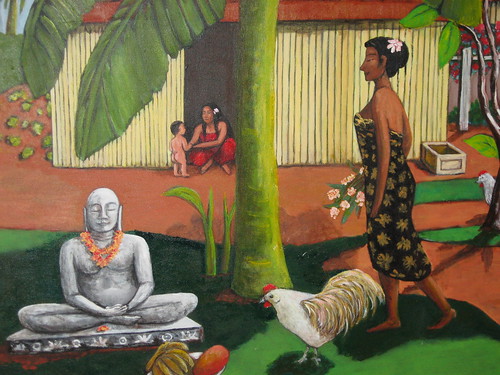
A painting inside the community's Council Hall.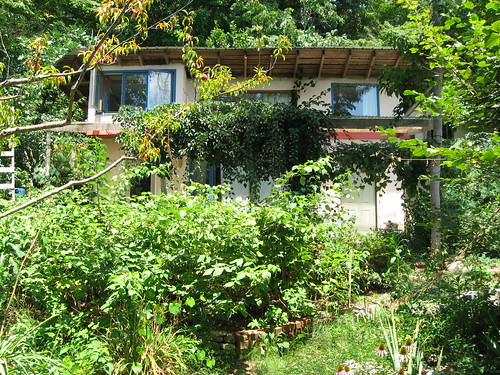
A characteristically Ecotopian home.
Good advice.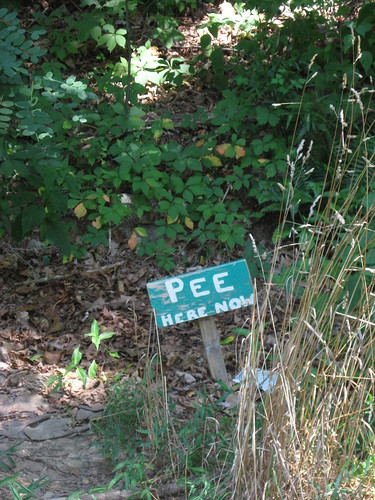
Also good advice.
Delicious berries.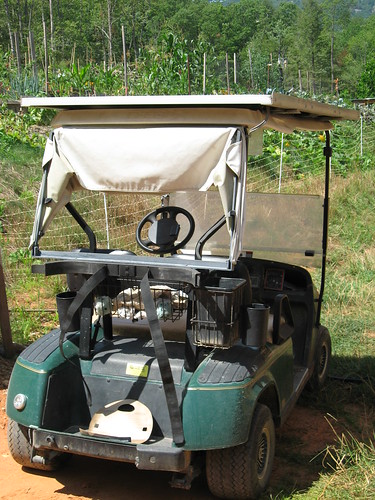
Delicious solar-powered golf cart.
Ducks.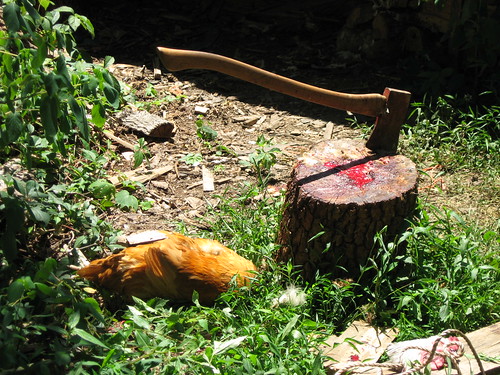
Sometimes this happens. That's part of it, too.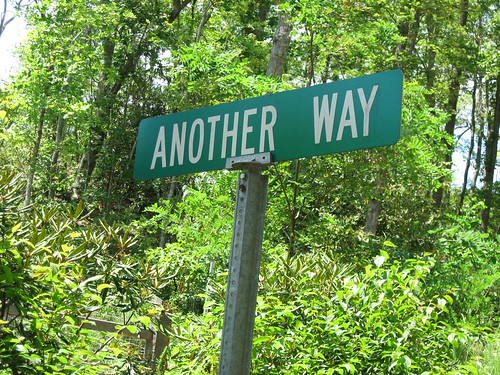
The name of the main thoroughfare in the community and a succinct expression of their mission statement—there really is one. And in fact, as our tour guide was quick to remind us, emphasizing the diversity of the community and the many approaches to sustainability to be found inside Earthaven, there's not just another way, but other ways.
Friday, July 25, 2008
io9's playing with great opening sentences from science fiction. (More at MeFi.) Contrary to the aesthetics of io9's list, it seems to me that the best are those which refuse to immediately announce themselves as science fiction. Here are just a few from favorite s.f. novels that I haven't seen anywhere else (all links go to Amazon):
"We slept in what had once been the gymnasium."Though what can match the quiet elegance of Ursula K. Le Guin's The Dispossessed? "There was a wall."
—Margaret Atwood, The Handmaid's Tale
"Mars was empty before we came."
—Kim Stanley Robinson, Red Mars
"On those cloudy days, Robert Neville was never sure when sunset came, and sometimes they were in the streets before he could get back."
—Richard Matheson, I Am Legend
"What's it going to be then, eh?"
—Anthony Burgess, A Clockwork Orange
Unless of course it's Octavia Butler in Dawn: "Alive!"
QUICK UPDATE: I realized too late that I'd omitted a book that should be on any list of this sort, Olaf Staledon's Star Maker:
One night when I had tasted bitterness I went out on to the hill.
Thursday, July 17, 2008
Having just this week finished my first trek through Kim Stanley Robinson's seminal Mars trilogy, I can't help but feel these pictures of the surface of Mars from the European Space Agency are a special shout-out just to me. A few more here. Via MeFi.


 Posts
Posts


