Seven steps toward a sustainable society from Anne and Paul Ehrlich, recently submitted for President-elect Obama's consideration via change.gov, via Dot Earth.
#1: Put births on a par with deaths.
#2: Put conserving on a par with consuming.
#3: Transform the consumption of education.
#4: Judge technologies not just on what they do for people but also to people and their life-support systems.
#5: Rapidly expand our empathy.
#6: Decide what kind of world we all want.
#7: Determine the institutions and arrangements best suited to govern a planetary society with a maximum of freedom within the constraints of sustainability.
Showing posts with label permaculture. Show all posts
Showing posts with label permaculture. Show all posts
Monday, November 10, 2008

Thursday, August 07, 2008
We'll eventually be doing a full writeup for our Indy article on energy issues in the Triangle and North Carolina, but for now let me say that Earthaven Ecovillage near Asheville is easily one of the more interesting and inspiring places I've visited in six years in North Carolina. Nearly fifteen years old, and one of the largest communities of its kind in America, the project serves as a model for sustainable living and alternative, off-the-grid mode(s) of life.
I'm not going to lie to you: I was thinking about Mars the whole time we were there.
I've been up since six, so that's about all the coherent thought I can manage at the moment. For a lot more useful background on Earthaven, check Think or Thwim's report from a year or so ago. (There's always the Washington Post, too.)
Lots and lots of photos—over a hundred!—at my Flickr site. Just a few favorites below...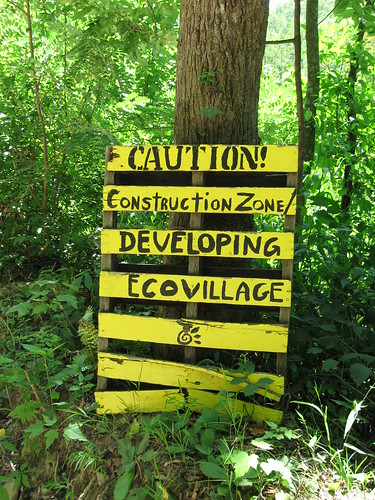
One of the many signs greeting you as you enter the community.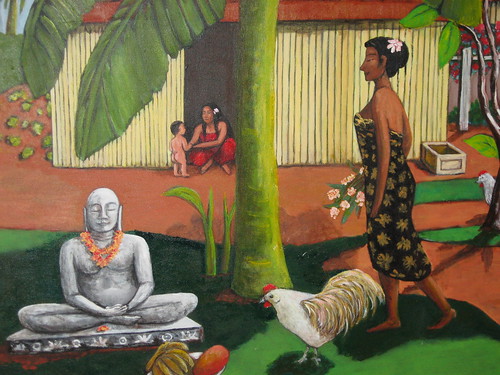
A painting inside the community's Council Hall.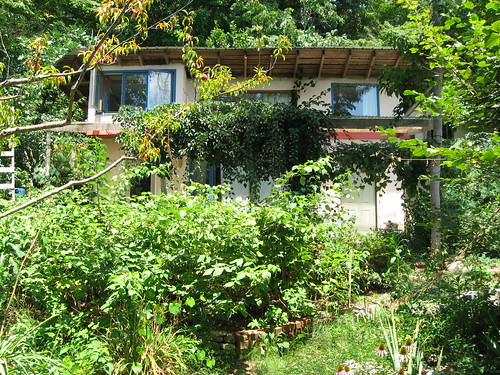
A characteristically Ecotopian home.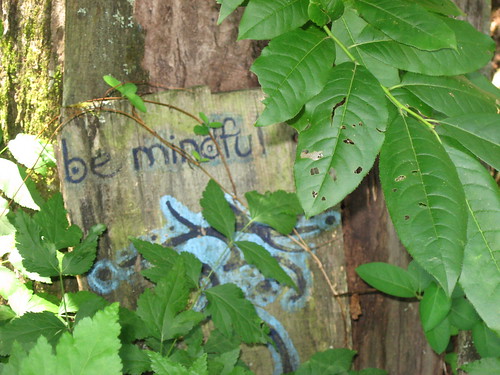
Good advice.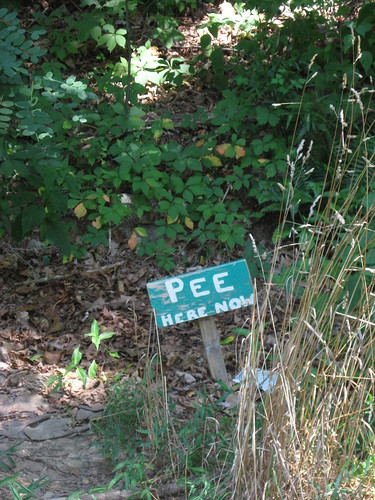
Also good advice.
Delicious berries.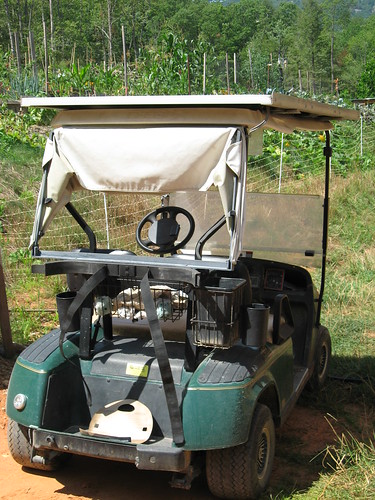
Delicious solar-powered golf cart.
Ducks.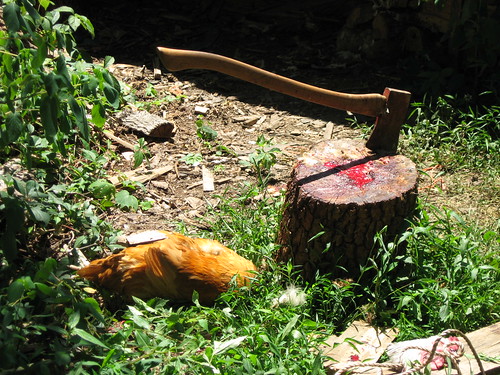
Sometimes this happens. That's part of it, too.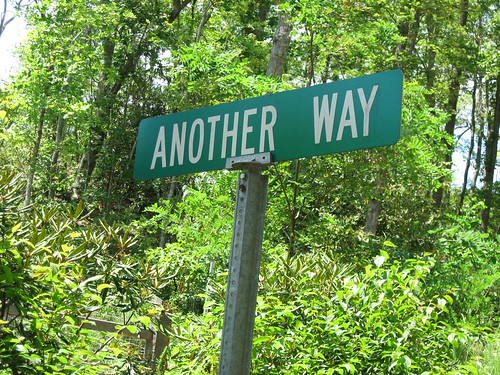
The name of the main thoroughfare in the community and a succinct expression of their mission statement—there really is one. And in fact, as our tour guide was quick to remind us, emphasizing the diversity of the community and the many approaches to sustainability to be found inside Earthaven, there's not just another way, but other ways.
Monday, December 24, 2007
On this Christmas Eve, Americans are having trouble paying off their credit cards, with 30-day-late accounts rising 26% to $17.3 billion and defaults rising 18% to nearly a billion. There's a reason for all this, and you can find it in Bill Moyer's PBS interview with Benjamin Barber (via MeFi), a Galbraithian analysis of capitalism's production not of products but of needs themselves:
As a society becomes increasingly affluent, wants are increasingly created by the process by which they are satisfied.... Wants thus come to depend on output. In technical terms, it can no longer be assumed that welfare is greater at an all-round higher level of production than at a lower one. It may be the same. The higher level of production has, merely, a higher level of want creation necessitating a higher level of want satisfaction.The orgy of Christmas shopping that continues unabated today—to be followed by deep-discount post-Christmas sales on Wednesday, and on and on—is only the clearest proof that this is what capitalism has become in the post-industrial West and, increasingly, elsewhere as well. Barber thinks the productive energies of capitalism might somehow be harnassed, through willpower and ethical living, for better ends, but I'm much more skeptical that capitalism can ever really move in a direction other than the one it has. What we need is a new logic, a new organizing principle. Call it sustainability or call it permaculture, call it environmental Marxism or environmental capitalism if you want, it's all the same to me—what's important is that the world figure out some way to stop doing the things capitalism demands it must. We have to stop consuming everything, resources, the future, ourselves.
BILL MOYERS: When politics permeates everything we call it totalitarianism. When religion permeates everything we call it theocracy.Merry Christmas.
BENJAMIN BARBER: Right.
BILL MOYERS: But when commerce pervades everything, we call it liberty.
(cross-posted to culturemonkey, which returns Jan. 2 with an all-new blogger and an all-new organizing principle of its own)
Thursday, December 20, 2007
Michael Pollan has an article in The New York Times today about sustainability, especially when it comes to agriculture and food production:
To call a practice or system unsustainable is not just to lodge an objection based on aesthetics, say, or fairness or some ideal of environmental rectitude. What it means is that the practice or process can’t go on indefinitely because it is destroying the very conditions on which it depends. It means that, as the Marxists used to say, there are internal contradictions that sooner or later will lead to a breakdown.The article goes on to focus on two stories in the news this year that suggest a sustainability tipping point could be upon us, antibiotic-resistant staph infection and Colony Collapse Disorder. Via Pandagon, which gets this right, I think:
Pollan argues that the word “sustainability” is losing its meaning, and it’s clear why—it’s incompatible with capitalism, and openly arguing for economic systems to replace capitalism is simply verboten in our society. Taboo, unacceptable, off the table. And it will be until it’s too late to reverse the damage done by the need for unchecked growth for profit.
Wednesday, December 19, 2007
Comparative Planetology: An Interview with Kim Stanley Robinson.
BLDGBLOG: In other words, your lifestyle may now be carbon neutral – but was it really any good in the first place?Via Boing Boing, which has more, including this on environmental catastrophe.
Robinson: Right. Especially if it’s been encoding, or essentially legitimizing, a grotesque hierarchy of social injustice of the most damaging kind. And the tendency for capitalism to want to overlook that – to wave its hands and say: well, it’s a system in which eventually everyone gets to prosper, you know, the rising tide floats all boats, blah blah – well, this is just not true.
We should take the political and aesthetic baggage out of the term utopia. I’ve been working all my career to try to redefine utopia in more positive terms – in more dynamic terms. People tend to think of utopia as a perfect end-stage, which is, by definition, impossible and maybe even bad for us. And so maybe it’s better to use a word like permaculture, which not only includes permanent but also permutation. Permaculture suggests a certain kind of obvious human goal, which is that future generations will have at least as good a place to live as what we have now.
It’s almost as if a science fiction writer’s job is to represent the unborn humanity that will inherit this place – you’re speaking from the future and for the future. And you try to speak for them by envisioning scenarios that show them either doing things better or doing things worse – but you’re also alerting the generations alive right now that these people have a voice in history.
The future needs to be taken into account by the current system, which regularly steals from it in order to pad our ridiculous current lifestyle.


 Posts
Posts


