 We saw Capitalism: A Love Story last night and had some heated discussion in the car afterward. While all the parties involved operate from a shared position that "Yes, capitalism is very bad," I found myself significantly disappointed in Moore's take on the problem. This is a topic that needs to be approached systematically, from a structural perspective, or you wind up doing more harm than good; it doesn't really lend itself to the anecdotal style of more reform-minded documentaries like Roger & Me and Sicko. In short Moore bit off much more than he could chew.
Politically I found the film both ahistorical and largely incoherent. To begin, the film opens with completely uncritical nostalgia for the 1950s before pretending that the economic collapses of the 1970s never happened, blaming Reagan alone for both post-Fordism and the financialization of capital. (Reagan and Reaganonomics certainly did a lot of harm to the country, and accelerated the crisis dramatically, but the dismantling of the country's manufacturing base and the explosion in private debt began about a decade before he took office.) Likewise, aside from a few scenes late in the film, Clinton is essentially let off the hook entirely, while Obama's participation in the ongoing transfer of wealth to Wall Street is also barely acknowledged. Neither the Global South nor generational American poverty nor systemic racism nor ecological crisis warrant any mention; in short the film is wrapped up so entirely in nostalgia for a particular version of middle-class American life that, despite its name, it's barely about "capitalism" at all.
Moore also weirdly conflates left and right populism in a way that, I think, is extremely pernicious. To take the example he focuses his climax on: most of the opposition to bailouts as such last year was coming from the right, and was located less in long-held principle than in a rhetorical attempt to regain control of the electoral debate—but Moore pretends that populism, like all populism, was somehow of the left. In fact, the progressive critique of the bailout was generally about its size—Krugman, remember, wanted it to be bigger—and the sorts of strings that should be attached to the funds—not whether or not it should happen at all.
Obama's election is likewise recast as the culmination of a "people's revolt" that somehow began with the bailouts, a revisionist history of the last year which just doesn't make any sense. The two things, in fact, had little to do with one another, and to the extent that they were related it was Obama's strong support for the bailouts that drove his poll numbers upward against McCain's. Indeed, that Obama supported the bailouts, and McCain quasi-opposed them, is never explicitly acknowledged by the film at all.
And don't get me started on the repeated reference to the Catholic Church as Moore's (sole) exemplar for anti-capitalist morality. There are a lot of things that might be said about the Church, and undoubtedly a lot of good people working through it, but its corporate structure and massive financial holdings don't exactly map for us a vision of a world beyond capital. Moore's argumentive style in Capitalism, more so than even his other films, is almost always emotive and anecdotal. A long section on so-called "dead peasant insurance"—the practice of companies taking out insurance policies on rank-and-file workers—never connects the practice to larger injustices, and tragedies like Hurricane Katrina or the death of a young mother are evoked for cheap pathos that stands in for actual critique. Small, isolated victories against boilerplate villains like foreclosing banks are taken as exemplary of a mass movement that, I'm sorry to report, doesn't seem to actually exist. And as is increasingly the case with Moore, the film's primary mode is unrepentant self-congratulation, incoherently casting failures as victories in much the same way as Slacker Uprising; Moore figures more and more in his films as the hero of a revolution that never came, that only happened in his dreams.
Even the visual style of the film is significantly inferior to recent offerings like Bowling, Fahrenheit, and Sicko; the film feels thrown together, even phoned in.
It should be said that Jaimee, Tim, Alex, and Julie all seemed to like the film rather more than I did, and their replies to these arguments generally fell along two lines:
1) It's a Michael Moore movie. What did you expect?
2) Okay, but [Sequence X] was actually quite good.
Taking these in reverse order: it's true that the film does have some rather nice individual sequences. One that springs to mind is an investigation into corruption surrounding a privatized juvenile-detention prison in Wilkes-Barre, Pennsylvania, in which two judges were recently indicted on racketeering charges for funneling children into the prison in exchange for kickbacks. But as terrible as this story is, like most of the film's examples this is still local and anecdotal, suggestive of reform and "bad apples" and not total system failure. It is too rarely that the film rises above the level of mere anecdote to the level of system, though it does here and there, as in its discussion of an unexpectedly forthright internal Citibank memo that declares America a "plutonomy" (for my money the film's best sequence).
(EDIT: Just a quick after-the-post interjection that while talking to Jaimee I was reminded about the striking footage of FDR and his proposed "Second Bill of Rights," which is actually the film's best sequence, as well as an approach to reform/revolution that could have structured a better version of this film.)
And yes, it's just a Michael Moore film and not Capital, and yes, rigor must sometimes be compromised in exchange for mass appeal. But we shouldn't mistake spectacle for revolution, either; Paramount's release of this film is much less the capitalist selling you a rope with which to hang him than the capitalist selling you a picture of a rope. At times the film can barely keep up the pretense of being about anything more than fluffing Michael Moore's ego, with scene after scene of him shouting impotently in front of buildings in precisely the same way he has for the last 20 years. (The film depicts these moments not as futile but as, of course, heroic, including impotently-shouting-outside-buildings footage from Roger & Me without any apparent sense of irony.) The film ends with Michael Moore threatening not to make any more movies for us at all unless we get off our asses and revolt—but the film, primarily a love song to his own career, provides absolutely no roadmap for collective action. Even An Inconvenient Truth, flawed as its call for action was, at least told us to change our lightbulbs; beyond a visit to michaelmoore.com Moore has no apparent thoughts whatsoever as to how a successful anti-capitalist political coalition might be forged in America today.
I'll go out on a limb and bet it doesn't begin with a film like Capitalism. If I'm wrong, I owe Michael Moore a Coke.
Saturday, October 03, 2009

Tuesday, September 15, 2009
Quote of the day.
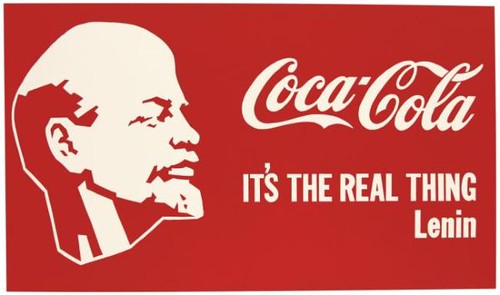
Lenin told the British science fiction writer H.G. Wells, who interviewed him in the Kremlin in 1920, that if life were discovered on other planets, revolutionary violence would no longer be necessary: "Human ideas—he told Wells—are based on the scale of the planet we live in. They are based on the assumption that the technical potentialities, as they develop, will never overstep 'the earthly limit.' If we succeed in making contact with the other planets, all our philosophical, social and moral ideas will have to be revised, and in this event these potentialities will become limitless and will put an end to violence as a necessary means of progress."A bonus image, archived in the same book:
—Susan Buck-Morss, Dreamworld and Catastrophe: The Passing of Mass Utopia in East and West (2002)
Monday, August 03, 2009
Wow, things got away from me today. Here's your massive Monday linkdump #1.
* As every other blog on the Internet has already told you, Slate now allows you to Choose Your Own Apocalypse. Also at Slate: four futures.
* Another story you've probably seen all over today: "College Grad Sues College Because She Can't Find a Job." Watch your back, Duke.
* Birthers are funny.
* I had been led to believe that redheads' resistance to anesthesia was the result of superpowers, but now I discover it comes from their superweakness.
* This week in corporate logos: why Coke is better that Pepsi.
Sunday, July 06, 2008
 Ezra Klein's had a number of good posts lately on the high environmental and social costs of Americans' meat-laden diets.
Most recently:
Bacon is transcendent. The words "porterhouse" and "steak" make my mouth water. Pork belly makes me simultaneously believe in God and doubt my own religious tradition. And because of this, I'm not a full vegetarian. But I should be. And not liking liberals don't change the truth about meat: Industrial agriculture is cruel, meat production is a huge contributor to global warming, and the market for meat contributes to world hunger in a substantial and direct way.My come-to-Gandhi story is almost exactly opposite, which is why I think it's been relatively easy for me to stay vegetarian for a decade: my vegetarianism originated in a visceral distaste for nearly all meat, with the eco-awareness and smug self-satisfaction turning out to be just nice bonuses along the way.
In general I'd say the emergence of flexitarianism is one of the better and more important memes to emerge out of last decade or so, though at this point I've completely ruined myself for anything that's recognizably meat-based. And it's unlikely flexitarianism could have worked for me, anyway; as anyone who's ever watched me try to make any sort of lifestyle change knows, the only workable strategy is total, unbreakable taboo. Eighteen-year-old me attempt to eat less-but-still-some meat would have resulted in my eating nothing but McDonald's Chicken Nuggets, which had been a big part of the problem in the first place.
Wednesday, May 14, 2008
I haven't had a single sip of delicious Coca-Cola in nearly fourteen months, which Andy Warhol says makes me un-American:
What's great about this country is that America started the tradition where the richest consumers buy essentially the same things as the poorest. You can be watching TV and see Coca Cola, and you know that the President drinks Coca Cola, Liz Taylor drinks Coca Cola, and just think, you can drink Coca Cola, too. A coke is a coke and no amount of money can get you a better coke than the one the bum on the corner is drinking. All the cokes are the same and all the cokes are good. Liz Taylor knows it, the President knows it, the bum knows it, and you know it.Quote via my cousin Colleen.
Monday, January 28, 2008
I'm actually still catching up from the weekend, so that "return to full strength" I mentioned will probably have to wait until later this afternoon or Tuesday morning. Still, I have been saving up some links:
* Be warned: delicious Coca-Cola will destroy your kidneys.
* Via Pandagon, Pittsburgh man Tasered in his own home while sleeping on his own couch.Police Chief Henry Wiehagen said the officers would not comment, but he disputed Hicks' version of events.* Via blucarbnpinwheel, Jonathan Lethem interviews Paul Auster. Two of my favorite writers in one place is very nice.
Hicks wasn't asleep, Wiehagen said, he was on the couch prone. The officers could not be certain he was unarmed and Hicks "didn't respond to their reasonable commands," he said.
"These policemen are very cautious and I don't blame them for being cautious," Wiehagen said, noting officers in his department have been shot at.
* Mini-Obama Endorsement Watch: Toni Morrison, who famously proclaimed in 1998 that Bill Clinton was "our first black president. Blacker than any actual person who could ever be elected in our children's lifetime," endorses Barack Obama.
* And at Paleo-Future, how experts think we'll live in 2000 A.D. Other experts have a different opinion.
Tuesday, May 29, 2007
Reaction Jackson Tuesday:
* Steve says my picture of the Mona Lisa puts him in mind of this YouTube video of five hundred years of female portraits in 2 minutes.
*Shankar links in the comments to David Cross's Open Letter to Larry the Cable Guy.
* Everyone in the world is talking about the creation mususem.
* Warning: soft drinks are seriously bad for you. I'm two months dry (de-fizzed?) and I'm starting to not miss the delicious taste... all that much. The first time I stopped drinking soda I went nine months before I relapsed, and I've bounced six-months-on, six-months-off since then—but this time I want to stay off the stuff for good.


 Posts
Posts


