Estimates of the carrying capacity of Planet Earth in the climate situation we're creating are always terrifying.
Saturday, March 14, 2009

Lots of pictures of Ozymandian Detroit around this weekend, from Time to Flickr. Lots of images to choose from, but the one I went with is a R. Crumb poster linked in the MeFi thread. 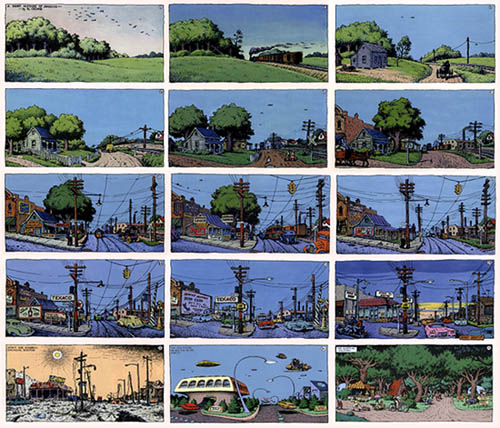
Sadly the picture's not big enough for the lettering to be read, so here's a closeup of the fourth to last panel.
Originally that's where the comic ended, but Crumb later went in and drew three possible answers: ecological collapse, technofuturism, and ecotopia. Right now we're still hovering over "What's next?"
My former students may appreciate the similarities between this static image and the Soylent Green opening titles...
Thursday, March 12, 2009
Man, I hope you all watched The Daily Show tonight. I've never seen Stewart go after anyone like he went after Cramer. Video tomorrow, but real-time commentary on Twitter tonight.
UPDATE: Video now at dailyshow.com. Jon Stewart remains one of the only people in mass culture who holds elites accountable to reason, ethics, logic, or the truth. The man is a national treasure.
Miscellany.
* Republicans have successfully transitioned from passively rooting for Obama to fail to actively sabotaging the economy. Well done, fellows.
* Views from the other universe: Ricky Gervais v. Elmo.
* Lots of people are linking to "the fifteen strangest college courses in America." Maybe this just demonstrates how far out of the mainstream Duke Lit is, but most of these seem perfectly cromulent to me.
* The economics of March Madness: how excessive spending on sports is a money-loser for nearly every Division I school. Marc Bousquet was right!
The greatest thing you'll see today. Two minutes and twenty-eight seconds may seem like a long time, but stay till the end.
Wednesday, March 11, 2009
Let this be our epitaph: "Number Of Americans Who Think Global Warming Is ‘Exaggerated’ Is Increasing." More at DotEarth.
Where to begin with this bizarre plea from Watchmen's screenwriter to see the movie again whether you liked it or not? The exuberant egotism? The naked commodification of nerd identity? The notion that huge corporate conglomerates deserve your charity and even, perhaps, your love?
Actually not a hard question. You've got to begin with this:
And yet... You'll be thinking about this film, down the road. It'll nag at you. How it was rough and beautiful. How it went where it wanted to go, and you just hung on. How it was thoughtful and hateful and bleak and hilarious. And for Jackie Earle Haley.Ho-lee shit.
Trust me. You'll come back, eventually. Just like Sally.
Might as well make it count for something.
Time for a quick linkdump.
* Even Lex Luthor needs a bailout.
* Two for fans of last night's comics archetype times table: A Sketch Towards a Taxonomy of Meta-Desserts and Fun to Draw.
* Is this the end of capitalism? David Harvey and The Nation's Alexander Cockburn report. (This time for sure.)
Tuesday, March 10, 2009
Computers are starting to challenge the best human players in Go.
Scott Eric Kaufman finally gets around to watching Watchmen. Special attention is paid to the absurd ubiquity of the Twin Towers throughout the film, something my viewing group mocked afterwards but which hasn't come up in discussions here thus far.
My review was also a focus of the discussion on the Poli-Sci-Fi Radio podcast this week, to which my rage-filled rebuttal is currently being shouted impotently into the void.
The official Creebobby comics archetype times table. Via MeFi.
The first book in Kim Stanley Robinson's indispensable Mars Trilogy, which I've had occasion to talk about once or twice before, is now available for free download as a PDF. Via io9.
When I say to my fellow academics “aim low” and stick to your academic knitting or counsel do your job and don’t try to do someone else’s or warn against the presumption of trying to fashion a democratic citizenry or save the world, I am encouraging (or so McLennen says) a hunkering down in the private spaces of an academic workplace detached from the world’s problems.Somebody told Stanley Fish he's a neoliberal. He doesn't seem to like it much, but he presents no real argument that he isn't. I suppose he may be saving that for part two (about academic leftists boycotting Israeli academics, apparently, because that's the crucial site for neoliberal agon.) (Thanks, Russ!)
And when I define academic freedom as the freedom to do the academic job, not the freedom to expand it to the point where its goals are infinite, my stance “forecloses the possibility of civic engagement and democratic action.” (McClennen)
Behold the 125-page transcript of the conference between George Lucas, Stephen Spielberg, and Lawrence Kasdan brainstorming Raiders of the Lost Ark. Discussion at MetaFilter.
A little busy today, but here are a few links I've saved up.
* Watchmen link of the day: The Fate of Hooded Justice and Captain Metropolis. Via the comments at the Candleblog review.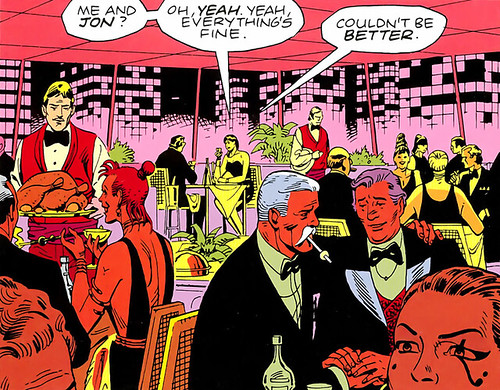
* Grant Morrison on the superhero genre.
I’m not even sure if there is a superhero genre or if the idea of the superhero is a special chilli pepper-like ingredient designed to energize other genres. The costumed superhero has survived since 1938, constantly shifting in tone from decade to decade to reflect the fears and the needs of the audience. The current mainstream popularity of the superhero has, I think, a lot to do with the fact that the Terror-stricken, environmentally-handicapped, overpopulated, paedophile-haunted world that’s being peddled by our news media is crying out for utopian role models and for any hopeful images of humankind’s future potential!* Don't Look Back—a flash game based on the Orpheus myth.
* Top 10 myths about sustainability.
* Bad news for solipsists: the universe exists independently of our observation. Via Kottke.
* Also from Kottke: famous directors take on famous comedy bits. A little amateurish, but it made me smile.
Monday, March 09, 2009
Higher education and the recession: thirteen reasons colleges are in this mess. (Requires subscription or university IP.) My upcoming review of How the University Works for Polygraph 21 tackles some of these points as well, particularly "1. Took on Risky Investments." When it shows up online, I'll link to it.
As if you might ever get sick of hearing about Watchmen, Bill's review at Candleblog takes mine as a starting point but goes on to defend the movie against me/Moore/itself.
WebUrbanist has nine 'breathtaking and inspiring pieces of public art.' More at MeFi.
Sunday, March 08, 2009
Sunday night.
* Patton Oswalt says if you didn't like The Watchmen you should just shut up. Fair enough, but you know, that's not really the title... (via Bill, who promises via Twitter both a blog post and a Poli-Sci-Fi Radio podcast on this soon)
* We all want to flee to the Cleve: a new Bruce Springsteen exhibit opens at the Rock and Roll Hall of Fame on April 1. (Thanks, Brent!)
* Science fiction set in 2009. The Postman and Dark Angel are legit picks—but when your list needs three movies from the last two years, Family Matters, and an episode of Charmed to work, it's time to rethink.
* Is the global economy a Ponzi scheme, are we all Bernie Madoffs, and what comes next?
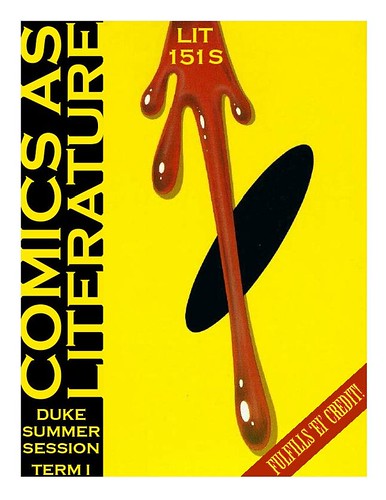
Two more posters for my "Comics as Literature" summer course in Duke's Term 1 this summer, which I've recently found out that UNC student can take for UNC tuition. Tell everyone.
LIT 151S Comics as Literature. Beginning with Batman and Superman, passing through R. Crumb, Harvey Pekar, and Maus, and moving into the contemporary era of Persepolis and Dykes to Watch Out For, this course will survey the history and reception of graphic narrative as the genre moves from a predominantly American, predominantly male fixation on the superhero towards an increasingly popular international art movement that crosses gender, class and ethnic lines. Likely texts will include Siegel and Shuster’s Superman, Frank Miller’s Batman, Stan Lee’s Iron Man, Art Spiegelman’s Maus, Harvey Pekar’s American Splendor, Chris Ware’s Jimmy Corrigan: The Smartest Kid on Earth, Marjane Satrapi’s Persepolis, Alison Bechdel’s Fun Home, Guy Delisle’s Pyongyang, Osamu Tezuka’s Buddha and Alan Moore’s Watchmen, as well as selected excerpts and Scott McCloud’s Understanding Comics.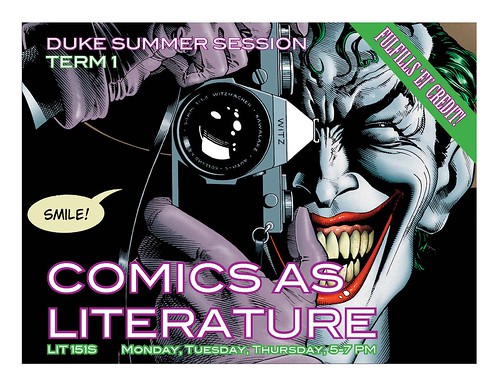


 Posts


